On this page
How to identify it
- Workers are up to about an inch long. Queens are larger: Penn State gives up to 1.3 inches (35 mm), while Ohio State and Kentucky give about 1 1/2 inches. They are among the largest wasps where they occur.[1][2][4]
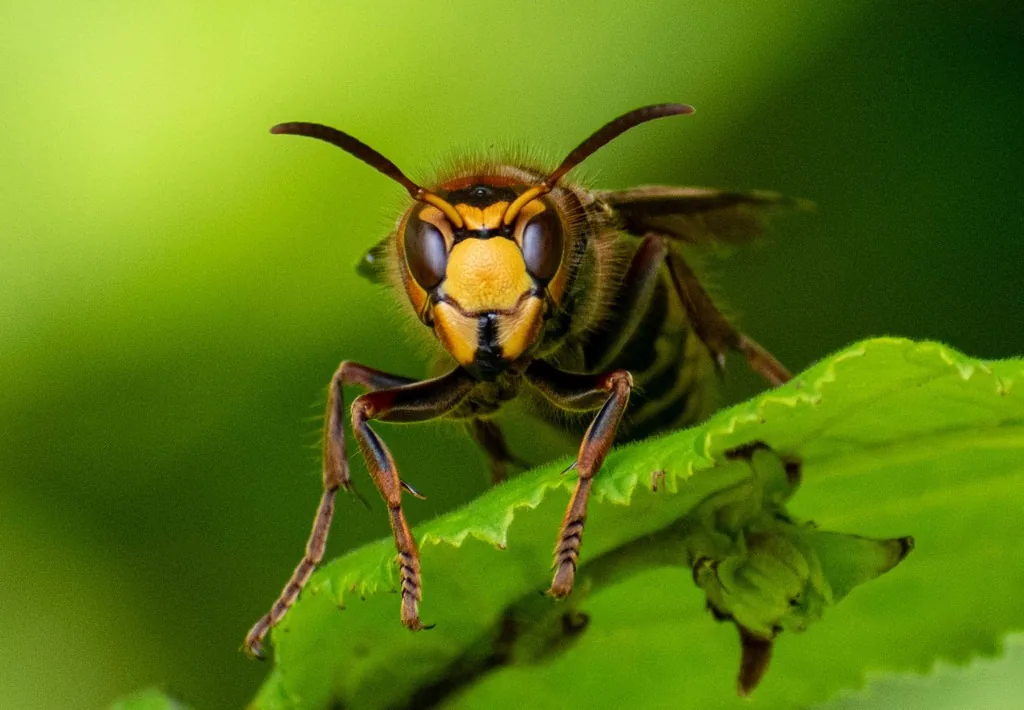
- The thorax and top of the head are reddish brown to dark red, the face is yellow, and the wings are tinted brown.[2][1][4]
- The abdomen is mostly yellow toward the rear, with black bands that trail backward into teardrop shapes.[1][2]
- It is one of the few wasps that fly at night and often turns up at lit windows and porch lights. A study confirmed workers flying in dim twilight and found no special night adaptations in their eyes; their large eyes, a result of large body size, probably let them see in dim light.[1][2][8]
Look-alikes
| Look-alike | How to tell them apart |
|---|---|
| Northern giant hornet | Has an entirely yellow-orange head, a mostly black thorax and a banded abdomen without teardrops, and is a half inch to an inch larger. In North America it was found only in Washington State and British Columbia, and Washington declared it eradicated in 2024.[1][2][4] |
| Cicada killer | A solitary wasp with a mostly black abdomen marked with yellow, reddish eyes, amber wings and a slimmer body. It digs its nest in the ground instead of building paper nests in hollow trees or walls.[1][2] |
| Bald-faced hornet | Despite its name, it belongs to the yellowjacket group. It is black and white rather than brown and yellow and builds large, exposed paper nests in trees.[2][1][5] |
Where it lives
Native to Europe and Asia; established across the eastern United States and spreading westward, with records reaching Arkansas (first in 1999), Oklahoma and Kansas. A single hornet found in British Columbia was the first record in western North America, with no sign of an established population. DNA suggests several separate introductions to North America, from both European and Korean lineages. GBIF's public U.S. records since 1990 (about 13,800) come from 26 states on the map, most from Virginia, Maryland and North Carolina.[1][2][9][10][13]
Biology and life cycle
Nests are paper, usually in protected cavities such as a hollow in a large standing tree, often 6 feet or more above ground, and sometimes in attics, barns, wall voids or, occasionally, in the soil.[1][2][4]
Queens appear in late April or early May in Kentucky, start a small paper nest and raise the first workers themselves. By July new queens and males are produced.[4][2]
Each nest lasts one season. Most nests have only 1,500 to 3,000 cells and peak in mid-September, usually with 200 to 400 workers, though large nests may have up to 1,000. Only mated queens survive winter, and old nests aren't reused.[1][2]
Queens overwinter under bark, in leaf litter or in wall voids, and may wander into living areas in spring.[1][2]
Workers hunt grasshoppers, flies, caterpillars, yellowjackets and other insects, and turn to sugary foods such as fallen fruit in late summer and fall.[1][2][4]
In southeastern Pennsylvania, European hornets were abundant at honeydew and sap wounds left by spotted lanternflies on tree-of-heaven, where they acted aggressively toward native insects, including pollinators.[11]
Damage and signs
- They strip bark from lilac, rhododendron, birch and other shrubs and trees to feed on sap, which can kill affected twigs and branch tips. Ohio State says the damage is rarely significant.[1][2][4]
- They feed on individual honey bees but are not known to wipe out apiaries the way invasive giant and yellow-legged hornets can; Penn State says attacks on honey bees appear more common in Europe than in North America.[2][1][4]
Health risk
Penn State says the sting is about as painful as a honey bee's, and Kentucky compares it with other wasps and bees, but a hornet can sting more than once. They are most defensive near the nest; a hornet foraging away from it is unlikely to sting unless harassed or stepped on. MedlinePlus says most stings can be treated at home, but some people have severe allergic reactions that need emergency care, and a 2025 German clinic study found that hornet-allergic patients had more severe reactions than wasp-allergic patients.[1][4][7][6][12]
Control
Prevention
Nests die out with hard frost, so waiting for cold weather is the simplest option when the nest isn't in a high-traffic spot. Ohio State and Kentucky add that a nest out of people's way is best left alone.[1][2][4]
Keep them out
Never block the entrance of a nest in a wall void, or hornets may chew through drywall into the home. In early spring, watch for queens going in and out, seal cracks around pipes and exhaust ducts, and check rooflines, windows and soffits.[1][2]
Sanitation
Pick up fallen fruit, keep trash cans closed, and turn off porch lights or floodlights near a nest at night.[1][2]
Traps and physical control
Protect damaged shrubs with mesh netting until the hornets die off, or kill individual hornets; no pesticide applied to the bushes themselves will kill them.[1][2]
Pesticides
If a nest must go, treat its entrance at night with a wasp and hornet aerosol or an insecticidal dust, following the label, and wear long sleeves and pants tucked into socks. Kentucky says night treatment minimizes the number of active hornets; Ohio State warns that, unlike other wasps, European hornets fly at night, so stings are still possible. Treating the outside of the nest does nothing.[1][2][4]
When to call a professional
Nests hidden in hollow trees can be up to 30 feet high. Kentucky advises strongly considering a pest control professional for a nest in or near the home, since treating from a ladder is dangerous.[1][2][4]
Common questions
- Is this a murder hornet?
- Almost certainly not. The European hornet is the species most often mistaken for the northern giant hornet, which was found only in the Pacific Northwest.[1][2]
- Why are hornets hitting my windows at night?
- European hornets fly at night and are attracted to light from windows and porch lights; turning off lights or drawing blinds helps.[2][1]
- Will hornets come back to the same nest next year?
- No. Overwintered queens build new nests each spring and don't reuse old ones.[1][2]
- What should I do if a European hornet stings me?
- Wash the site with soap and water and apply ice wrapped in a cloth, 10 minutes on and 10 off. Have someone stay with the person to watch for an allergic reaction. Call 911 for trouble breathing, swelling of the face or mouth, throat tightness or trouble swallowing, weakness or turning blue. People with a history of severe reactions should carry their emergency allergy kit.[7][6]
Sources
- Penn State Extension, “European Hornet (updated July 19, 2024).” extension.psu.edu/european-hornet (accessed 2026-11-11)
- Ohio State University Extension (Ohioline), “European Hornets and Look-Alikes (ENT-0102, February 2025).” ohioline.osu.edu/factsheet/ent-0102 (accessed 2026-11-11)
- iNaturalist, “Vespa crabro taxon page (order and family).” www.inaturalist.org/taxa/54327 (accessed 2026-11-11)
- University of Kentucky Entomology, “European Hornet in Kentucky (ENTFACT-600).” entomology.ca.uky.edu/ef600 (accessed 2026-11-11)
- Clemson Cooperative Extension Home & Garden Information Center, “Baldfaced Hornets.” hgic.clemson.edu/factsheet/baldfaced-hornets/ (accessed 2026-11-11)
- Centers for Disease Control and Prevention, NIOSH, “Insects and Scorpions at Work.” www.cdc.gov/niosh/outdoor-workers/about/insects-and-scorpions.html (accessed 2026-11-11)
- MedlinePlus, U.S. National Library of Medicine, “Insect bites and stings (Medical Encyclopedia 000033).” medlineplus.gov/ency/article/000033.htm (accessed 2026-11-11)
- PLoS One, via PubMed, “Hornets can fly at night without obvious adaptations of eyes and ocelli (Kelber et al. 2011).” pubmed.ncbi.nlm.nih.gov/21765923/ (accessed 2026-11-11). Cited from the PubMed abstract.
- Zootaxa, via PubMed, “First record of Vespa crabro in western North America with a review of recorded species of Vespa in Canada (Bass, Needham and Bennett 2022).” pubmed.ncbi.nlm.nih.gov/36095620/ (accessed 2026-11-11). Cited from the PubMed abstract.
- Scientific Reports, via PubMed, “Molecular and morphological insights into the taxonomic classification and introduction pathways of Vespa crabro (Ji et al. 2025).” pubmed.ncbi.nlm.nih.gov/40877389/ (accessed 2026-11-11). Cited from the PubMed abstract.
- Environmental Entomology, via PubMed, “Honeydew and feeding-wound exudate from invasive spotted lanternfly on tree-of-heaven subsidize North American pollinators, parasitoids, and other invertebrates (Cannon and Helmus 2025).” pubmed.ncbi.nlm.nih.gov/41248239/ (accessed 2026-11-11). Cited from the PubMed abstract.
- International Archives of Allergy and Immunology, via PubMed, “Characteristics of patients with anaphylaxis to European hornet (Vespa crabro) venom compared to anaphylaxis to wasp venom in southern Germany (Bertlich et al. 2025).” pubmed.ncbi.nlm.nih.gov/39602896/ (accessed 2026-11-11). Cited from the PubMed abstract.
- Global Biodiversity Information Facility (GBIF), “Vespa crabro: occurrence records in the U.S., 1990-2026 (GBIF occurrence search).” api.gbif.org/v1/occurrence/search?taxonKey=1311527&country=US&hasGeospatialIssue=false&occurrenceStatus=PRESENT&year=1990%2C2026&facet=stateProvince&facetLimit=400&limit=0 (accessed 2026-11-11). State counts are records reported (iNaturalist research-grade, museum specimens, surveys), not abundance.