On this page
How to identify it
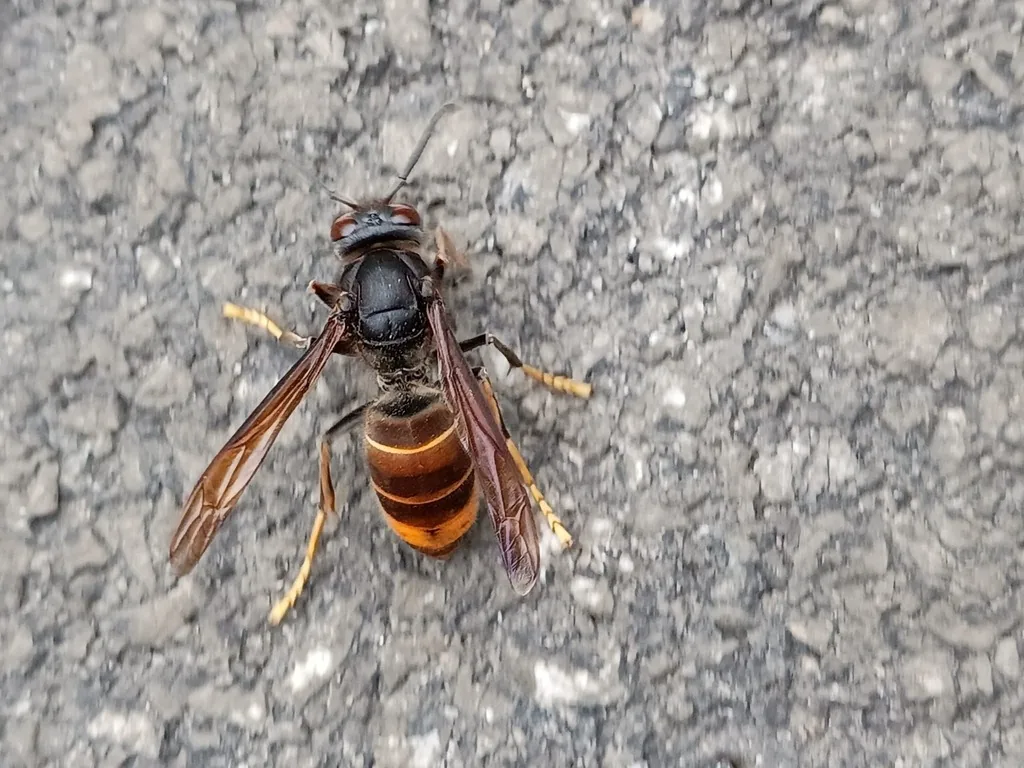
- The form found outside Asia is mostly dark, with a yellow face, black thorax, black legs that end in yellow segments, and an abdomen that is dark at the base and yellow toward the tip.[3][5][4]
- Penn State gives queens as 0.78 to 1.26 inches long and the first summer workers as about 0.6 inch, with late-season workers reaching queen size. Clemson's Department of Plant Industry gives a body length of 0.7 to 1.0 inch, and North Carolina says about an inch.[3][4][5]
- Colonies build three kinds of paper nest: a tennis-ball-sized embryo nest in spring, often under eaves, porch ceilings or in sheds; a larger primary nest by early summer; and a secondary nest from late summer that can grow bigger than a basketball.[1][5][6][4]
- Secondary nests are egg-shaped and usually high in tall trees; North Carolina says usually at least 33 feet up. They look much like bald-faced hornet nests.[3][5]
Look-alikes
| Look-alike | How to tell them apart |
|---|---|
| Bald-faced hornet | Black with white markings on the face, thorax and abdomen, and all-black legs. Its round to egg-shaped paper nests hang from trees and shrubs and are far more common, so look at the wasps, not just the nest.[3][6] |
| European hornet | Larger, with reddish-brown on the head and thorax and black teardrop marks on a yellow abdomen. It nests in cavities such as hollow trees or wall voids, often flies at night and comes to lights.[3][4] |
| Cicada killer | About 2 inches long, solitary, and nests in the ground; the rear of its abdomen is black.[3] |
| Northern giant hornet | Has a completely yellow head and brown-and-yellow striped abdomen, and has been found only in Washington State and nearby British Columbia.[3] |
Where it lives
Native to tropical and subtropical Southeast Asia. In the United States it has been detected in Chatham, Bryan, Effingham and Liberty counties in Georgia; Beaufort, Colleton, Charleston, Dorchester, Jasper and York counties in South Carolina; and, as of August 2026, Union and Guilford counties in North Carolina. Most finds have been between Savannah and Charleston.[1][5][2][3]
Biology and life cycle
Only mated queens survive the winter. In spring each queen builds an embryo nest and raises the first workers, the workers build a primary nest, and in summer the colony moves to a larger secondary nest. Males and new queens are produced in late summer and fall, and the old colony dies with cold weather.[3][1][2][5]
Damage and signs
- It hunts bees (especially honey bees), wasps and flies, hovering at hive entrances to catch bees as they come and go, a behavior called hawking. In Europe honey bees made up nearly 70% of its prey in urban areas but 30% in more diverse farmland.[3][5][4]
- Western honey bees lack the defenses that Asian honey bees use against it. One European study found 30% of commercial honey bee colonies weakened by hornet attacks and 5% killed outright.[3]
- Clemson DPI warns of reduced foraging and colony failure, and APHIS says established hornets could seriously affect honey bee populations, pollination and agriculture.[4][2]
Health risk
Hornet stings are painful, and most deaths from insect stings come from allergic reactions to the venom. In parts of Spain this hornet has become the most common cause of anaphylaxis from stinging insects, although a national review there found no rise in sting-related deaths as it spread. Call 911 for trouble breathing, wheezing, or swelling of the face or mouth.[7][8][9]
Control
Prevention
Check the wasps before deciding a paper nest belongs to this hornet; bald-faced hornet nests look similar and are much more common. In North Carolina, residents and beekeepers are asked to set and monitor homemade traps from March (for queens) or May (for workers) until the first fall frost.[3][5]
When to call a professional
Don't try to remove a nest yourself. APHIS says only trained state or federal responders should remove or treat yellow-legged hornet nests, because removal is dangerous and an escaping queen can spread the hornet.[2][4]
Report suspected hornets or nests with a photo if you can take one safely: in Georgia to the Georgia Department of Agriculture, in South Carolina through Clemson DPI's reporting tool, and in North Carolina through NCDA&CS's reporting tool. In other states, APHIS says to contact your State Plant Regulatory Official or State Plant Health Director; in Pennsylvania, Penn State's Insect Identification Lab takes reports.[2][1][4][5][3]
How far it has spread
Penn State says it was introduced to France, where it was first found in 2004, and has since spread through France and northern Spain into the United Kingdom, Germany, Italy and elsewhere. Only one color form has left Asia.[3][8]
In South Carolina, Clemson DPI removed 1 embryo and 15 secondary nests in 2024 and 13 embryo, 27 primary and 99 secondary nests in 2025. By mid-July 2026 crews had about 4,300 traps out in 13 counties and had caught more than 4,000 queens in the Low-Country.[4]
Clemson says it moves mainly with people through trade, travel and tourism, often riding on vehicles and cargo, and spreads naturally about 10 to 20 miles a year. Penn State notes that models predict it could survive across most of eastern North America.[6][3]
If you are stung
Have someone stay with the person to watch for an allergic reaction. Wash the site with soap and water and scrape out any stinger with a fingernail, gauze or a straight edge; don't squeeze it or use tweezers.[10][7]
Put wrapped ice on the sting, 10 minutes on and 10 minutes off, and don't scratch it. Over the next several days watch for signs of infection such as increasing redness, swelling or pain.[7][10]
Call 911 for trouble breathing, wheezing, shortness of breath, or swelling anywhere on the face or in the mouth, and use the person's epinephrine kit if they carry one. After a severe reaction, ask for a referral to an allergist.[7]
Where sources disagree
Colony size: Penn State says mature colonies average about 400 workers and approach 2,000 at most. The Georgia Department of Agriculture says secondary nests average 6,000 workers, and APHIS says nests can hold up to 6,000.[3][1][2]
Body length: 0.78 to 1.26 inches for queens (Penn State), 0.7 to 1.0 inch (Clemson DPI), about an inch (North Carolina).[3][4][5]
Common questions
- How can I tell a yellow-legged hornet from a bald-faced hornet?
- Bald-faced hornets are black and white with all-black legs. Yellow-legged hornets are black and yellow with a yellow face, and their legs end in yellow segments.[3][6][5]
- Where are yellow-legged hornets in the US?
- It has been detected in coastal Georgia and South Carolina, mostly between Savannah and Charleston, in York County, South Carolina, and as of August 2026 in Union and Guilford counties, North Carolina.[5][2][3]
- Should I spray a nest I think belongs to yellow-legged hornets?
- No. Keep away, take a photo only if it is safe, and report it. APHIS says only trained state or federal responders should remove these nests.[2][4][1]
- Are yellow-legged hornet stings more dangerous than other wasp stings?
- The venom can cause the same severe allergic reactions as other stinging insects, and it has become a leading cause of sting anaphylaxis in parts of Spain. A review in Spain found no rise in sting deaths as the hornet spread. Anyone with breathing trouble or facial swelling after a sting needs emergency care.[8][9][7]
Sources
- Georgia Department of Agriculture, “Yellow-Legged Hornet.” agr.georgia.gov/yellow-legged-hornet (accessed 2026-11-11)
- USDA Animal and Plant Health Inspection Service, “Yellow-Legged Hornet.” www.aphis.usda.gov/plant-pests-diseases/yellow-legged-hornet (accessed 2026-11-11)
- Penn State Extension, “Yellow-Legged Hornet.” extension.psu.edu/yellow-legged-hornet (accessed 2026-11-11)
- Clemson University Department of Plant Industry (Regulatory Services), “July 2026 Yellow-Legged Hornet Update: Report Nests (Hornet Herald).” blogs.clemson.edu/regulatory/july-2026-yellow-legged-hornet-update-report-nests/ (accessed 2026-11-11)
- North Carolina Department of Agriculture and Consumer Services, “Plant Industry: Yellow-Legged Hornet.” www.ncagr.gov/YLH (accessed 2026-11-11)
- Clemson University Department of Plant Industry (Regulatory Services), “April 2026 Yellow-Legged Hornet Update: Separating the Yellow-Legged Hornet from the Look-a-likes (Hornet Herald).” blogs.clemson.edu/regulatory/hornet-herald-11/ (accessed 2026-11-11)
- MedlinePlus, U.S. National Library of Medicine, “Insect bites and stings (Medical Encyclopedia).” medlineplus.gov/ency/article/000033.htm (accessed 2026-11-11)
- Clinical and Experimental Allergy, via PubMed, “Vidal (2022), The Asian wasp Vespa velutina nigrithorax: entomological and allergological characteristics.” pubmed.ncbi.nlm.nih.gov/34822191/ (accessed 2026-11-11)
- Journal of Medical Entomology, via PubMed, “Herrera and Leza (2026), No evidence of increased mortality associated with Vespa velutina spread in Spain.” pubmed.ncbi.nlm.nih.gov/41824780/ (accessed 2026-11-11)
- U.S. Centers for Disease Control and Prevention, “Insects and Scorpions at Work (NIOSH).” www.cdc.gov/niosh/outdoor-workers/about/insects-and-scorpions.html (accessed 2026-11-11)
- iNaturalist, “Vespa velutina taxon page (order and family).” www.inaturalist.org/taxa/119019 (accessed 2026-10-06)