The short answer
- Size: a cicada killer is huge for a wasp. Kentucky gives females 1.5 to nearly 2 inches and males up to 1.5 inches. A yellowjacket worker is about 1/2 inch long (Penn State, Ohio State); UC IPM gives 1/2 to 1 inch.[1][2][6][8][7]
- The hole: a cicada killer hole has a pile of loose soil or sand at the entrance, often with a shallow furrow leading in, and each female digs her own tunnel. A yellowjacket nest is usually just an entrance hole with a steady stream of wasps flying in and out.[2][1][3][5]
- Behavior: big wasps hovering at eye level over the lawn are male cicada killers, which have no stinger. Yellowjackets live in colonies, defend the nest as a group and can sting repeatedly.[1][2][3][5][6]
- Season: cicada killers are seen mostly in July and August. Yellowjacket colonies keep growing into late summer and fall, when Ohio State says a nest can reach about 4,000 to 5,000 workers.[1][3][8]
Profiles on this site
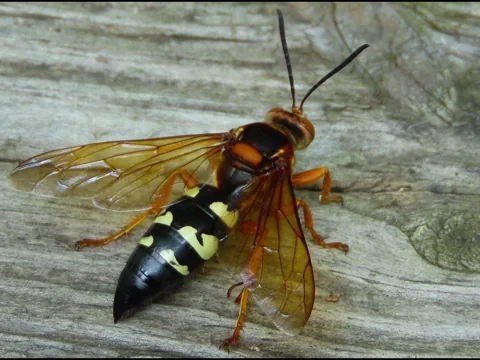 Eastern Cicada Killer
Sphecius speciosus
Cicada killers are very large solitary wasps seen mostly in July and August. Females dig burrows and stock them with annual cicadas. They look alarming, but the Missouri Department of Conservation calls them virtually harmless unless handled roughly, and Kentucky says they aren't a stinging hazard unless directly disturbed.
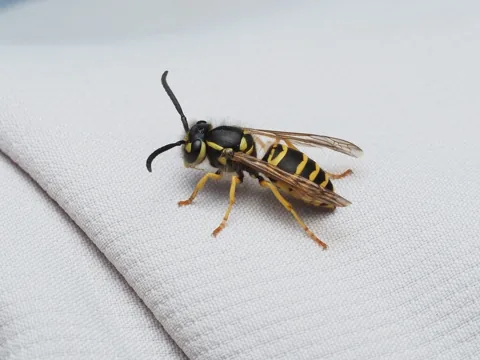 Eastern Yellowjacket
Vespula maculifrons
The eastern yellowjacket is a native, ground-nesting yellowjacket common across the eastern US in lawns, woodlands, pastures and parks; it defends its nest aggressively and can sting repeatedly.
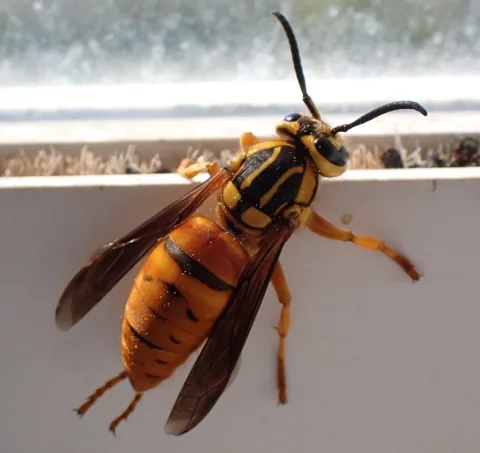 Southern Yellowjacket
Vespula squamosa
The southern yellowjacket is a native yellowjacket that normally nests in the ground. Its large, burnt-orange queens often start colonies by taking over eastern yellowjacket nests.
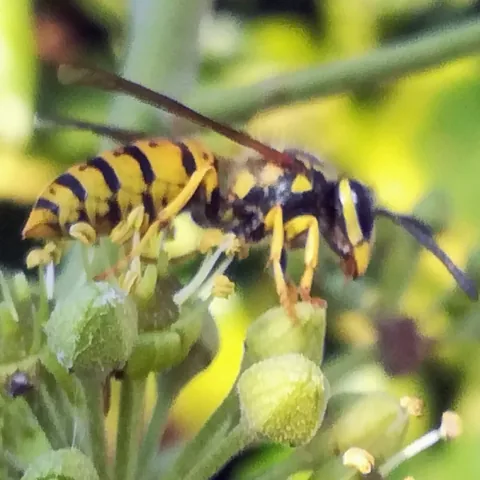 German Yellowjacket
Vespula germanica
The German yellowjacket is an invasive wasp from Eurasia that has spread across the northern US, displaces native yellowjackets and often nests in buildings.
Side by side: cicada killer and yellowjacket
Names: the eastern cicada killer is Sphecius speciosus, a solitary digger wasp. The ground-nesting yellowjackets are social wasps in the genus Vespula, such as the eastern yellowjacket (Vespula maculifrons) and the southern yellowjacket (Vespula squamosa).[3][2][5][6]
Size: cicada killer females 1.5 to nearly 2 inches and males up to 1.5 inches (Kentucky); Missouri says they can exceed 1.5 inches, while Minnesota gives about 1 to 1.5 inches. Yellowjacket workers about 1/2 inch (Ohio State, Penn State; UC IPM gives 1/2 to 1 inch), with queens up to 18 mm (Penn State) or about 3/4 inch (Ohio State).[1][2][3][8][6][7]
Color: the cicada killer has a dark head, a black and reddish-brown thorax and a black abdomen with yellow bands, plus reddish-brown or orange-tinged legs and amber wings. Kentucky counts three light-yellow stripes on the abdomen. Yellowjackets have jagged bright yellow and black stripes (UC IPM); eastern yellowjacket workers have a wide, anchor-shaped black mark on the first abdominal segment (Missouri).[3][1][2][7][5]
Body: both are wasps with few hairs. Ohio State says yellowjackets have hard, shiny, mostly hairless bodies, and Minnesota says solitary wasps have few hairs on the body or legs. Minnesota adds that most solitary digger wasps are larger than yellowjackets.[8][3]
Nest: each cicada killer female digs her own tunnel in sandy or light soil, often with many tunnels close together in one patch. Yellowjackets build a paper nest underground, commonly in an old rodent burrow or other cavity, used by the whole colony.[3][2][1][7][8][5]
Holes: a cicada killer entrance has a conspicuous mound of excavated soil, often with a furrow as if someone dragged a thumb across it (Missouri); Kentucky says the tunnels can be 12 to 15 inches deep and up to 36 inches long. A yellowjacket nest usually shows only the entrance hole with wasps flying in and out (Missouri); UC IPM says wasps flying from a hole in the ground indicate a probable nest.[2][1][5][7]
Season: cicada killer adults are active in July and August (Kentucky, Minnesota). Yellowjacket workers appear from June (Penn State), and colonies are largest in August and September (Ohio State); the workers die when cold weather arrives (Ohio State).[1][3][6][8]
Food: female cicada killers hunt annual (dog-day) cicadas, paralyze them with a sting and stock one or two per cell for their young. Yellowjacket workers hunt insects for protein and, from late summer, look for sweets, which is when they turn up at picnics, garbage cans and pet food dishes outside.[2][1][7][8]
How to confirm which one you have
Watch the hole from a distance in the daytime. Minnesota says ground-nesting solitary wasps nest in groups but each wasp has its own nest, while a yellowjacket nest is one colony; Missouri says all most people see of a yellowjacket nest is the entrance hole with yellowjackets flying in and out.[3][5]
Look for the soil pile. Piles of sand or loose soil near retaining walls, in turf or in beds, with large wasps nearby, are cicada killer excavations (Kentucky). Missouri adds the thumb-like furrow leading into the hole.[1][2]
Check the size against something you know. A wasp nearly 2 inches long is a cicada killer; yellowjacket workers are about 1/2 inch.[1][8][6]
Watch what the wasps carry. A female cicada killer glides in with a huge paralyzed cicada and drags it into her tunnel (Missouri, Kentucky). Washington State notes that these hunting wasps paralyze their prey and take it back to a nest dug into the ground.[1][2][4]
Why it matters
The sting risk is very different. Kentucky says cicada killers are not considered stinging hazards unless directly disturbed, and Missouri says a female could sting a person only if handled roughly. Yellowjackets, by contrast, are a significant stinging threat that defends its nest as a group (Missouri).[1][2][5]
Cicada killers are beneficial predators. Minnesota says solitary wasps help keep insect populations in check, are not aggressive toward people and should be tolerated and ignored whenever possible; Kentucky says control is not necessary or typically feasible.[3][1]
- Lawn sprays don't fix either one the way people expect. Kentucky and Minnesota say liquid insecticide sprayed on the turf or nest area does little against cicada killers, while yellowjacket nests are treated at the entrance at night, when the colony is inside (Kentucky ENT-620, Penn State).[1][3][9][6]
What to do about each
Cicada killers: leave them alone if you can. Minnesota says the adult females die by the end of the summer. Kentucky lists swatting individual wasps (a tennis racket is the traditional tool) and, if truly necessary, an insecticide dust placed directly into the tunnels; it names bifenthrin dust as one option. Liquid sprays on the turf above the tunnels won't reduce them.[1][3]
Make the spot less inviting for next year. Kentucky says cicada killers want well-drained, light-textured soil in full sun, so wood or stone mulch, shade or more irrigation in that area can make them nest elsewhere.[1]
Yellowjackets: Penn State says a nest can be ignored unless it is near a building entrance, in a lawn that gets mowed, or where people are likely to run into it. Otherwise you can hire a pest control company or treat it yourself.[6][10]
If you treat a yellowjacket ground nest yourself: find the entrance in daylight, treat after dark when the wasps are inside and less active, and use a dust, foam or labeled product aimed into the entrance (Kentucky ENT-620, Penn State, UC IPM). Penn State warns against dusting only the outside of the entrance from a distance, which angers the colony. Kentucky says calling a professional is usually prudent when the nest is hard to reach.[9][10][6][7]
Stings, allergies and pets
Stinging: CDC NIOSH says people who are allergic to venom can have anaphylaxis, a severe and potentially life-threatening reaction that needs emergency care. If several stinging insects attack at once, NIOSH says to run away from them.[11]
First aid: NIOSH and MedlinePlus say to wash the sting with soap and water, remove any stinger (MedlinePlus suggests scraping it out with the edge of a credit card rather than pinching it), and apply ice to reduce swelling. Have someone stay with the person to watch for an allergic reaction.[11][12][13]
Call 911 for trouble breathing, wheezing, swelling of the face or mouth, throat tightness or trouble swallowing (MedlinePlus). MedlinePlus says to call Poison Help (1-800-222-1222) or an emergency room if the person is allergic to the insect or was stung inside the mouth or throat, and that people with a sting allergy should carry an insect sting kit with epinephrine.[12][13]
- Pets: the Merck Veterinary Manual says wasps and yellowjackets can sting multiple times because their stingers are not barbed, that small animals are most often stung on the face and in the mouth, and that multiple stings can cause severe local and whole-body reactions. Treatment includes removing any stinger and supportive care from a veterinarian.[14]
Common questions
- Do cicada killers sting people?
- Rarely. Males have no stinger at all. Kentucky says cicada killers are not considered stinging hazards unless directly disturbed, and Missouri says a female could sting a person only if handled roughly.[1][2][3]
- Why do the big wasps fly right at me?
- Those are almost always male cicada killers guarding an area where females nest. Kentucky says males hover at eye level to inspect people, and Missouri says they are completely harmless because they lack stings entirely.[1][2]
- Are ground yellowjackets dangerous?
- They can be. Missouri calls yellowjackets a significant stinging threat because they defend the nest as a group, and Penn State says the eastern yellowjacket can sting repeatedly. Ohio State warns not to mow over a ground nest.[5][6][8]
- Will spraying the lawn get rid of cicada killers?
- No. Kentucky says liquid insecticides applied to the turf above the tunnels won't reduce them, and Minnesota says spraying the nest area isn't very effective. Changing the site (mulch, shade, irrigation) works better over time.[1][3]
- What should I do if my dog gets stung?
- Watch for swelling, especially of the face and mouth, and call your veterinarian. The Merck Veterinary Manual says multiple stings can cause severe local and whole-body reactions.[14]
Photo credits
- Eastern Cicada Killer: (c) Steve Kerr, some rights reserved (CC BY) — via iNaturalist, CC BY 4.0
- Eastern Yellowjacket: Brighton Lee, public domain (CC0), via iNaturalist
- Southern Yellowjacket: (c) Cole Shoemaker, some rights reserved (CC BY) — via iNaturalist, CC BY 4.0
- German Yellowjacket: (c) Gianni Del Bufalo bygdb, some rights reserved (CC BY) — via iNaturalist, CC BY 4.0
Sources
- University of Kentucky Entomology, “Cicada Killer Wasps (ENTFACT-004).” entomology.ca.uky.edu/ef004 (accessed 2026-11-14)
- Missouri Department of Conservation, “Eastern Cicada-Killer Wasp (Field Guide).” mdc.mo.gov/discover-nature/field-guide/eastern-cicada-killer (accessed 2026-11-14)
- University of Minnesota Extension, “Solitary wasps.” extension.umn.edu/yard-and-garden-insects/solitary-wasps (accessed 2026-11-14)
- Washington State University Extension, “Sphecidae: Thread-waisted Wasps (Hortsense).” hortsense.cahnrs.wsu.edu/fact-sheet/sphecidae-thread-waisted-wasps/ (accessed 2026-11-14)
- Missouri Department of Conservation, “Yellowjackets (Vespula Wasps) (Field Guide).” mdc.mo.gov/discover-nature/field-guide/yellowjackets-vespula-wasps (accessed 2026-11-14)
- Penn State Extension, “Eastern Yellowjacket.” extension.psu.edu/eastern-yellowjacket (accessed 2026-11-14)
- University of California Statewide IPM Program, “Yellowjackets and Other Social Wasps (Pest Notes).” ipm.ucanr.edu/home-and-landscape/yellowjackets-and-other-social-wasps/ (accessed 2026-11-14)
- Ohio State University Extension (Ohioline), “Yellowjackets (HYG-2075).” ohioline.osu.edu/factsheet/hyg-2075 (accessed 2026-11-14)
- University of Kentucky Entomology, “Controlling Wasps, Hornets, and Yellowjackets (ENTFACT-620).” entomology.mgcafe.uky.edu/ef620 (accessed 2026-11-14)
- Penn State Extension, “Getting Rid of Paper Wasps, Yellowjackets, and Other Stinging Insects.” extension.psu.edu/getting-rid-of-paper-wasps-yellowjackets-and-other-stinging-insects (accessed 2026-11-14)
- CDC National Institute for Occupational Safety and Health (NIOSH), “Insects and Scorpions at Work.” www.cdc.gov/niosh/outdoor-workers/about/insects-and-scorpions.html (accessed 2026-11-14)
- MedlinePlus, U.S. National Library of Medicine, “Insect bites and stings (Medical Encyclopedia).” medlineplus.gov/ency/article/000033.htm (accessed 2026-11-14)
- MedlinePlus, U.S. National Library of Medicine, “Bee, wasp, hornet, or yellow jacket sting (Medical Encyclopedia).” medlineplus.gov/ency/article/002847.htm (accessed 2026-11-14)
- Merck Veterinary Manual, “Wasp, Bee, and Ant Stings to Animals.” www.merckvetmanual.com/toxicology/venomous-arthropods/hymenoptera (accessed 2026-11-14)