On this page
How to identify it
- Nests are easy to spot as small cones or piles of soil with a hole in the middle, the entrance to each nest. Iowa State puts the hole at about the width of a pencil to the size of an index finger.[1][3]
- Hundreds to thousands of nests can be built close together, most often where grass or ground cover is thin.[1][3][4]
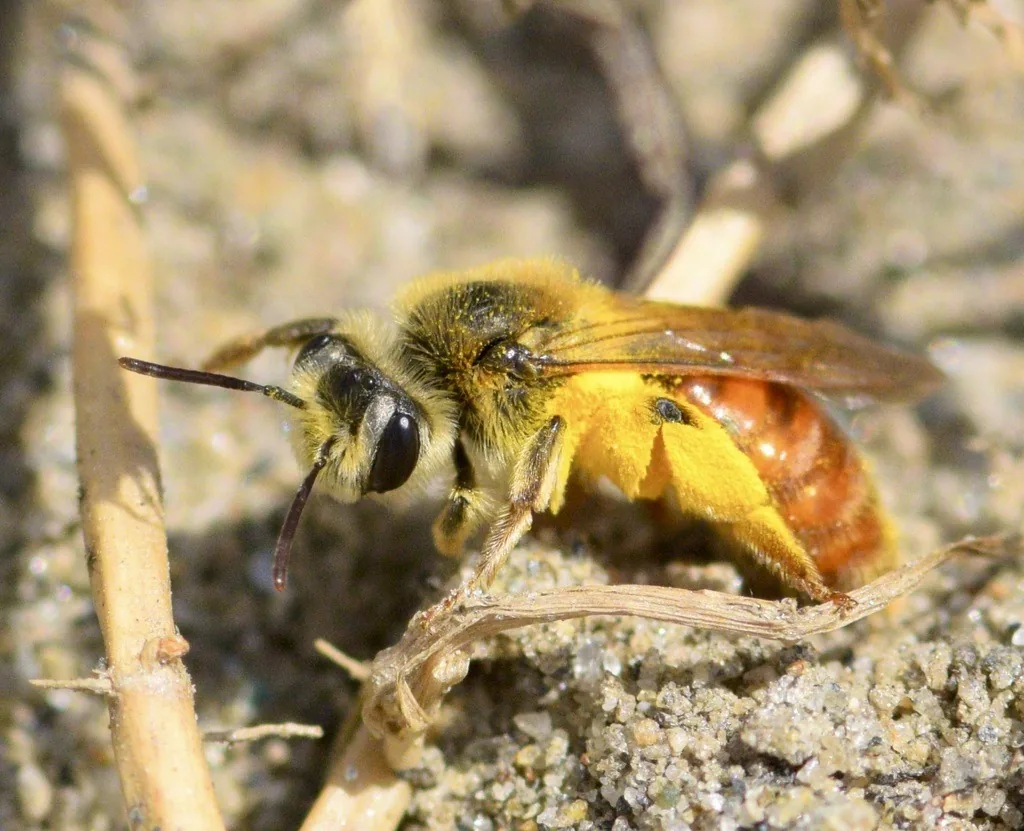
- The bees are small to medium, about 1/4 to 1/2 inch by Iowa State's measure and 0.3 to 0.7 inch by Washington State's. Most are dark and moderately hairy; Washington State notes large pollen-collecting hairs on the upper hind legs.[3][2]
- Andrena is a large genus, with about 400 species in North America, and many are specialists whose life cycle is timed to particular flowers.[2]
Look-alikes
| Look-alike | How to tell them apart |
|---|---|
| Cellophane bees | Cellophane bees (Colletes) also nest in spring ground aggregations with the same soil cones, and each female has her own nest. Cuckoo bees, which lay eggs in other bees' nests, show up a few weeks after both emerge.[1][5] |
| Ground-nesting yellowjackets | At a yellowjacket nest many wasps go in and out of a single entrance; at a solitary bee nest only one bee uses each entrance.[5] |
| Sweat bees | Sweat bees also nest in lawns but may be solitary or social, with tunnels connecting underground.[5] |
Where it lives
Penn State notes mining bees are among the most abundant ground-nesting bees in the northeastern US, and Pennsylvania alone has at least 438 bee species.[1]
Biology and life cycle
There is one emergence a year, usually in early spring, and mining bees are among the first bees out in late winter. NC State says the most conspicuous activity is typically in March, when dozens to hundreds emerge after developing as larvae the year before.[2][4]
Of Pennsylvania's at least 438 bee species, about a third emerge in March and April.[1]
Most prefer loose, exposed soil on south-facing slopes, which warm earlier in spring; Connecticut adds sparse vegetation and loose, sandy, dry soil.[1][5][2]
Females dig the tunnels and stock cells at the end with nectar and pollen for their young. After a few weeks the adults die, and the larvae develop underground until the next spring.[5][3][4]
They pollinate native plants and crops such as apples, pears, cherries and blueberries; Connecticut calls the andrenids important pollinators of fruit trees.[1][5]
Damage and signs
- Iowa State calls mining bees an occasional lawn pest, especially in dry areas with sparse vegetation, but not a serious one: the tunnel entrances disrupt the lawn without usually damaging it.[3]
- Thin grass usually comes first. Iowa State says it looks as if the bees thinned the grass, but more likely they moved in because it was already thin.[3]
- Nests are common in backyards and urban gardens, and dense nesting sites can look intimidating, but Penn State says they are not dangerous.[1]
Health risk
Females can sting but aren't aggressive: Penn State and Connecticut say they sting only when handled, stepped on or cornered, and an NC State entomologist lay in a nesting site for over an hour without being stung. For a bee sting, MedlinePlus advises scraping out any stinger with a straight edge rather than squeezing it, washing with soap and water and applying wrapped ice 10 minutes on and 10 off; call 911 for trouble breathing, swelling of the face or mouth, or throat tightness.[1][5][4][7][8]
Control
Prevention
The usual advice is to leave them alone. They are active only a few weeks, and Penn State and Connecticut both advise against pesticides because these are important native pollinators.[1][5][4]
If control is truly needed, Penn State suggests watering the nesting area to encourage the bees to nest elsewhere.[1]
For the longer term, thicken the cover: level the area and grow dense turf or a ground cover suited to the site, or till and add organic matter. On paths, driveways and plant beds, mulch, pea gravel or denser plantings discourage nesting.[3][5][4]
Keep them out
Utah State suggests roping off a nesting area to keep people away until the bees go inactive, then renovating the bare soil.[6]
Where sources disagree
Insecticides: Penn State strongly recommends against chemicals and Connecticut says pesticides should not be used on ground-nesting bees; Iowa State lists a granular turf insecticide as one option, though its author doubts it is justified.[1][5][3]
How long they stay: Penn State says ground-nesting spring bees are active about 6 to 8 weeks; Connecticut says usually three to four weeks, longer if different species take turns at the same site.[1][5]
Sharing nests: Penn State says each nest holds only one female; Iowa State says several females may share a common entrance tunnel.[1][3]
Size: Iowa State gives 1/4 to 1/2 inch; Washington State gives 0.3 to 0.7 inch for the family.[3][2]
Common questions
- What are the little dirt mounds with holes in my lawn in spring?
- Often the nests of mining bees, which build small soil cones with a hole in the middle, usually in bare or thin patches of lawn.[1][3]
- Will ground-nesting bees sting me?
- Rarely. They aren't aggressive and sting only when handled, stepped on or cornered.[1][5]
- How do I get mining bees to nest somewhere else?
- Water the nesting area during the season, and later fill in the bare soil with dense turf, ground cover or mulch. Sprays aren't recommended.[1][3][5]
- Are ground-nesting bees common?
- Yes. MedlinePlus notes there are 4,000 native bee species in the U.S. and that 70 percent of all bees live in nests in the ground.[8]
Sources
- Penn State Extension, “Spring Bees: Who Are They and Where Do They Live?.” extension.psu.edu/spring-bees-who-are-they-and-where-do-they-live (accessed 2026-11-11)
- Washington State University Extension, Hortsense, “Andrenidae: Mining and Miner Bees.” hortsense.cahnrs.wsu.edu/fact-sheet/andrenidae-mining-and-miner-bees/ (accessed 2026-11-11)
- Iowa State University Extension and Outreach, Yard and Garden, “Mining (Andrenid) Bees.” yardandgarden.extension.iastate.edu/article/2002/4-19-2002/andrenid.html (accessed 2026-11-11)
- NC State Extension, Plant Disease and Insect Clinic, “It's the Season for Busy Ground-Nesting Bees!.” pdic.ces.ncsu.edu/2022/03/its-the-season-for-busy-ground-nesting-bees/ (accessed 2026-11-11)
- The Connecticut Agricultural Experiment Station, “Ground Nesting Bees (fact sheet).” portal.ct.gov/-/media/CAES/DOCUMENTS/Publications/Fact_Sheets/Entomology/GroundNestingBeespdf.pdf (accessed 2026-11-11)
- Utah State University Extension, “Solitary/Ground Bees.” extension.usu.edu/planthealth/ipm/notes_nuisance/solitary-ground-bees (accessed 2026-11-11)
- MedlinePlus, U.S. National Library of Medicine, “Insect bites and stings (Medical Encyclopedia).” medlineplus.gov/ency/article/000033.htm (accessed 2026-11-11)
- MedlinePlus, U.S. National Library of Medicine, “Bee, wasp, hornet, or yellow jacket sting (Medical Encyclopedia).” medlineplus.gov/ency/article/002847.htm (accessed 2026-11-11)
- iNaturalist, “Andrena taxon page (order and family).” www.inaturalist.org/taxa/57669 (accessed 2026-11-11)