On this page
How to identify it
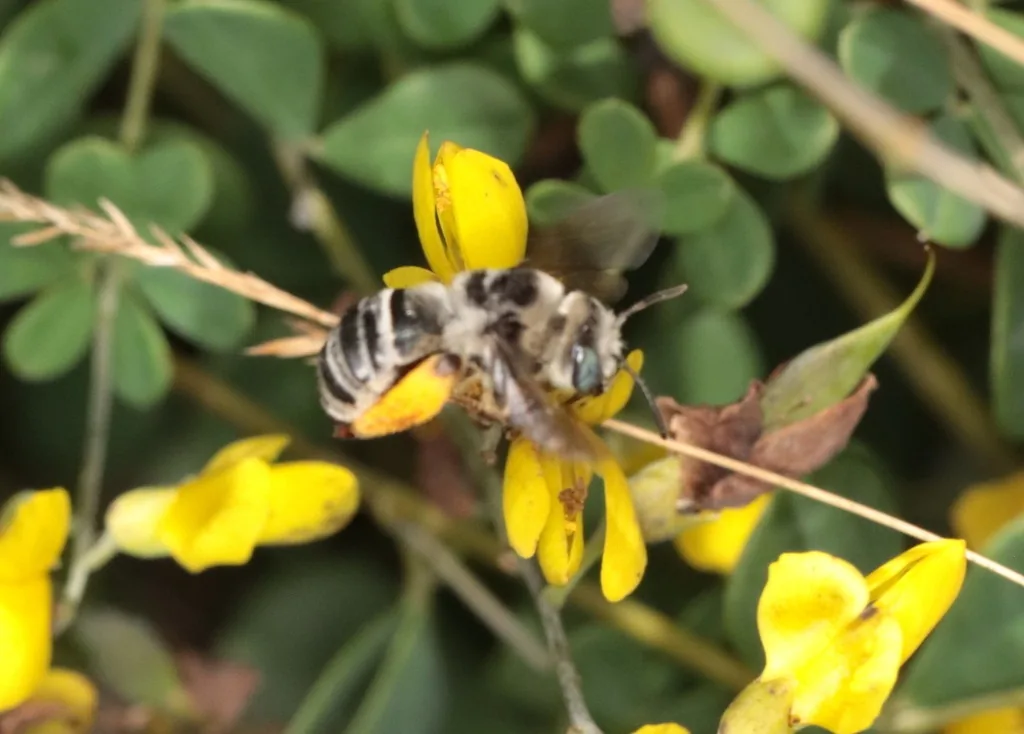
- Look for a fuzzy, medium-sized bee with unusually long antennae, the feature that gives longhorn bees their name. UF/IFAS gives a length of 9 to 15 mm, with yellowish wings and antennae that can reach from the head past the waist to the abdomen.[1][2][3]
- Many longhorn bees have yellow faces.[1][2]
- Melissodes is one of the two major genera of longhorn bees, alongside Eucera. They belong to the same family as honey bees, bumble bees and carpenter bees.[1]
- Females have an extremely hairy scopa, a brush of hairs on the rear of the body used to collect pollen and carry it back to the nest.[3]
Look-alikes
| Look-alike | How to tell them apart |
|---|---|
| Squash bees | Members of the same longhorn bee tribe that collect pollen only from squashes, gourds and pumpkins, and are active very early in the day when squash flowers open.[1] |
Where it lives
GBIF has about 7,000 U.S. records since 1990. Most come from Texas, Florida and Colorado, followed by California, Alabama, Virginia, Georgia, Mississippi and South Carolina, with a few records from Mexico and Canada. A 2025 study of Connecticut bees also reported it as an update to the bee fauna of Massachusetts. UF/IFAS says it has been found from northwestern Canada across the continental United States to the southern tip of Mexico.[4][5][6][3]
Biology and life cycle
Most bees in its family live alone rather than in colonies, even when many nest close together.[2]
Most longhorn bees visit particular kinds of plants for pollen.[1][2]
U.S. records peak in June. Most come from May through August, with a few as early as March and as late as October.[7]
In southeast Georgia blueberry farms and nearby forests, it was among the six most common of 72 wild bee species caught in traps from March to October; together those six made up nearly 60 percent of the wild bees caught.[8]
It nests underground, and much of its life cycle is still unstudied. UF/IFAS says it is thought to have one generation a year, larvae pupate in the nest before emerging as adults, and adults are active for about a month to forage, mate and nest.[3]
Each female builds her nest alone and provisions it with pollen for her young. Related Melissodes species nest in dry soils made up of rock or sand.[3]
Damage and signs
- It causes no damage. Longhorn bees are pollinators, and many native wildflowers depend on bees like them to set seed. UF/IFAS calls it a major wildflower pollinator: Melissodes bees have been found on over 50 wildflower genera, including ironweeds, sneezeweeds, passionflowers, sweet clovers and mountain mint, and in Florida this species uses pollen from the squash, mustard, sunflower, blueberry, crepe myrtle and primrose families.[1][2][3]
Health risk
Longhorn bees are not aggressive. Like most solitary bees, they are only likely to sting if handled or stepped on with bare feet.[1][2]
Control
Prevention
No control is needed. Missouri's conservation department calls longhorn bees valuable native pollinators that are not aggressive.[1]
If you are stung
For most stings, wash the area with soap and water and put ice wrapped in a washcloth on it, 10 minutes on and 10 minutes off. An antihistamine or anti-itch cream can help, and watch the spot for signs of infection over the next few days.[9]
Call 911 if someone who was stung has trouble breathing or wheezing, swelling of the face or mouth, throat tightness or trouble swallowing, feels weak, or turns blue. If they carry an epinephrine kit for insect allergies, help them use it.[9]
Where the sources disagree
Season: UF/IFAS says it is typically more active in the fall months, while GBIF's U.S. records peak in June, with most from May through August.[3][7]
Common questions
- What is the fuzzy bee with very long antennae on my flowers?
- Possibly a longhorn bee, such as the common long-horned bee. Longhorn bees are fuzzy, medium-sized bees named for their long antennae, and many have yellow faces.[1][2]
- Will a long-horned bee sting me?
- It is unlikely. Longhorn bees are not aggressive and usually sting only if handled or stepped on barefoot.[1][2]
- Does the common long-horned bee pollinate crops?
- It visits some. UF/IFAS says in Florida it uses pollen from the squash, sunflower and blueberry families, among others, but it prefers wildflowers to fruiting plants and its value to produce growers is unknown.[3]
Sources
- Missouri Department of Conservation, “Longhorn Bees (Field Guide).” mdc.mo.gov/discover-nature/field-guide/longhorn-bees (accessed 2026-11-14)
- Missouri Department of Conservation, “Apid Bees (Field Guide group page).” mdc.mo.gov/discover-nature/field-guide/apid-bees (accessed 2026-11-14)
- University of Florida/IFAS Extension (Featured Creatures), “Common Long-Horned Bee, Melissodes communis (Cresson), IN1304.” ask.ifas.ufl.edu/publication/IN1304 (accessed 2026-11-14)
- Global Biodiversity Information Facility (GBIF), “Melissodes communis: U.S. occurrence records since 1990 by state (GBIF occurrence search).” api.gbif.org/v1/occurrence/search?taxonKey=5040655&country=US&hasGeospatialIssue=false&occurrenceStatus=PRESENT&year=1990%2C2026&facet=stateProvince&facetLimit=400&limit=0 (accessed 2026-11-14). Exact count at access: 7,049 U.S. records since 1990 (Texas 2,539; Florida 1,477; Colorado 1,197; California 366; Alabama 253; Virginia 225; Georgia 220).
- Global Biodiversity Information Facility (GBIF), “Melissodes communis: occurrence records since 1990 by country (GBIF occurrence search).” api.gbif.org/v1/occurrence/search?taxonKey=5040655&hasGeospatialIssue=false&occurrenceStatus=PRESENT&year=1990%2C2026&facet=country&limit=0 (accessed 2026-11-14). Exact counts at access: 7,139 records since 1990; United States 7,049, Mexico 73, Canada 17.
- Zootaxa, via PubMed, “Biodiversity of Bees (Hymenoptera: Apoidea: Anthophila) in Connecticut (USA) (Zarrillo, Stoner and Ascher 2025).” pubmed.ncbi.nlm.nih.gov/40174048/ (accessed 2026-11-14)
- Global Biodiversity Information Facility (GBIF), “Melissodes communis: U.S. occurrence records since 1990 by month (GBIF occurrence search).” api.gbif.org/v1/occurrence/search?taxonKey=5040655&country=US&hasGeospatialIssue=false&occurrenceStatus=PRESENT&year=1990%2C2026&facet=month&facetLimit=12&limit=0 (accessed 2026-11-14). Exact counts at access by month: Mar 88, Apr 270, May 1,614, Jun 2,214, Jul 1,113, Aug 973, Sep 421, Oct 116; other months under 20.
- Environmental Entomology, via PubMed, “Wild bees show local spatial and temporal dynamics in southeastern US blueberry farmscapes (Rezende et al. 2025).” pubmed.ncbi.nlm.nih.gov/39805148/ (accessed 2026-11-14)
- MedlinePlus, U.S. National Library of Medicine, “Insect bites and stings (Medical Encyclopedia).” medlineplus.gov/ency/article/000033.htm (accessed 2026-11-14)
- iNaturalist, “Melissodes communis taxon page (order and family).” www.inaturalist.org/taxa/224858 (accessed 2026-11-14)