On this page
How to identify it
- Sweat bees are small: Washington State gives about 0.1 to 0.4 inch for the common sweat bee genera (Agapostemon, Halictus and Lasioglossum).[1][2]
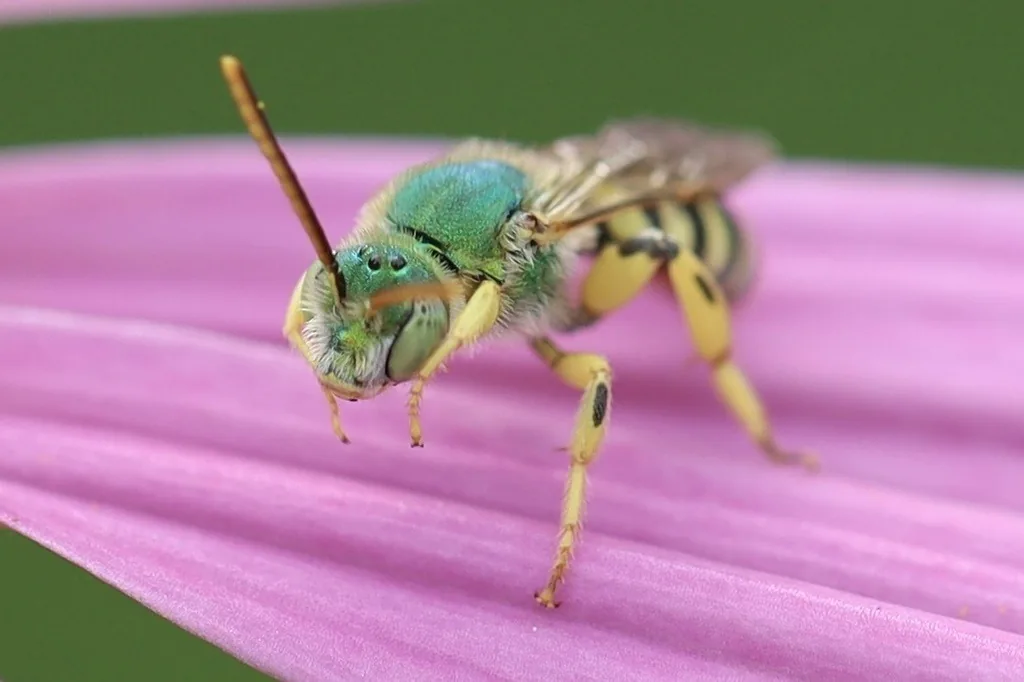
- Most are dull to metallic black or brown, while others are bright metallic green or blue; some have bands like a honey bee.[3][2]
- Agapostemon species usually have a bright metallic green head and thorax with a black-and-yellow striped abdomen. In Maryland, Agapostemon virescens has an iridescent green thorax and a striped, hairy black abdomen, and Augochlorella aurata is metallic green all over.[1][3]
- Females carry pollen on the hairs of their hind legs. Like all halictids they have short tongues and can't reach nectar in deep flowers. UF/IFAS says males are often slimmer, lack the pollen brush and sometimes have yellow markings on the face, abdomen or legs; parasitic species such as Sphecodes carry no pollen at all.[1][2][4]
- Specialists separate sweat bees from other bees, and from each other, by details of the wing veins and antennae. UF/IFAS says a strongly curved basal vein in the wing separates sweat bees from other bee families, and Lasioglossum has weak or reduced wing veins.[2][4]
- Grown larvae are pale grubs without hairs, usually less than 15 mm long; pupae are delicate and rarely seen.[4]
Look-alikes
| Look-alike | How to tell them apart |
|---|---|
| Cuckoo wasps | Also small and metallic blue or green, but their bodies are covered with tiny pits that give a pebbly look, and they can roll into a ball for defense; females can't sting.[2] |
Where it lives
Halictid bees occur worldwide and are the second largest bee family, with about 500 species in North America; the Missouri Department of Conservation says more than 500 north of Mexico. Sweat bees are widespread and abundant, found statewide in Missouri, and just over a quarter of Maryland's 437 bee species are halictids. UF/IFAS counts over 50 species in eight genera in Florida and says most of them are also common throughout the eastern United States.[1][2][3][4]
Biology and life cycle
Nearly all sweat bees nest in the ground, often in bare, loose or sandy soil in sunny spots; a few nest in rotting wood.[1][2][3]
Halictus and Lasioglossum species are attracted to human sweat, which they drink for its salt.[1][2]
Behavior ranges from solitary to social, and some species, such as Halictus rubicundus, switch between the two. In social species, Missouri describes nests started in April being joined by other overwintered females; by summer one egg-layer remains, some of her daughters work, and others mate and overwinter to start nests the next spring. UF/IFAS says sweat bees show the widest range of social behavior of any bee group, from solitary and communal to semi-social and primitively eusocial; most social colonies last one year and start with a single queen, typically in spring.[3][2][1][4]
A genetic study of 206 halictine bees found that eusociality in Halictus and Lasioglossum most likely arose once, in a common ancestor about 35 million years ago.[5]
Females stock each underground cell with a ball of pollen and nectar that feeds the larva. UF/IFAS says each cell gets one egg, the larva eats the store until it is gone, and cells are usually lined with a waxy substance, probably from a gland on the underside of the abdomen.[1][2][4]
Many are generalists that visit whatever flowers are blooming, and some can buzz-pollinate, vibrating flowers to shake loose pollen, something honey bees can't do.[3][2]
Some sweat bees, including the Sphecodes cuckoo bees, are cleptoparasites that lay their eggs in other bees' nests instead of building their own. UF/IFAS says Sphecodes females usually kill the egg or larva in the cell before laying their own egg.[1][2][3][4]
UF/IFAS says solitary species spend the winter as prepupae or adults, and most have one generation a year; some prepupae may stay in that stage for a year or more.[4]
Damage and signs
Health risk
Sweat bees are not aggressive. A bee drinking your sweat usually leaves after a gentle brush, but pressing on or swatting a female may bring a sting, and Maryland's natural resources agency says the venom often causes only mild irritation. Anyone with signs of a severe allergic reaction to any sting, such as trouble breathing or swelling of the face or mouth, needs emergency care.[2][3][6]
Control
Prevention
No chemical control is recommended for these beneficial bees. Avoid regular use of broad-spectrum insecticides, and the Missouri Department of Conservation advises avoiding neonicotinoid-treated plants and seed.[1][2][3]
To support them, leave patches of bare, sunny soil near flower beds and plant flowers that bloom through the season. UF/IFAS adds wildflower plantings, minimum tillage and less insecticide use.[3][2][4]
Traps and physical control
Gently brush or scrape a sweat bee off your skin instead of swatting or pressing it, which is what triggers a sting.[2][3]
When to call a professional
For a sting, wash the site with soap and water, use ice wrapped in a washcloth for 10 minutes on and 10 off, and an antihistamine or anti-itch cream if needed. Call 911 for trouble breathing, swelling in the face or mouth, throat tightness or weakness.[6]
Where sources disagree
Size: Washington State gives 0.1 to 0.4 inch for sweat bees (and 0.1 to 0.8 inch for the whole family), while the Missouri Department of Conservation lists 1/4 to 3/4 inch for halictids but adds that many sweat bees are quite small.[1][2]
Social life: Missouri's field guide calls halictids solitary insects with no hive to defend, yet also describes social nests with workers; Maryland says most sweat bees are solitary and a handful are social.[2][3]
Social life (continued): UF/IFAS says some species are solitary or social in different populations, depending on season, place and altitude.[4]
Common questions
- Why do sweat bees land on me?
- They are after the moisture and salt in your perspiration, much like deer at a salt lick.[2][1]
- Do sweat bees sting?
- Females can, but they are not aggressive and usually sting only when pressed or swatted. The sting is mild for most people.[2][3]
- Should I get rid of sweat bees in my yard?
- Usually not. They pollinate wildflowers, fruits and vegetables and other crops, and leaving some bare, sunny soil and using fewer insecticides helps them. UF/IFAS names stone fruits, pome fruits, alfalfa and sunflower among the crops they pollinate.[2][3][1][4]
- What should I do if a sweat bee stings me?
- Wash the spot with soap and water and use a wrapped ice pack. Get emergency help for trouble breathing or swelling in the face or mouth.[6]
Sources
- Washington State University Extension, “Halictidae: Alkali Bees, Sweat Bees and Cuckoo Bees (HortSense, reviewed May 15, 2026).” hortsense.cahnrs.wsu.edu/fact-sheet/halictidae-alkali-bees-sweat-bees-and-cuckoo-bees/ (accessed 2026-11-14)
- Missouri Department of Conservation, “Halictid Bees (Sweat Bees), Field Guide.” mdc.mo.gov/discover-nature/field-guide/halictid-bees-sweat-bees (accessed 2026-11-14)
- Maryland Department of Natural Resources, “Native Animal Profile: Sweat Bees (aka Halictid Bees) (Oct. 18, 2019).” news.maryland.gov/dnr/2019/10/18/native-animal-profile-sweat-bees-aka-halictid-bees/ (accessed 2026-11-14)
- University of Florida/IFAS Extension (Featured Creatures), “Sweat Bees, Halictid Bees, Halictidae, EENY-499/IN897.” ask.ifas.ufl.edu/publication/IN897 (accessed 2026-11-14)
- Molecular Phylogenetics and Evolution, via PubMed, “Gibbs, Brady, Kanda and Danforth (2012), Phylogeny of halictine bees supports a shared origin of eusociality for Halictus and Lasioglossum.” pubmed.ncbi.nlm.nih.gov/22982437/ (accessed 2026-11-14)
- MedlinePlus, U.S. National Library of Medicine, “Insect bites and stings (Medical Encyclopedia).” medlineplus.gov/ency/article/000033.htm (accessed 2026-11-14)
- iNaturalist, “Halictidae taxon page (order and family).” www.inaturalist.org/taxa/49707 (accessed 2026-11-14)