On this page
How to identify it
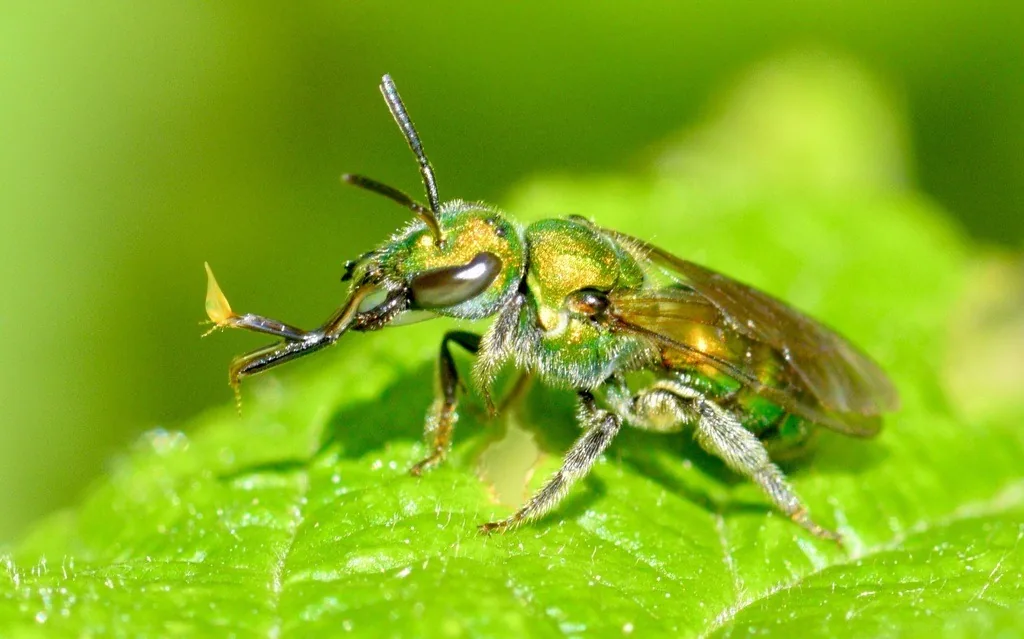
- It is a sweat bee (family Halictidae). Sweat bees are small, and while most are black or brown, some are bright metallic green or blue.[1][3]
- Females carry pollen on hairy hind legs. Males are a bit thinner, with slightly longer antennae, and lack the pollen-carrying hairs.[2]
- Females are slightly larger than the related golden sweat bee (Augochlorella aurata): head width averaged about 2.3 mm against 2.0 mm in one study.[4]
- UF/IFAS describes the adult as heavily sculptured, with numerous tiny pits over the iridescent head, thorax and abdomen, in colors ranging from green to blue to gold.[9]
- Females have 12 antennal segments and males 13. Females carry pollen-collecting hairs (scopa) on the hind legs, which males lack, and males are usually smaller, UF/IFAS says.[9]
- Among Augochlora, this species is told by its green color and by fine ridges running all the way across a small plate at the back of the thorax. UF/IFAS says no clear trait separates it from the rare Augochlora azteca, which is restricted to Puerto Rico.[9]
Look-alikes
| Look-alike | How to tell them apart |
|---|---|
| Cuckoo wasps | Also small and metallic blue-green, but their bodies are covered in small pits that give a pebbly look, they can roll into a ball for defense, and the females can't sting. UF/IFAS adds that sweat bees, this one included, have a sharply curved basal vein in the forewing, a feature typical of all sweat bees.[1][9] |
| Sweat bees | It is one of many sweat bees, a family of small, non-aggressive bees known for landing on people to drink sweat.[1] |
| Golden sweat bee (Augochlorella aurata) | A closely related metallic sweat bee of the same region that nests in the ground and lives in small colonies with worker daughters; the pure gold-green sweat bee nests in rotting logs and lives alone.[4][1] |
Where it lives
Eastern North America, where it is one of the most common bees, especially in and around woods. It shares the eastern United States with the golden sweat bee and turns up in upper Midwest grasslands as well. UF/IFAS gives its range as Quebec south to Florida, with the western edge running from Minnesota to Texas, and says it is most commonly found in and next to wooded areas.[2][4][5][9]
Biology and life cycle
Females dig their nests in the rotting wood of fallen logs, unlike most sweat bees, which nest in the ground.[4][2][1][3]
It is solitary. Females start nests in late spring and early summer after coming out of winter dormancy, and their daughters leave to start nests of their own instead of staying on as workers.[4]
Each larva eats a mass of pollen and nectar its mother provided; the adults are generalists that visit many kinds of flowers for nectar and pollen.[1][3][4]
Adults have been found spending the winter under the loose bark of logs lying on the ground.[2]
Each nest is a gallery of cells dug in moist, rotting wood, often in an abandoned insect burrow. UF/IFAS says each cell gets a ball of pollen and nectar and a single egg, and is lined with a wax-like secretion that helps keep the humidity high.[9]
It is active from February to November in the South but only from April to September in the North. Egg to adult takes 17 to 40 days depending on temperature, and the egg stage lasts slightly over 24 hours in summer warmth.[9]
There are typically two to three generations a year, probably fewer in the North. Mated females of the last generation spend the winter alone or huddled with other females, usually in insect burrows or old nests; males die by the end of fall, UF/IFAS says.[9]
Females forage from morning to early afternoon and may make up to 10 pollen trips to stock a single cell, then build new cells in the late afternoon and overnight. Females likely die after completing nine to 12 nests.[9]
Males don't help with nests. They swarm in front of flowers to catch passing females and spend the night in logs or burrows, sometimes several together, all facing the same direction.[9]
Because females nest only in decaying wood, UF/IFAS says this bee can't be managed with the nest boxes, hollow-twig bundles or bee blocks sold for other solitary bees, and it is not sold commercially.[9]
Damage and signs
- No damage. Sweat bees are important pollinators, and this species forages on many kinds of flowers. UF/IFAS says it collects pollen from more than 20 families of flowering plants, can make up as much as 90% of the bees in the canopy of eastern woods, and has been proposed as one of the few animal pollinators of walnut.[1][4][9]
Health risk
Sweat bees are small and not aggressive, having no hive to defend. They land on people to drink sweat for its moisture and salts, and pressing on a female may earn a mild sting. A gentle scrape usually sends one on its way. UF/IFAS says females lick sweat for its salts and may sting if startled or threatened while doing so; males are less drawn to sweat and cannot sting.[1][9]
Control
Prevention
No control is needed. Sweat bees are gentle native pollinators, and many native bee species are declining.[1]
Traps and physical control
If one lands on your skin, brush it off gently instead of pressing on it.[1]
If you're stung
For a sting, wash the spot with soap and water, then put ice wrapped in a washcloth on it for 10 minutes and off for 10 minutes, repeating as needed. An antihistamine or an anti-itch cream can help, and over the next several days watch for signs of infection such as increasing redness, swelling or pain.[6]
Call 911 if a stung person has trouble breathing or wheezing, swelling of the face or mouth, throat tightness or trouble swallowing, feels weak or turns blue. People who are allergic to venom can have anaphylaxis, a life-threatening reaction that needs emergency care; if they carry an emergency allergy kit, use it.[6][7]
Where the sources disagree
Winter shelter: a USGS bee photographer reports finding adults overwintering under the loose bark of logs on the ground; UF/IFAS says mated females usually overwinter hidden in insect burrows or old nests.[2][9]
Common questions
- What is the tiny shiny green bee landing on my arm?
- Possibly a sweat bee such as the pure gold-green sweat bee; sweat bees land on people to drink sweat for its salt and moisture.[1][2]
- Do sweat bees sting?
- They can, but they aren't aggressive: a female pressed against the skin may give a mild sting. UF/IFAS says only females can sting, and they may do so if startled or threatened while licking sweat.[1][9]
- Where do pure gold-green sweat bees nest?
- In moist, rotting wood, often in abandoned insect burrows, UF/IFAS says. Each female digs a gallery of wax-lined cells and stocks each one with pollen and nectar for a single egg.[9]
- Do pure gold-green sweat bees live in colonies?
- No. UF/IFAS says each female builds her own nest and raises her own young, though at high densities neighboring nests may be separated by only a thin wall of hardened wood pulp, and females sometimes gather in response to their own pheromones or to salt.[9]
Sources
- Missouri Department of Conservation, “Halictid Bees (Sweat Bees) (Field Guide).” mdc.mo.gov/discover-nature/field-guide/halictid-bees-sweat-bees (accessed 2026-11-11)
- U.S. Geological Survey, “Augochlora pura, male (USGS Bee Inventory and Monitoring Lab image notes).” www.usgs.gov/media/images/augochlora-pura-m-back-hardy-co-west-virginia (accessed 2026-11-14)
- Washington State University HortSense, “Halictidae (alkali bees, sweat bees and cuckoo bees).” hortsense.cahnrs.wsu.edu/fact-sheet/halictidae-alkali-bees-sweat-bees-and-cuckoo-bees/ (accessed 2026-11-11)
- Annals of the Entomological Society of America, via PubMed Central, “The Loss of Sociality Is Accompanied by Reduced Neural Investment in Mushroom Body Volume in the Sweat Bee Augochlora pura (Pahlke et al. 2021).” pmc.ncbi.nlm.nih.gov/articles/PMC8423109/ (accessed 2026-11-11)
- Environmental Entomology, via PubMed, “Evaluating Native Bee Communities and Nutrition in Managed Grasslands (Stein et al. 2020).” pubmed.ncbi.nlm.nih.gov/32215621/ (accessed 2026-11-11)
- MedlinePlus, U.S. National Library of Medicine, “Insect bites and stings (Medical Encyclopedia).” medlineplus.gov/ency/article/000033.htm (accessed 2026-11-11)
- U.S. Centers for Disease Control and Prevention, “Insects and Scorpions at Work (NIOSH).” www.cdc.gov/niosh/outdoor-workers/about/insects-and-scorpions.html (accessed 2026-11-11)
- iNaturalist, “Augochlora pura taxon page (order and family).” www.inaturalist.org/taxa/82523 (accessed 2026-11-11)
- University of Florida IFAS Extension, Featured Creatures, “Pure Gold-Green Sweat Bee, Augochlora pura (Say 1837) (EENY-715/IN1225; C. A. Short and A. Lucky).” ask.ifas.ufl.edu/publication/IN1225 (accessed 2026-11-14)