On this page
How to identify it
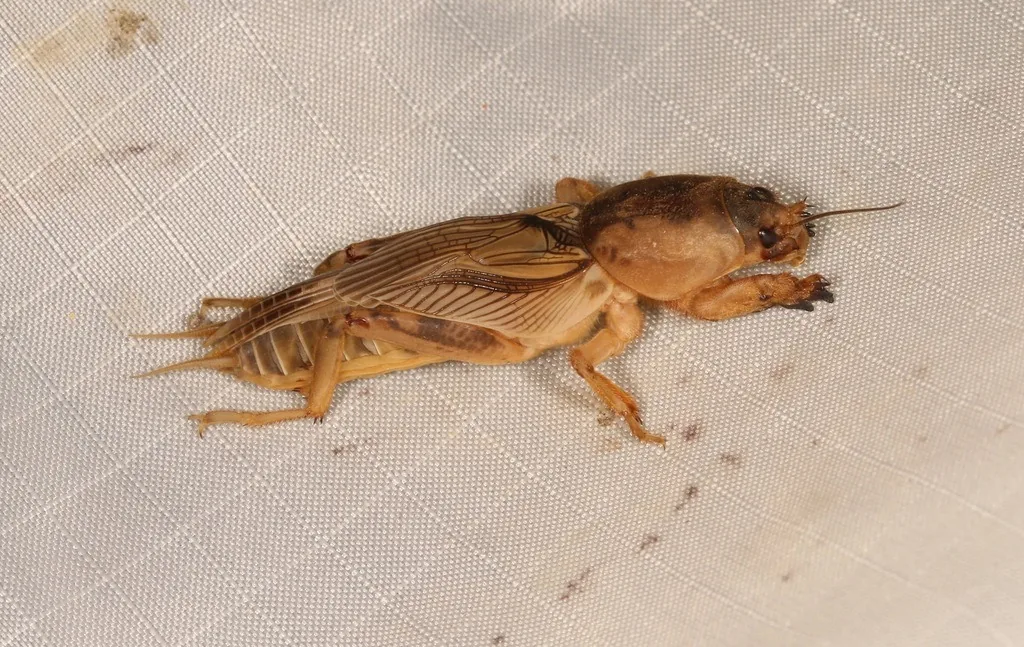
- All mole crickets have enlarged, shovel-like front legs built for digging. Texas A&M gives adults of both pest species as about 1 1/4 inches long; Clemson gives 1 1/2 to 2 inches for the tawny mole cricket and 1 to 1 1/2 inches for the smaller southern mole cricket.[4][1]
- Nymphs look much like small adults but lack fully formed wings; newly hatched nymphs are about 1/4 inch long and grow wing pads as they molt six to eight times.[4][1]
- The southern mole cricket is dull dark brown to almost black, with four light spots on the shield behind the head and a wide U-shaped gap between the two digging claws.[4][1]
- The tawny mole cricket is tan, with a mottled brown shield and no light spots, and its two digging claws nearly touch at the base, forming a narrow V.[4][1]
- A third introduced species, the shortwinged mole cricket, can be a problem in Florida and Georgia.[2]
- UF/IFAS gives adults as 22–33 mm long. The shortwinged mole cricket has forewings shorter than the shield behind its head, so it cannot fly; tawny and southern adults have long wings and are told apart by the spacing of the digging claws.[6][5]
- The males' calls differ: the southern mole cricket gives a low ringing trill at about 50 pulses per second in the first two hours after sunset, and the tawny a loud nasal trill at about 130 pulses per second in the first 90 minutes.[5]
Look-alikes
Where it lives
Tawny and southern mole crickets occur from North Carolina south to Florida and west to Texas and are worst in sandy coastal-plain soils; the southern mole cricket reaches farther inland. In Texas it is established east of a line from Corpus Christi through San Antonio to Fort Worth. Isolated populations also occur in Arizona and California, where researchers reported the first southern mole crickets found in California in 2014. UF/IFAS says the shortwinged mole cricket was first seen at Tampa in 1899, the southern at Brunswick, Georgia, in 1904 and the tawny at Brunswick in 1899. The flightless shortwinged species stays mostly in southern Florida and the southern Georgia-northeast Florida area, plus Puerto Rico and the Virgin Islands; the southern mole cricket has also been reported in Yuma, Arizona, and Los Angeles County, California.[2][4][3][7][5]
Biology and life cycle
In the Carolinas and Texas they have one generation a year; Clemson notes two or more generations farther south. Texas A&M says most tawny mole crickets overwinter as adults and most southern mole crickets as nymphs.[1][2][4]
Adults fly and mate in spring, with dispersal flights just after sunset. Males call from a funnel-shaped chamber that opens at the soil surface for about an hour after sunset, and they tend to use the same parts of a lawn year after year.[4][1][2]
Females lay clusters of eggs in chambers in the top foot of soil. Clemson's turf IPM page says two to five clusters of 25 to 60 eggs; the Clemson home-lawn fact sheet says about 35 eggs per cluster and 100 to 150 in all. Eggs hatch in about 10 to 40 days, depending on soil temperature.[2][1]
They are most active in warm, wet soil. When the soil dries they dig deeper, and in winter they move deeper still; damage often happens at night as they tunnel up to the surface to feed.[1][4]
The tawny mole cricket feeds mainly on grass roots and shoots. The southern mole cricket is mostly a predator of small soil animals such as earthworms and insects; Texas A&M puts its diet at about 80 percent animal food.[1][2][4][3]
UF/IFAS says the number of nymphal instars is variable, probably eight to 10, and that tunnels usually lie within the upper 20 to 25 cm of soil. In southern Florida the southern mole cricket has two generations, with flights in spring, summer and autumn.[5]
Rain after a long dry spell increases the number of mole crickets flying and drawn to lights, UF/IFAS says, and flying adults often burrow into moist soil near lights or sprinkler heads to mate and lay eggs, so new infestations can start there.[6]
Damage and signs
- Tunneling uproots turf so that it dries out, and it can break up pre-emergent herbicide barriers. Small nymphs do little visible harm; the worst damage shows up in late summer and early fall as nymphs near full size.[2][4][1]
- Bermudagrass is the grass most often hit, but zoysiagrass, centipedegrass and creeping bentgrass are damaged too, and no turfgrass is immune. NC State notes that coarser bermudagrass varieties are less susceptible than fine-textured hybrids.[4][2][3]
- Sand-based athletic fields and golf courses are especially hard hit because the crickets tunnel easily in sandy soil, and tunneling is most damaging on closely managed turf such as golf greens.[4][1]
- UF/IFAS says bahiagrass, bermudagrass and seashore paspalum are the most susceptible turfgrasses, while centipedegrass, St. Augustinegrass and zoysiagrass are least often injured; no grass is completely resistant. Damage is worse at irrigated sites.[6]
- In vegetables they feed on roots and stems and often girdle seedlings; tomato, pepper, cabbage, lettuce and many other crops are listed as injured. Armadillos and other predators digging for them can damage turf too.[6][5]
Health risk
Extension sources describe mole crickets as turf pests whose harm is tunneling and root feeding; none of the sources here reports a health risk to people or pets.[1][3][4]
Control
Prevention
Confirm them with a soapy-water flush on the edge of the damage. Texas A&M uses 1 tablespoon of lemon-scented liquid dish detergent per gallon of water; Clemson uses 1 to 2 fluid ounces of dish soap per gallon poured over about 2 square feet. Mole crickets come to the surface quickly if present.[4][1]
Keep the lawn healthy with soil testing, correct fertilizing, watering and mowing height; raising the mowing height can help mask damage.[1][2]
Map the areas where you find them, since mole crickets return to the same spots each year, and spot-treat only those areas.[1][2]
Biological control
Introduced natural enemies include a parasitic Larra wasp, which has spread on its own in the Southeast and cannot be bought, a parasitic fly and the mole cricket nematode Steinernema scapterisci. Lab work shows the nematode infects and kills pest mole crickets and is compatible with several turf insecticides.[2][3][8][9][10]
UF/IFAS says the Larra wasp, released in south Florida in 1981 and north Florida in 1988, attacks only Neoscapteriscus mole crickets and does not sting people. It needs nectar from plants such as larraflower, white pentas or partridge pea and will forage at least 200 yards from them. The mole cricket nematode was applied across Florida as a biopesticide until 2012, and golf courses with the Brazilian red-eyed fly have considerably less damage.[6]
Pesticides
Time insecticides for small nymphs: Clemson recommends June and July, and Texas A&M says May through July. Spring treatments of adults are not recommended unless damage is severe, because adults die after egg laying, and large fall nymphs and adults are harder to kill.[1][4][2]
Water the lawn the day before treating, since dry soil drives mole crickets deeper. Baits work best on active adults in spring and fall; do not water for 2 to 3 days after applying a bait, which would dissolve it.[1][2]
Mole crickets can detect and avoid soil treated with some insecticides, and Clemson advises alternating insecticide classes to slow resistance.[11][1]
UF/IFAS advises targeting only infested areas and rotating active ingredients by IRAC group number; on golf courses, treating fairways, greens and tees while leaving roughs untreated keeps beneficial organisms around.[6]
Where sources disagree
Size: Texas A&M gives about 1 1/4 inches for adults of both species, while Clemson gives 1 1/2 to 2 inches for tawny and 1 to 1 1/2 inches for southern mole crickets.[4][1]
Nematode products: Clemson's home-lawn fact sheet (updated 2022) calls a beneficial nematode the only commercially available biological product, while Clemson's turf IPM page says no product containing Steinernema scapterisci is currently sold.[1][2]
Most damaged grasses: Texas A&M and NC State name bermudagrass first and say zoysiagrass is damaged too, while UF/IFAS lists zoysiagrass among the least often injured, with bahiagrass, bermudagrass and seashore paspalum the most susceptible.[4][3][6]
Nymph development: UF/IFAS says the number of instars is probably eight to 10.[5]
Common questions
- How can I tell if mole crickets are damaging my lawn?
- Look for raised tunnels, loose or spongy turf and dying patches, then pour a soapy-water flush on the edge of the damage; mole crickets come to the surface within minutes if they are there.[1][4][2]
- When is the best time to treat for mole crickets?
- In early summer, roughly May through July, while nymphs are small. Large nymphs and adults in late summer and fall are much harder to control.[1][4][2]
- Why do mole crickets come back to the same spots every year?
- Adults tend to return to the same areas to mate and lay eggs, so the patches hit last year are the ones to watch and spot-treat.[1][2]
- Do Larra wasps sting people?
- No. UF/IFAS says the Larra wasp parasitizes only pest mole crickets and does not sting people, which is why it was considered safe to release.[6]
Sources
- Clemson Cooperative Extension, Home & Garden Information Center, “Mole Cricket Management in Turfgrass (HGIC 2155, updated Aug. 24, 2022).” hgic.clemson.edu/factsheet/mole-cricket-management-in-turfgrass/ (accessed 2026-11-14)
- Clemson University Turfgrass and Ornamental IPM (TandoIPM), “Mole Crickets.” blogs.clemson.edu/tandoipm/mole-crickets (accessed 2026-11-14)
- NC State Extension, “Mole Crickets in Turf (TurfFiles, 2017).” content.ces.ncsu.edu/mole-cricket-in-turf (accessed 2026-11-14)
- Texas A&M AgriLife Extension, “Tawny and Southern Mole Crickets: Identification and Control (SCSC-PU-159).” extensionentomology.tamu.edu/wp-content/uploads/2025/03/tawny-and-southern-mole-crickets-1.pdf (accessed 2026-11-14)
- University of Florida/IFAS Extension (Featured Creatures), “Shortwinged, Southern and Tawny Mole Crickets, Neoscapteriscus spp., EENY-235/IN391 (J. Capinera and N. Leppla).” ask.ifas.ufl.edu/publication/IN391 (accessed 2026-11-14)
- University of Florida/IFAS Extension (EDIS), “Mole Cricket IPM Guide for Florida, IPM-206/IN1021 (Kerr, Leppla, Buss and Frank).” ask.ifas.ufl.edu/publication/IN1021 (accessed 2026-11-14)
- Environmental Entomology, via PubMed, “Dillman et al. (2014), A modified mole cricket lure and description of Scapteriscus borellii range expansion and calling song in California.” pubmed.ncbi.nlm.nih.gov/24472207/ (accessed 2026-11-14)
- Environmental Entomology, via PubMed, “Portman et al. (2010), Nectar-seeking and host-seeking by Larra bicolor, a parasitoid of Scapteriscus mole crickets.” pubmed.ncbi.nlm.nih.gov/20550809/ (accessed 2026-11-14)
- Journal of Nematology, via PubMed, “Nguyen and Smart (1991), Pathogenicity of Steinernema scapterisci to selected invertebrates.” pubmed.ncbi.nlm.nih.gov/19283088/ (accessed 2026-11-14)
- Journal of Economic Entomology, via PubMed, “Barbara and Buss (2005), Integration of insect parasitic nematodes with insecticides for control of pest mole crickets.” pubmed.ncbi.nlm.nih.gov/16022294/ (accessed 2026-11-14)
- Pest Management Science, via PubMed, “Kostromytska et al. (2018), Behavioral responses of pest mole crickets, Neoscapteriscus spp., to selected insecticides.” pubmed.ncbi.nlm.nih.gov/28902461/ (accessed 2026-11-14)
- iNaturalist, “Neoscapteriscus vicinus taxon page (order and family).” www.inaturalist.org/taxa/558126 (accessed 2026-11-14)