On this page
How to identify it
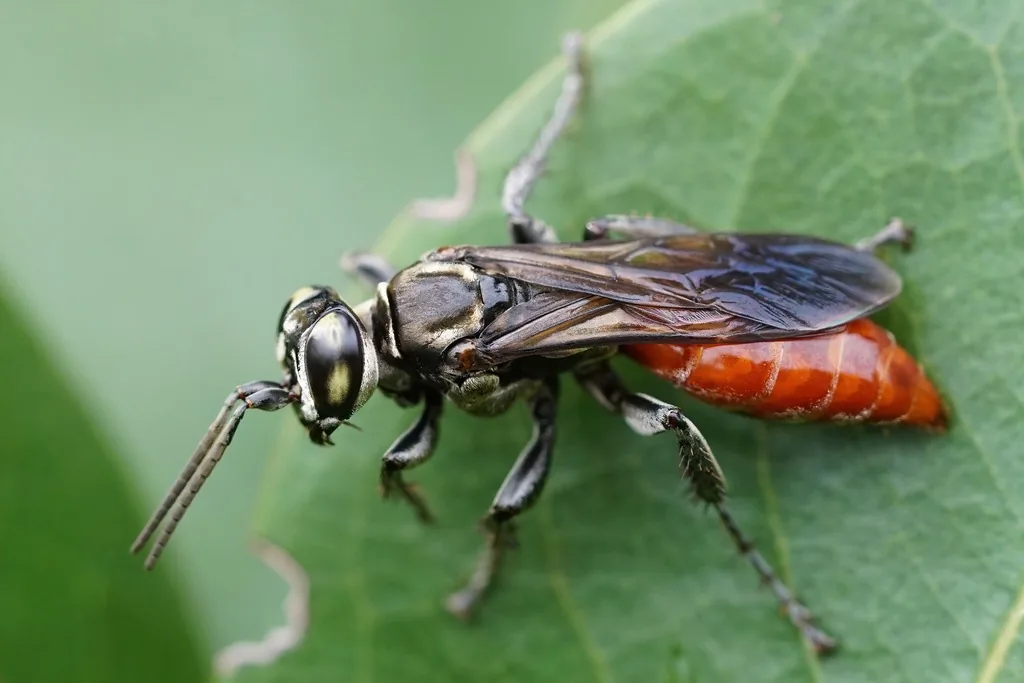
- The wasp is black with an entirely red abdomen and silvery white markings on the head; the wings are smoky brown to indigo blue.[4][6]
- Females reach about 22 mm long; males are smaller.[4]
- Females hunt in daylight in pastures and managed grass infested with mole crickets, entering the burrows and chasing the crickets into the open. Between hunts they are found on flowering plants.[1][2]
- The wasps are easily disturbed, which makes them hard to monitor. In coastal Mississippi they were seen only on the flowers of Spermacoce verticillata and pentas.[2]
- Away from flowers it is seldom seen. A hunting female runs over the ground during the brightest hours of the day, stops, runs again, and slips into mole cricket tunnels.[4]
- Wasps are also attracted to the chemical phenylacetaldehyde.[4]
Look-alikes
| Look-alike | How to tell them apart |
|---|---|
| Larra analis (native Larra wasp) | The native Larra analis is a specialist on the native northern mole cricket and does no harm to the pest Scapteriscus mole crickets, which are the only hosts of L. bicolor. UF/IFAS adds that its abdomen is only partly red, that it lays its egg behind a hind leg of the host rather than between the first and second pairs of legs, and that it is found at least as far north as Pennsylvania and as far west as Kansas.[1][4] |
Where it lives
It is native to South America. Wasps from Brazil were established in Puerto Rico in the late 1930s; Puerto Rican stock released in Florida in 1981 to 1983 settled only at Fort Lauderdale. Bolivian wasps released in and near Gainesville in 1988 and 1989 were established by late 1993 and have spread. A 2001 release at Tifton, Georgia, became established, and the wasp reached coastal Mississippi and Alabama on its own. Frank and Walker report that a 2002 release at Baton Rouge, Louisiana, failed, while Held and Abraham list Louisiana among the states where it was introduced. Because of its tropical origin, Frank and Walker doubted it would range much north of 32°N. UF/IFAS reports that the Bolivian stock was found established around Gainesville in autumn 1993 and had been detected in at least 44 Florida counties by the end of 2008. Outside Florida it has been recorded at Hilton Head (2009) and Goose Creek (2012), South Carolina, and in 2009 and 2010 at a golf course in Laurinburg, North Carolina. It has also been introduced into Hawaii.[1][2][4][5][6]
Biology and life cycle
It attacks only Scapteriscus mole crickets. Florida's three pest mole crickets, the tawny, southern and shortwinged, all belong to that South American genus.[1]
A female enters a mole cricket's burrow, forces the cricket to the surface and stings it, paralyzing it for a few minutes. She lays one egg on its underside and leaves, and the cricket revives and resumes its usual activities.[1][2]
Females hunt mole cricket adults and large nymphs.[1]
The egg hatches in 6 to 7 days. The larva feeds externally on the cricket for about 11 days, kills it when nearly full-grown, then makes a cocoon in the soil and pupates.[2][1]
Adults emerge about 6 to 8 weeks after pupation; in winter the pupa can stay underground for months. In Florida there are two to three overlapping generations a year.[2][1]
In coastal Mississippi, monitored from 2006 to 2008, adults were active from June to November, starting at about 7 a.m. in August and 9 a.m. in October and continuing until near dusk.[2]
Adults need nectar. In northern Florida, the neotropical wildflower Spermacoce verticillata (southern larraflower) was far more useful to the wasps than other plants, and in coastal Mississippi they also fed on pentas.[1][2]
Mole cricket nymphs less than about a third to half grown are not attacked; beyond that, the wasps show no preference for host size. The egg is laid between the first and second pairs of legs.[4]
UF/IFAS reports egg hatch in as little as four days in summer and about 12 to 30 days from egg-laying to pupation. The larva has five instars and feeds with its mandibles inserted into the host, then pupates in the soil among the host's remains, inside a cocoon of cemented sand grains.[4]
The pupal stage lasts a little less than 50 days in summer and many months in winter diapause; North Carolina researchers give about 50 days from egg to adult.[4][5]
In the southern United States adults have been seen from May to December, with a longer season in southern Florida, and most abundantly from September to November, usually at flowers.[4]
Recorded nectar plants include partridge pea, cowpea, goldenrod, boneset, anise, fiddler's spurge and shrubby false buttonweed (Spermacoce verticillata); what the wasps need is shallow flowers. They have also been seen in large numbers at garden peas.[4]
Damage and signs
- The wasp itself causes no damage. Its larvae kill pest mole crickets, which eat the roots and leaves of pasture and turf grasses and destroy vegetable seedlings.[1]
- Pest mole crickets in north central Florida have declined by 95 percent since the wasp and an introduced mole cricket nematode, Steinernema scapterisci, became established.[8]
Health risk
Frank and Walker describe it as a solitary wasp that does not build or defend nests by stinging intruders and is not a threat to humans. Females use their sting to paralyze mole crickets. UF/IFAS likewise describes Larra wasps as solitary wasps that have no communal nests to guard and are not aggressive.[1][4]
Control
Prevention
Leave it alone: it was deliberately imported into Florida as a biological control agent for pest mole crickets.[1][2]
Biological control
To attract and hold the wasps where mole crickets are a problem, plant nectar flowers. Frank and Walker found Spermacoce verticillata the most useful and suggest plots of it can boost local wasp numbers; it is a non-native weed, and pentas also drew wasps in Mississippi.[1][2]
UF/IFAS and the Florida Entomologist report that buckwheat is not a suitable substitute nectar plant and partridge pea works only in summer, while Spermacoce verticillata, though not native and reported as a minor weed in southern Florida, is the best attractant; plots of it have been used to spread the wasp.[4][7][8]
How it came to the United States
Three South American Scapteriscus mole crickets became pests in Florida between 1899 and 1924. The native Larra analis, which attacks the native northern mole cricket, does them no harm.[1]
Larra bicolor was taken from Brazil to Puerto Rico in the late 1930s. A Florida biological control effort in the 1940s ended once chlordane was found to control mole crickets; after the EPA banned chlordane in the 1970s, the state legislature funded a UF/IFAS mole cricket research program that began in 1978.[1]
Wasps brought from Puerto Rico in 1981 to 1983 established only at Fort Lauderdale and gave little control. Researchers then imported wasps from cooler sites in Bolivia, hoping they would be better adapted, and released them near Gainesville in 1988 and 1989.[1]
After the wasp, a parasitic fly and a mole cricket nematode spread into the Gainesville area, mole cricket numbers at two long-running trap stations fell from about 1992 to just 5 percent of their earlier baseline.[1]
Pest mole crickets reached the southeastern United States about 1900, probably as stowaways in ships' ballast. Attempts to bring Larra bicolor to Florida in the 1940s were abandoned once chlordane came into use; after chlordane was banned, the Florida Legislature ordered a UF/IFAS mole cricket research program in 1978.[4]
The Puerto Rican wasps were released at Gainesville, Tampa, Lakeland, Bradenton and Fort Lauderdale; at Fort Lauderdale they parasitized under 1% of one mole cricket species and none of the other two. Bolivian wasps, from a cooler climate, proved highly effective at two study sites near Gainesville.[4]
Native mole crickets are not at risk
Larra bicolor attacks only Scapteriscus mole crickets. The native northern mole cricket is not closely related to them and has its own native specialist wasp, Larra analis.[1]
UF/IFAS reports that the wasps fail in 90% of their attempts on the native northern mole cricket, which entangles them in a sticky secretion. In turn, the native Larra analis has not evolved to attack the pest mole crickets in the 100 years it has been exposed to them.[4]
Where the sources disagree
Egg hatch: Held and Abraham give 6-7 days; UF/IFAS says hatching may take as little as four days in summer.[2][4]
Generations: Held and Abraham give two to three generations a year in Florida, while UF/IFAS and Frank and Walker say only that there are several a year.[2][4][1]
Adult season: in coastal Mississippi Held and Abraham saw adults from June to November; UF/IFAS gives May to December for the southern United States.[2][4]
Bolivian stock: Held (2005) notes that the Bolivian release may have included two other Larra species, L. praedatrix and L. godmani, as well as L. bicolor.[6]
Common questions
- Is this wasp dangerous to people?
- Frank and Walker describe it as not social and not a threat to humans; it does not build or defend nests by stinging intruders.[1]
- How can I attract mole cricket hunters?
- Plant nectar flowers near mole cricket problems. Frank and Walker found Spermacoce verticillata far more useful to the wasp than other plants, though it is a non-native weed; pentas also attracted wasps in coastal Mississippi.[1][2]
- Do mole cricket insecticides affect the wasp?
- The sources do not test this directly. Frank and Walker's preliminary estimate that the wasp may kill about 70 percent of tawny mole crickets assumes no chemical pesticides, and they suggest golf courses that need chemicals use them on tees and greens and rely on biological control on roughs and fairways. North Carolina researchers also note that widespread insecticide treatment in recent years has significantly reduced both the mole cricket hosts and the sites available to the wasp.[1][5]
- When can I see mole cricket hunters?
- UF/IFAS reports adults from May to December in the southern United States, most abundantly from September to November, usually feeding at flowers in the brightest part of the day.[4]
Sources
- American Entomologist (Entomological Society of America); author copy on Singing Insects of North America, Orthopterists' Society, “Permanent Control of Pest Mole Crickets (Orthoptera: Gryllotalpidae: Scapteriscus) in Florida (Frank and Walker, American Entomologist 52(3):138-144, 2006).” orthsoc.org/sina/s341fw06.pdf (accessed 2026-11-14)
- USGA Turfgrass and Environmental Research Online; hosted by Michigan State University Libraries, “Biology of Larra bicolor, a Parasitoid of Mole Crickets, on Golf Courses (Held and Abraham, USGA Turfgrass and Environmental Research Online 9(4):1-10, 2010).” usgatero.msu.edu/v09/n04.pdf (accessed 2026-11-14)
- iNaturalist, “Larra bicolor taxon page (order and family).” www.inaturalist.org/taxa/451964 (accessed 2026-11-09)
- University of Florida IFAS Extension (EDIS, Featured Creatures), “Larra Wasps, Larra analis Fabricius; Mole Cricket Hunters, Larra bicolor Fabricius, EENY-268 (J. H. Frank and A. Sourakov).” ask.ifas.ufl.edu/publication/IN451 (accessed 2026-11-14)
- Florida Entomological Society (Florida Entomologist), “First Record of Larra bicolor (Hymenoptera: Crabronidae) in North Carolina (P. T. Hertl and R. L. Brandenburg), Florida Entomologist 96(3), 2013.” journals.flvc.org/flaent/article/view/82622 (accessed 2026-11-14)
- Florida Entomological Society (Florida Entomologist), “Occurrence of Larra bicolor (Hymenoptera: Sphecidae), Ectoparasite of Mole Crickets (Scapteriscus spp.), in Coastal Mississippi (D. W. Held), Florida Entomologist 88(3), 2005.” journals.flvc.org/flaent/article/view/75447 (accessed 2026-11-14)
- Florida Entomological Society (Florida Entomologist), “Nectar Sources for Larra bicolor (Hymenoptera: Sphecidae), a Parasitoid of Scapteriscus Mole Crickets, in Northern Florida (H. A. Arevalo and J. H. Frank), Florida Entomologist 88(2), 2005.” journals.flvc.org/flaent/article/view/75410 (accessed 2026-11-14)
- Florida Entomological Society (Florida Entomologist), “Management of Pest Mole Crickets in Florida and Puerto Rico with a Nematode and Parasitic Wasp (N. C. Leppla, J. H. Frank, M. B. Adjei and N. E. Vicente), Florida Entomologist 90(1), 2007.” journals.flvc.org/flaent/article/view/75637 (accessed 2026-11-14)