On this page
How to identify it
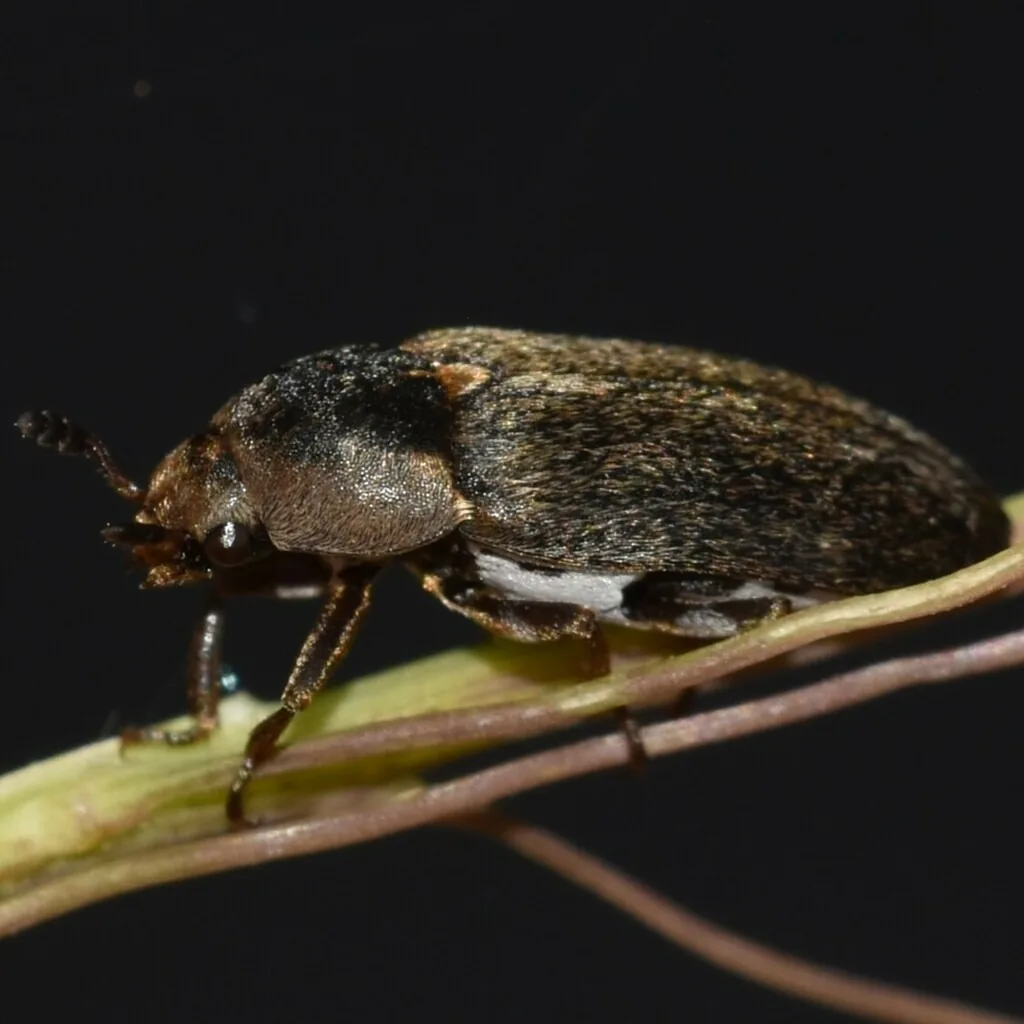
- Adults are oblong beetles with dark brown to black upper surfaces and short antennae ending in a three-segmented club. The museumpests.net sheet gives 7 to 9 mm; Colorado State gives 6 to 10 mm (1/4 to 1/3 inch) for Dermestes species in general. UF/IFAS gives 5.5 to 10.0 mm and says each side of the thorax has a band of white hairs.[2][1][3]
- The underside is white with black spots along the sides, and the pronotum is edged with white hairs. UF/IFAS adds a large black patch on the last abdominal segment.[2][3]
- A distinctive feature is the pointed tips of the wing covers. UF/IFAS says the rear edges of the wing covers are serrated and each ends in a small spine projecting straight out.[2][3]
- Larvae grow to about 12 mm and are densely covered with long and short black hairs, giving them a fuzzy look. Colorado State notes that some dermestid larvae have spines on the back of the abdomen. UF/IFAS says larvae are dark brown above, usually with a central yellow line, and yellowish brown underneath, with two long horn-like projections (urogomphi) on the last segment that curve upward and away from the tip of the abdomen.[2][1][3]
- Shed larval skins and live larvae are the usual clues to where they are breeding. UF/IFAS describes hide beetle droppings as dark brown, fibrous and stringy, resembling horse hair, and says they can show where beetles have been in the past.[1][2][3]
- Pupae are oval, usually smaller than the larvae and without their long hairs, and usually sit inside the last larval skin, UF/IFAS says.[3]
Look-alikes
| Look-alike | How to tell them apart |
|---|---|
| Larder beetle | Penn State describes the larder beetle as dark brown with the front halves of the wing covers densely covered in pale yellow hairs, usually with six dark spots in the band. The hide beetle has no band and has a white underside. UF/IFAS adds that larder beetle larvae have tail projections curving down toward the tip of the abdomen, while the hide beetle's curve upward.[4][2][3] |
| Black larder beetle | Another dark Dermestes beetle with no yellow band; Colorado State notes most Dermestes are dark. Check the underside: in the hide beetle it is white with black spots along the sides.[1][2] |
Where it lives
Found around the world in both tropical and temperate regions. Colorado State lists Dermestes species among the few dermestids most often found in homes there. UF/IFAS says it is native throughout the continental United States and Canada, and also Hawaii, and also occurs in Oceania, southeast Asia and Italy.[2][1][3]
Biology and life cycle
A female can lay hundreds of creamy white eggs, singly or in small batches on the food, and they can hatch in as little as 2 to 6 days. A 2015 study adds that the species is easy to rear, with high fecundity and a short life cycle. UF/IFAS says males secrete a pheromone from a gland at the base of the abdomen that attracts females, beetles gather on a food source to feed and mate (small food sources usually have about one to 13 beetles), and a female lays eggs in cracks of the food within 24 hours of first mating, in batches of three to 20, with lifetime totals from 198 to 845.[2][5][3]
The larval period runs from 35 to 200 days, and the pupal stage typically lasts 5 to 30 days. In a 2016 rearing study at six temperatures, larvae went through seven instars, and more than half survived in every trial. UF/IFAS says larvae pass through five to 11 instars, with more instars under unfavorable conditions.[2][6][3]
Mature larvae leave the food to dig a pupal chamber, boring into wood, cork, plaster, bone or cracks, and even tin or styrofoam. UF/IFAS says larvae look for a pupation site during the last 10 days of the final instar; without one they can delay pupation by over 20 days, at the cost of smaller adults.[2][1][3]
Adults can fly and can live about 200 days. UF/IFAS says adults typically live four to six months.[2][3]
Here's a grim fact: researchers who keep lab colonies give the larvae chunks of styrofoam to hide in, because younger larvae kill and eat larvae and pupae that have stopped moving to pupate. UF/IFAS likewise says exposed pupae that fail to find a pupal chamber are often eaten by larvae.[5][3]
Under optimum conditions the whole life cycle takes about five to seven weeks, UF/IFAS says. Full development needs temperatures consistently above 18°C; at 18°C it takes 96 days from egg to adult, while near the optimum of about 30°C adults appear in around 38 days.[3]
Because it shows up on remains in mid to late decay, forensic entomologists use it to help estimate time since death; UF/IFAS says adults generally arrive five to 11 days after death and larvae have been collected as late as day 51.[3]
Damage and signs
- Adults and larvae feed on raw skins, rawhide and carcasses, plus wool stained with sweat or blood, fur, feathers, hair, stored tobacco, cured and dried meat, fish, dry pet food, dead insects and rodents in wall voids, abandoned bird nests and inactive beehives.[2]
- Dried pet food and other meat-based materials are typical targets for beetles in this genus.[1]
- When larvae burrow out pupal chambers, they can do considerable damage to specimens and to buildings; Colorado State notes that mature larvae excavate wood beams. UF/IFAS lists timber, cork, plaster, linen and cotton among the materials larvae bore into to pupate, and says this structural damage is also a problem in the poultry industry.[2][1][3]
- It is a minor pest of the silk industry today but was once a major one: UF/IFAS says larvae bore into silkworm cocoons to eat the pupae, spoiling the cocoons for reeling, and a 20% loss in silk production was recorded in India in 1987.[3]
Health risk
It feeds on dead animal matter, and none of the sources reports bites or stings. The harm is food, pet food and stored goods fouled with larvae and shed skins, and wood or other materials bored by pupating larvae.[1][2]
Control
Prevention
Store pet food and treats in insect-proof containers, and clean up spills so beetles have nothing to breed in.[1][4]
Keep them out
Seal around windows, doors, vents and eave openings to keep flying adults from moving in from outside.[1]
Sanitation
The most reliable fix is finding and removing the infested item, often pet treats, dried meat or fish, a hide or a mount. Dead insects or rodents in wall voids and old bird nests can also be the source.[1][2]
Look for shed larval skins and live larvae to trace the breeding site; adults may wander far from it. Vacuum thoroughly around it, including cracks and crevices.[1][2]
Traps and physical control
Items you want to keep can be frozen below 0 degrees F for at least three days or heated above 130 degrees F for several hours. Penn State gives 0 degrees for 3 to 4 days, or 140 degrees for half an hour, for the closely related larder beetle.[1][4]
Pesticides
Insecticides alone don't work against dermestids; at most they back up a thorough cleanout of breeding sites. Wood that larvae have bored for pupation may also need treatment.[1][2]
Where the sources disagree
Adult size: the museumpests.net sheet gives 7 to 9 mm, Colorado State 6 to 10 mm for Dermestes species in general, and UF/IFAS 5.5 to 10.0 mm.[2][1][3]
Adult lifespan: the museumpests.net sheet says adults can live about 200 days, while UF/IFAS says they typically live four to six months.[2][3]
Common questions
- Why are hide beetles used to clean skulls?
- Their larvae eat skin and flesh, so museums use colonies to strip skeletons from zoological specimens. The museum sheet advises keeping these colonies away from collection areas. UF/IFAS says taxidermists use them to clean skulls and that they are especially useful for small, delicate bones that chemical cleaning could harm, but progress needs watching because the beetles may start eating bone if left too long without other food.[2][1][3]
- Can hide beetle larvae damage my house?
- They can. Mature larvae tunnel into wood, plaster, cork and similar materials to make a pupal chamber, and this can cause considerable damage. UF/IFAS lists timber, cork, plaster, linen and cotton.[2][1][3]
- What are the fuzzy brown worms in my dog food?
- Hairy, dark larvae in dry pet food are often dermestid beetle larvae, such as hide or larder beetles. Throw out the infested food, vacuum the area, and keep new food in sealed containers.[1][2][4]
Sources
- Colorado State University, Department of Agricultural Biology, “Dermestid beetles.” agsci.colostate.edu/agbio/ipm-pests/dermestid-beetles/ (accessed 2026-11-12)
- Integrated Pest Management Working Group, museumpests.net, “Hide Beetle, Dermestes maculatus (De Geer) fact sheet (2012).” museumpests.net/wp-content/uploads/2014/03/Hide-Beetle.pdf (accessed 2026-11-12)
- University of Florida IFAS Extension (EDIS), “Hide beetle, Dermestes maculatus DeGeer, EENY-466 (Featured Creatures; B. Shaver and P. Kaufman, November 2009; archival EDIS copy).” journals.flvc.org/edis/article/view/118300 (accessed 2026-11-14). Ask IFAS https://ask.ifas.ufl.edu/publication/IN836 returns 410 Gone (retired); this is the archived EDIS copy in the University of Florida's EDIS journal on journals.flvc.org.
- Penn State Extension, “Larder Beetle.” extension.psu.edu/larder-beetle (accessed 2026-11-12)
- EvoDevo, via PubMed Central, “Dermestes maculatus: an intermediate-germ beetle model system for evo-devo (Xiang et al. 2015).” pubmed.ncbi.nlm.nih.gov/26478804/ (accessed 2026-11-12). Cited from the open-access full text (PMC4609124).
- Journal of Forensic Sciences, via PubMed, “The effect of temperature and laboratory rearing conditions on the development of Dermestes maculatus (Zanetti, Visciarelli and Centeno 2016).” pubmed.ncbi.nlm.nih.gov/26477981/ (accessed 2026-11-12). Cited from the PubMed abstract.
- iNaturalist, “Dermestes maculatus taxon page (order and family).” www.inaturalist.org/taxa/1578850 (accessed 2026-11-12)