On this page
How to identify it
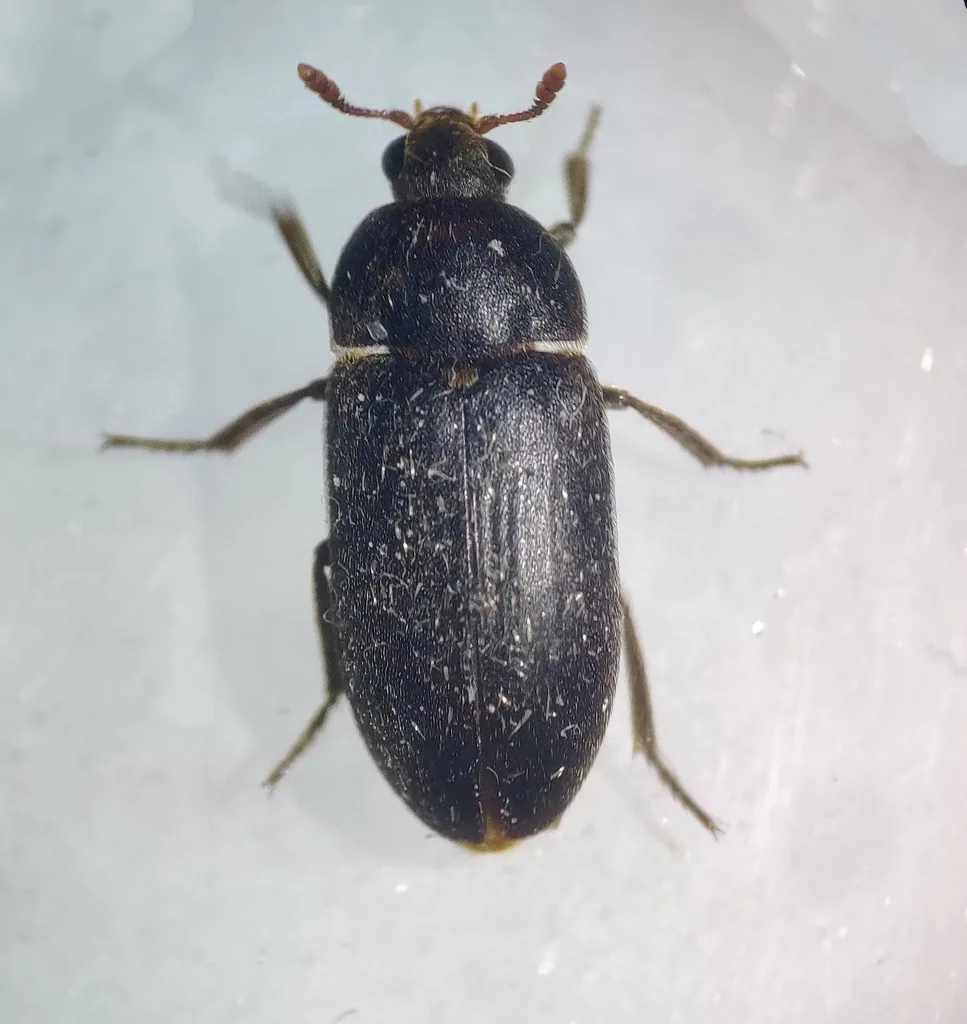
- Adults are 7 to 9 mm long, dark brown to black with no pattern on the wing covers, gray hairs on the wing covers and yellow patches on the underside. UF/IFAS says the whole body is covered with yellowish-gray hair and the underside of the abdomen is light brown with dark brown patches in the middle and on the sides. Males have a small stout bristle ringed by golden bristles on the third and fourth abdominal segments underneath, which females lack.[3][8]
- Larvae grow to about 14 mm and have a narrow, lighter stripe down the back. Dermestes larvae in general are dark reddish-brown with a tapered body. UF/IFAS describes grown larvae as reddish-brown to black, about 10 to 14 mm (1/3–1/2 in) long, with a broken yellow stripe down the middle of the back and a pair of broad-based spines (urogomphi) at the tail end that point straight up and aren't strongly curved.[3][1][8]
- Cast larval skins are a common sign, since larvae molt several times as they grow.[3][1]
- Eggs are elongate, about 1.9 mm long and 0.48 mm wide, and pearly white when first laid. Newly hatched larvae are white with rows of dark bristles and darken with each molt.[8]
- Dermestid frass is distinctive, UF/IFAS says: dark brown, dry and stringy, and its presence on attacked material is a good sign of an infestation.[8]
Look-alikes
| Look-alike | How to tell them apart |
|---|---|
| Larder beetle | The larder beetle (Dermestes lardarius) has a broad, pale tan to yellow band with black spots across the front of the wing covers; the black larder beetle has no pattern. UF/IFAS adds that the larder beetle's underside is lighter, while the black larder beetle has dark brown patches underneath, and that larder beetle larvae's tail spines point up and back, away from the body.[2][1][3][8] |
| Hide beetle | Another dark Dermestes beetle of animal materials. Colorado State notes that most Dermestes species are dark, and that species raised to clean skeletons are often called hide beetles. UF/IFAS separates the larvae by their tail spines: the hide beetle's (Dermestes maculatus) point up and inward toward the body, while the black larder beetle's point straight up.[1][8] |
Where it lives
Larder beetles are found around the world in both tropical and temperate regions. Black larder beetles have been reported from a poultry facility in Brazil, a house in Malaysia and cricket farms. UF/IFAS says it is native to North America and Hawaii but now occurs in all zoogeographical regions of the world; in Florida it has been reported from counties including Alachua, Broward, Miami-Dade, Duval, Orange and Volusia.[3][4][5][6][8]
Biology and life cycle
Larder beetles rest through winter and become active in spring. A female can lay hundreds of eggs, singly or in small batches on the food, and the eggs hatch in two weeks or less.[3]
Dermestes adults usually overwinter and fly well. Full-grown larvae leave the food to find a place to pupate and can tunnel into wood beams.[1][3]
Museums use black larder beetles to clean flesh from skeletons of zoological specimens, so museum pest specialists advise keeping these colonies apart from collections.[3][1]
Its larvae carry hastisetae: dense, detachable, barbed hairs the larvae use to defend against arthropod predators.[6]
UF/IFAS says eggs hatch in about two days at 35°C (95°F) and six days at 21°C (69.8°F). Larvae take about 19 days over six to seven instars at 35°C and 50 days over seven to nine instars at 21°C, and pupae about five and 12 days.[8]
Humidity matters too: at 25°C (77°F) larval development took 50 days at 80% relative humidity and 60 to 70 days at 40%.[8]
A female lays eggs singly or in batches of 17 to 25, and 200 to 800 in her lifetime. At 21°C, males lived up to 169 days and females up to 173.[8]
Adults and larvae are cannibalistic: UF/IFAS says adults eat larvae of all stages and pupae, and larvae eat other larvae and eggs.[8]
Damage and signs
- Food includes raw skins and hides, carcasses, bones, cured and dried meat, furs, feathers, hair, wool stained with sweat or blood, stuffed animals, stored tobacco, dead insects in wall voids, abandoned bird nests, dead rodents in walls or chimneys, inactive beehives and even rodent bait.[3][2]
- Dermestes beetles are most often linked to meat-based material, including dried pet foods.[1][2]
- Larvae that bore pupal chambers can damage museum specimens and building materials.[3][1]
- It is a pest of cricket farms. In lab tests, crickets raised with it grew more slowly at first, but not enough to explain the heavy yield losses farms report.[6]
- UF/IFAS lists cheese, dried fish, leather, copra, silk, wool and milk powder among the products it damages, though it scavenges more on dead insects and carrion. It is an important pest of museum collections and fishmeal-processing plants.[8]
- It also attacks silkworm cocoons to reach the pupae and preys on adult silkworm moths; UF/IFAS cites a 20% loss of silk production in Mysore, India.[8]
Health risk
None of the sources describes it biting or harming people. It matters to poultry: at a Brazilian poultry facility, black larder beetles carried the larval (cysticercoid) stage of the chicken tapeworm Raillietina laticanalis, and chickens fed those larvae became infected. UF/IFAS also lists it as a host of the poultry tapeworm Choanotaenia infundibulum.[4][1][8]
Control
Prevention
Vacuum up dead insects around windows and lint and hair where they gather, and store pet food in tight-fitting plastic containers.[1][2]
Keep them out
Seal cracks around windows and doors, vents and openings under the eaves, since most dermestids fly in.[1]
Screens and sealed cracks and crevices help keep beetles out; UF/IFAS lists pheromone traps and cold and heat treatment as other physical methods.[8]
Sanitation
Find and remove the breeding site; discarded larval skins and live larvae usually point to it, while adults can wander well away. Cleaning up the food source is the best approach.[1][2]
UF/IFAS says to inspect kitchens, pantries, garages and basements where cheese, meat, fish, dried pet food, insect collections and mounted animals are stored, plus attics and crawlspaces, which may hide dead insects, rodents, birds and reptiles. It calls good sanitation the best way to prevent and control it.[8]
Traps and physical control
Items that can't be thrown out can be frozen or heated to kill all stages: below 0°F, or above 130°F for several hours. Larger items need longer.[1][2]
Pesticides
Insecticides only help alongside a thorough cleanout. If the food source can't be found, Wisconsin suggests treating baseboards, outlet plates and other entry points into walls with an indoor insecticide labeled for that use; dusts are preferred in foam insulation. Follow the label.[1][2]
Foggers (bug bombs) don't reach into walls, sonic devices don't work and there are no reliable repellents.[2]
When to call a professional
For a severe infestation, UF/IFAS says fumigation may be the best method of control.[8]
Black larder beetles and decomposition
Because it feeds on carcasses, it turns up in forensic cases. On a decomposing body found in a house in Penang, Malaysia, both adults and larvae were present, and investigators judged the infestation may have begun at a fairly early stage of decomposition. UF/IFAS says its larvae help forensic scientists estimate time since death. In a summer study on pig carcasses, adults arrived as early as two days in, while larvae were present from the dry stage (15 to 36 days) to the skeletal stage; its frass can serve as an alternative DNA or toxicology sample.[5][8]
Where sources disagree
Freezing time: Colorado State says items held below 0°F for three days or more; Wisconsin gives 24 hours at 0°F for larder beetles.[1][2]
Heat: Colorado State says above 130°F for several hours; Wisconsin says 130°F for two to three hours.[1][2]
Underside: the Museum Pests Working Group says the underside has yellow patches; UF/IFAS says it is light brown with dark brown patches in the middle and on the sides.[3][8]
Larval color: the Museum Pests Working Group says yellowish brown with a narrow lighter stripe; UF/IFAS says reddish-brown to black with a broken yellow stripe.[3][8]
Common questions
- Where are black larder beetles coming from?
- Usually a hidden food source: a dead mouse or bird in a wall or chimney, an old bird nest, dead insects in wall voids, or stored meat or pet food.[3][2][1]
- What are the little skins I keep finding?
- Shed larval skins. Along with live larvae, they are the best clue to where the beetles are breeding.[1][3]
- Why is it also called the incinerator beetle?
- UF/IFAS lists incinerator beetle as another common name and says the species has been associated with incinerator-burnt waste materials.[8]
Sources
- Colorado State University Extension, “Dermestid Beetles (Carpet Beetles), Fact Sheet 5.549.” extension.colostate.edu/resource/dermestid-beetles-carpet-beetles/ (accessed 2026-11-11)
- University of Wisconsin-Madison Extension, Wisconsin Horticulture, “Larder Beetles.” hort.extension.wisc.edu/?p=1101 (accessed 2026-11-11)
- Integrated Pest Management Working Group (MuseumPests.net), “Black Larder Beetle, Dermestes ater (pest fact sheet).” es.museumpests.net/wp-content/uploads/2014/03/black-larder-beetle.pdf (accessed 2026-11-14)
- Veterinary Parasitology, via PubMed, “Studies on the influence of age in the infection of caged chickens by Raillietina laticanalis and on the susceptibility to reinfection (Ueta and Avancini 1994).” pubmed.ncbi.nlm.nih.gov/8030182/ (accessed 2026-11-11)
- Tropical Biomedicine, via PubMed, “The infestation of Dermestes ater (De Geer) on a human corpse in Malaysia (Kumara et al. 2009).” pubmed.ncbi.nlm.nih.gov/19696730/ (accessed 2026-11-11)
- Journal of Economic Entomology, via PubMed, “Farmed crickets raised with dermestids suffer from reduced and delayed growth (Muzzatti et al. 2025).” pubmed.ncbi.nlm.nih.gov/39278631/ (accessed 2026-11-11)
- iNaturalist, “Dermestes ater taxon page (order and family).” www.inaturalist.org/taxa/218262 (accessed 2026-11-11)
- University of Florida IFAS Extension, Featured Creatures, “Black Larder Beetle, Incinerator Beetle, Dermestes ater DeGeer (EENY480/IN866; N. Bujang and P. Kaufman).” ask.ifas.ufl.edu/publication/IN866 (accessed 2026-11-14)