The short answer
- Call your veterinarian right away if your pet acts sick after any flea or tick product. FDA lists dizziness, wobbliness, incoordination, poor appetite, depression, vomiting, diarrhea and excessive salivation, and says some animals have had seizures or died.[1]
- If it is a collar, take it off now. FDA says to remove a flea and tick collar immediately if your pet has a bad reaction.[1]
- Bathe only on your vet's advice. FDA says that, depending on the product, your vet may tell you to bathe the pet right away, if it is safe to do so, with mild dish soap and lots of water. Merck says skin exposure to pyrethrin or pyrethroid products is handled with a gentle bath in mild detergent and cool water.[1][7][8]
- A dog product on a cat is a common cause. EPA's veterinarians found cats exposed to dog products was an important problem because cats are more sensitive to certain pesticides, and FDA says never to use a dog product on a cat.[4][1]
- Keep the package. FDA says to save it in case you need to report a problem; the label tells you whether to report to FDA (an NADA or ANADA number) or EPA (an EPA Reg. No.).[1][3]
The pests these products target
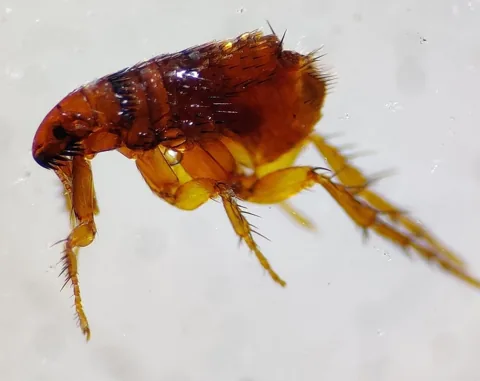 Cat Flea
Ctenocephalides felis
The cat flea is the most common external parasite of domestic cats and dogs, and the flea most often found on both. Adults spend most of their time on the pet, while eggs, larvae and pupae build up wherever the pet rests.
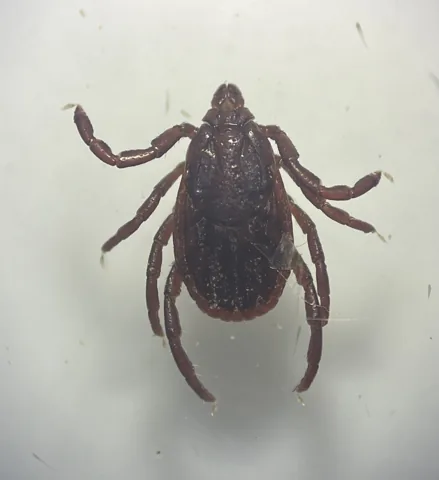 Brown Dog Tick
Rhipicephalus sanguineus
The brown dog tick is unusual: unlike most ticks, it can complete its entire life cycle indoors. It occurs across the United States, is met more often in the southern states, and can build up to high numbers on dogs and in homes and kennels. UF/IFAS Featured Creatures adds that this lets it set up populations even in colder climates.
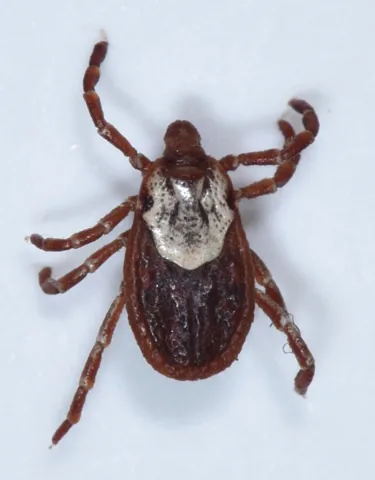 American Dog Tick
Dermacentor variabilis
The American dog tick, also called the wood tick, is widely distributed east of the Rocky Mountains. Adult females are the stage most likely to bite people, especially in spring and summer, and adults commonly climb to the crown of the head.
Signs of a reaction to watch for
FDA's list for flea and tick products in general: dizziness, wobbliness, incoordination, poor appetite, depression, vomiting, diarrhea and excessive salivation. Some animals have had seizures and some have died.[1]
EPA's review of spot-on incidents found the most commonly affected body systems were the skin, the digestive tract and the nervous system.[4]
For pyrethrin and pyrethroid products, Merck says signs involve the nervous system: excessive drooling, mild tremors, incoordination and excitability or depression, and in severe cases severe tremors and seizures. Merck lists the same broad picture for pyrethroid poisoning in dogs and cats: salivation, vomiting, hyperexcitability, tremors, seizures, trouble breathing and weakness.[7][8]
Any seizure, collapse, trouble breathing or nonstop drooling and tremors is a reason to call your vet or an emergency clinic now, not to wait and see.[1][7]
What to do first
1. Call your veterinarian right away. That is FDA's first step for a bad reaction to any spot-on, shampoo, dip or collar, and its first step for any adverse event with an isoxazoline chewable or topical.[1][2]
2. Collar: remove it immediately, FDA says.[1]
3. Spot-on, shampoo or dip on the skin: ask your vet whether to bathe. FDA says your vet may recommend an immediate bath, if it is safe to do so, using mild dish soap and rinsing with large amounts of water. Merck adds that the area should be washed gently with cool water, and that shampoos containing insecticides should not be used for this bath.[1][8]
4. Do not give oils, milk or home remedies. Merck says vegetable oils and fats promote absorption of pyrethrins from the gut and should be avoided, and that inducing vomiting is not usually recommended.[7]
5. Have the package in hand when you call. FDA says to save the packaging in case a problem occurs; it carries the active ingredients and the registration or approval number the vet, poison control or NPIC will ask for.[1][3]
For pesticide products (EPA Reg. No. on the label), NPIC answers questions at 800-858-7378, and FDA points owners there for EPA-registered products. EPA's incident page says anyone with symptoms should follow the first aid on the label and contact a health care provider or a poison control center.[6][3][5]
Cats and dog products
EPA's expert veterinarian team found that misuse or accidental exposure of cats to dog spot-ons was an important problem, that cats can be harmed by dog products because they are more sensitive to certain pesticides, and that label warnings against using dog products on cats were not working well enough.[4]
Merck says cats appear to be more sensitive to pyrethroid toxicity than other pets. Permethrin is a pyrethroid; see our page on permethrin and cats for the details rather than repeating them here.[8]
EPA also pursued label statements about cats exposed through interactions with a freshly treated dog in multi-pet homes. Keep cats away from a dog until the dog's product has dried, and follow the dog product's label on this point.[4]
FDA's rule of thumb: match the product to your pet's species, life stage and weight class, and if a product is for dogs, do not use it on cats.[1]
The FDA isoxazoline warning (chewables and some topicals)
FDA alerted pet owners and veterinarians to the potential for neurologic adverse events in dogs and cats treated with drugs in the isoxazoline class, including muscle tremors, ataxia (wobbliness) and seizures. FDA says seizures may occur in animals without a prior history.[2]
FDA lists these approved isoxazoline products: Bravecto (fluralaner) tablets for dogs; Bravecto (fluralaner) topical solution for cats and dogs; Bravecto Plus (fluralaner and moxidectin) topical solution for cats; Bravecto 1-month (fluralaner) tablets for dogs; Credelio (lotilaner) tablets for dogs and cats; Nexgard (afoxolaner) tablets for dogs; Nexgard Plus (afoxolaner, moxidectin and pyrantel) chewable tablets for dogs; Nexgard Combo (esafoxolaner, eprinomectin and praziquantel) topical solution for cats; Simparica (sarolaner) tablets for dogs; Simparica Trio (sarolaner, moxidectin and pyrantel) tablets for dogs; and Revolution Plus (selamectin and sarolaner) topical solution for cats.[2]
FDA still considers these products safe and effective for dogs and cats and says most pets have not had neurologic reactions. Its advice is to review your pet's medical history with your vet, especially a history of seizures, before choosing one.[2]
If your pet has any adverse event on an isoxazoline, FDA says to consult your veterinarian first, then report it to the manufacturer or directly to FDA.[2]
EPA or FDA: who regulates your pet's product
FDA says some flea and tick products are regulated by FDA and some by the Environmental Protection Agency, and the label tells you which.[3][2]
FDA-approved animal drugs carry a six-digit New Animal Drug Application (NADA) number, or an ANADA number for generics, in the statement 'Approved by FDA under NADA #'. The pills and chews in FDA's isoxazoline list are this kind.[3][2]
EPA-registered pesticide products carry 'EPA Reg. No.' on the back panel, usually near the manufacturer's address. EPA says it regulates the pet spot-on products and that companies must report pet incident data to it.[3][4]
Flea and tick products come as pills and chews, collars, sprays, dips, shampoos, powders and spot-ons squeezed onto the skin, FDA says. The form does not tell you the agency; the number on the label does.[1][3]
What EPA's spot-on review found
EPA formed an expert veterinarian team and reviewed the analysis with FDA's Center for Veterinary Medicine and Health Canada's Pest Management Regulatory Agency. The findings are in EPA's Review of Enhanced Reporting of 2008 Pet Spot-on Incidents.[4]
Findings: most incidents were minor but some deaths and major incidents occurred; small-breed dogs were affected more than larger breeds for some products; cats exposed to dog products were an important problem; and the required safety testing did not accurately predict the toxicity seen in the incidents.[4]
EPA found most but not all incidents happened because products were misused. It concluded the products could be used safely with added restrictions: narrower pet weight ranges per vial, clearer labels separating dog and cat products, and larger fonts and pictograms.[4]
What that means at home: weigh your pet, buy the size band that matches, read the label every time (FDA says directions and warnings may have changed), and talk to your vet before treating a weak, old, medicated, sick, pregnant or nursing pet, or one that reacted before.[4][1]
How to report a reaction
FDA-approved drug (NADA or ANADA number): FDA recommends calling the drug company. The company is required to send the report to FDA's Center for Veterinary Medicine and gives it a case number you can request.[3]
To report straight to FDA, use Form FDA 1932a, 'Veterinary Adverse Experience, Lack of Effectiveness or Product Defect Report', which covers any animal drug or device. Questions go to AskCVM@fda.hhs.gov or 1-888-FDA-VETS (1-888-332-8387).[3]
For isoxazolines specifically, FDA says you can report to the manufacturer, which must pass the report to FDA, or directly to FDA; the makers' contact numbers are on FDA's isoxazoline fact sheet and the product package.[2]
EPA-registered product (EPA Reg. No.): FDA directs owners to the National Pesticide Information Center at 800-858-7378. EPA's incident reporting page has a dedicated route for pets and domestic animals, and EPA says registrants must report pet incident data to it.[3][5][4]
Have ready: the product name and registration or approval number, your pet's species and weight, how and when it was applied, the signs you saw and your vet's contact details. FDA notes the company may contact your vet for more information.[3][1]
Common questions
- Should I wash off a spot-on my pet is reacting to?
- Call your vet first. FDA says that, depending on the product, your vet may recommend an immediate bath, if it is safe to do so, with mild dish soap and plenty of water. Merck says to wash gently with cool water and not to use an insecticidal shampoo.[1][8]
- Are flea and tick pills safer than spot-ons?
- Neither form is risk-free. FDA lists the isoxazoline pills and chews with a class warning for tremors, wobbliness and seizures, and EPA's review found harm from some spot-ons. Pick with your vet based on your pet's history.[2][4]
- My cat licked the dog's flea treatment. What now?
- Call your vet or a poison control center now and have the dog product's package with you. EPA found cats exposed to dog products was an important problem because cats are more sensitive to certain pesticides.[4][5]
- Is drooling after a flea product an emergency?
- Excessive salivation is on FDA's list of reaction signs, and Merck lists drooling with tremors and incoordination for pyrethrin and pyrethroid products. Call your vet right away to ask.[1][7]
- Does reporting a reaction do anything?
- Yes. FDA says it uses adverse event reports to monitor products after they reach the market, and EPA's spot-on review used pet incident reports to require label and packaging changes.[3][4]
Photo credits
- Cat Flea: (c) Thomas Gyselinck, some rights reserved (CC BY) — via iNaturalist, CC BY 4.0
- Brown Dog Tick: (c) NoahM, some rights reserved (CC BY) — via iNaturalist, CC BY 4.0
- American Dog Tick: (c) Don Loarie, some rights reserved (CC BY) — via iNaturalist, CC BY 4.0
Sources
- U.S. Food and Drug Administration, “Safe Use of Flea and Tick Products in Pets.” www.fda.gov/consumers/consumer-updates/safe-use-flea-and-tick-products-pets (accessed 2026-11-15)
- U.S. Food and Drug Administration, Center for Veterinary Medicine, “Fact Sheet for Pet Owners and Veterinarians about Potential Adverse Events Associated with Isoxazoline Flea and Tick Products.” www.fda.gov/animal-veterinary/animal-health-literacy/fact-sheet-pet-owners-and-veterinarians-about-potential-adverse-events-associated-isoxazoline-flea (accessed 2026-11-15)
- U.S. Food and Drug Administration, Center for Veterinary Medicine, “How to Report Animal Drug and Device Side Effects and Product Problems.” www.fda.gov/animal-veterinary/report-problem/how-report-animal-drug-and-device-side-effects-and-product-problems (accessed 2026-11-15)
- U.S. Environmental Protection Agency, “EPA Evaluation of Pet Spot-on Products: Analysis and Plans for Reducing Harmful Effects.” www.epa.gov/pets/epa-evaluation-pet-spot-products-analysis-and-plans-reducing-harmful-effects (accessed 2026-11-15)
- U.S. Environmental Protection Agency, “Reporting Unintended Exposure and Harm from Pesticides (Incidents).” www.epa.gov/pesticide-incidents (accessed 2026-11-15)
- National Pesticide Information Center, “Pesticide Use Around Pets.” npic.orst.edu/health/pets.html (accessed 2026-11-15)
- Merck Veterinary Manual, “Insecticide Poisoning (Pet Owners).” www.merckvetmanual.com/special-pet-topics/poisoning/insecticide-poisoning (accessed 2026-11-15)
- Merck Veterinary Manual, “Plant-Derived Insecticide Toxicosis in Animals.” www.merckvetmanual.com/toxicology/insecticide-and-acaricide-organic-toxicity/plant-derived-insecticide-toxicosis-in-animals (accessed 2026-11-15)