The short answer
- Check an outdoor cat every day. CDC says to feel through the fur for small bumps and to look in and around the ears, around the eyelids, under the collar, under the front legs, between the back legs, between the toes and around the tail.[13][12]
- Remove a tick right away with tweezers, never bare fingers. Merck says to grasp the tick close to the skin and pull gently, and to avoid hot matches. Take a heavily infested cat to the vet for removal.[1][12]
- Never put a dog tick product on a cat. Merck says some products that work well on dogs are dangerous for cats, EPA found cats are more sensitive to certain pesticides, CDC says permethrin should not be used on cats, and FDA says a product for dogs should not be used on cats.[1][10][16][9]
- Call your vet now if your cat seems depressed or lethargic, stops eating, has a fever, breathes hard or looks jaundiced after time outdoors in tick season. Merck lists these as signs of cytauxzoonosis, a tick-borne disease that is often fatal.[2][3]
- Ask your vet which cat tick product to use. CDC says cats are extremely sensitive to a variety of chemicals and to ask your veterinarian before applying any tick product, and Merck says to get a prescription or recommendation from your vet.[15][1]
Ticks that bite cats
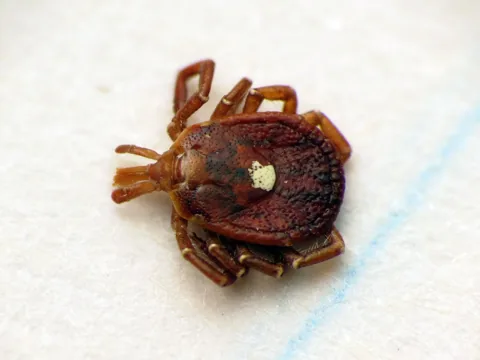 Lone Star Tick
Amblyomma americanum
The lone star tick is a very aggressive tick that readily bites people and pets across the Northeast, South and Midwest; its bite is linked to alpha-gal syndrome, a red meat allergy.
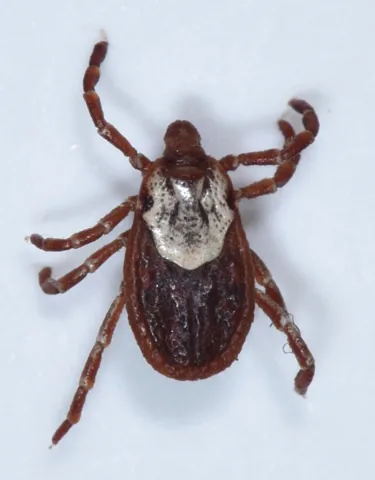 American Dog Tick
Dermacentor variabilis
The American dog tick, also called the wood tick, is widely distributed east of the Rocky Mountains. Adult females are the stage most likely to bite people, especially in spring and summer, and adults commonly climb to the crown of the head.
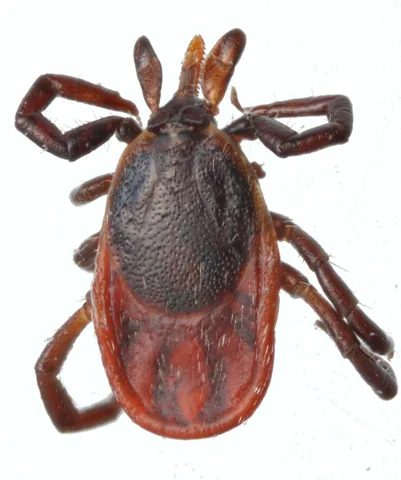 Blacklegged Tick
Ixodes scapularis
The blacklegged tick, often called the deer tick, is widely distributed across the eastern United States and spreads the bacteria that cause Lyme disease along with several other infections.
Which cats get ticks
Merck says ticks are much less commonly found on cats than on dogs, but cats that spend time outdoors, especially in wild areas, are often affected.[1]
CDC says dogs and cats often come into contact with ticks outside, and that pets can carry ticks into the home where the ticks may then bite people.[12]
Merck says most ticks live in particular spots such as tall grass or the border between woods and lawn, and that keeping animals away from tick-prone areas is the most effective way to limit exposure.[1]
Tell your vet whether your cat is indoor, outdoor or both. CDC says to share your cat's lifestyle and to ask about the best tick prevention products and the tick-borne diseases in your area.[15]
Where ticks hide on a cat
Run your fingers through the fur with gentle pressure to feel for small bumps, CDC says, and check pets that go outdoors every day.[13][12]
CDC's pet tick check lists these spots: in and around the ears, around the eyelids, under the collar, under the front legs, between the back legs, between the toes and around the tail.[13]
A new tick is flat. Merck says ticks that have been on an animal only a short time look flat, while ticks that have fed for days look much more rounded from the blood they have taken in.[1]
CDC says ticks on a pet can be hard to spot, especially on animals with long and dark fur.[12]
Removing a tick from a cat
Use tweezers. Merck says to grasp the tick carefully close to the skin and pull gently, and never to remove a tick with bare hands, because some tick-borne germs can pass through breaks in the skin.[1]
Don't use heat. Merck says the use of hot matches should be avoided, and CDC says petroleum jelly, heat, nail polish and other substances may agitate a tick and push infected fluid into the skin.[1][14]
CDC's tick removal steps for people also apply to the tick itself: pull with steady, even pressure without twisting or jerking, dispose of a live tick in a sealed container, in tape, in alcohol or down the toilet, never crush it with your fingers, and wash the bite area and your hands afterward.[14]
If your cat won't hold still, or has many ticks, let the vet do it. Merck says a severely infested cat should be taken to a veterinarian for tick removal, and that heavy infestations can damage the skin and cause anemia, paralysis or other complications.[1]
Our dog tick removal guide covers tools and what to do if mouthparts stay in the skin in more detail.[14]
What to watch for afterward
Watch the spot. Merck says that if a tick bite turns red or swollen, a prompt trip to the veterinarian is warranted.[1]
Merck says that even if your cat had only a few ticks, you should have it checked for the many diseases ticks spread.[1]
CDC says to watch a pet closely for changes in behavior or appetite if you know or suspect it was bitten by a tick.[12]
Cytauxzoonosis (bobcat fever): a tick-borne emergency
Cytauxzoonosis is caused by the parasite Cytauxzoon felis. Merck calls it a life-threatening infectious disease of domestic cats and says the parasite lives in bobcats and spreads to cats by ticks.[2][3]
Merck says the lone star tick is the main tick that spreads it to cats. Spread by the American dog tick has been reported under experimental conditions, but that tick is considered a less effective vector.[2]
Where: Merck says it occurs mainly in wooded areas of the southern and southeastern United States when ticks are active, and has reported it in Missouri, Arkansas, Florida, Georgia, Louisiana, Mississippi, Oklahoma, Texas, Kentucky, Kansas, Tennessee, North Carolina, South Carolina, Nebraska, Iowa, Virginia and Illinois, with anecdotal reports from Alabama and Ohio.[3][2]
When: Merck says it is typically diagnosed from April through September, matching lone star tick activity, and can occur earlier in spring or later in fall depending on the climate.[2]
Highest risk: Merck says cats living near heavily wooded, low-density residential areas close to natural or unmanaged habitat, where both ticks and bobcats may be nearby, are at highest risk.[2]
Signs: Merck lists high fever, weakness, depression, lethargy, dehydration, trouble breathing, loss of appetite and jaundice. Cats close to death may have a low body temperature and cry out as if in pain. Treat any of these after possible tick exposure as an emergency and call your vet now.[3][2]
Merck says cytauxzoonosis is confirmed with blood tests, that newer aggressive treatment has improved survival but the disease remains very serious, and that some cats do survive. Merck says it does not appear to spread from cat to cat without ticks.[3][2]
Prevention: Merck says routine use of a tick preventive is recommended and to use vet-recommended tick control and avoid tick-infested areas, but notes that disease has occurred in cats despite topical products alone.[2][3][1]
Other tick diseases in cats
Tularemia: Merck says cats are at higher risk than many other domestic animals because they hunt, and that cats can catch it from tick, flea or deer fly bites or from infected prey such as rabbits. Signs can include sudden high fever, swollen glands, lethargy, poor appetite and open sores in the mouth and throat.[7][8]
Tularemia can spread to people. Merck says the bite of a cat that has recently fed on an infected animal has rarely been a source of human infection, and CDC lists tick bites and contact with infected animals among the ways people get it.[7][17]
Lyme disease: Merck lists cats among the animals that get Lyme borreliosis, but says its clinical signs, well documented in dogs and horses, are less common in cats.[6]
Babesiosis: Merck says cats are susceptible to these tick-borne blood parasites, but that illness from Babesia felis in domestic cats has mostly been reported in southern Africa.[4]
Tick paralysis: Merck lists cats among the animals affected by tick paralysis, and names the American dog tick and the Rocky Mountain wood tick as the most common causes in North America. Our tick paralysis page covers the signs and how to find the tick.[5]
Anemia: Merck says severe tick infestations can lead to anemia and death, and that ticks also release toxins and leave wounds that can become infected.[1]
Never use dog tick products on cats
Merck says care is needed in choosing a tick product because some products work well on dogs but are dangerous for cats.[1]
EPA's veterinary team found that misuse or accidental exposure of cats to dog products was an important problem, that cats can be harmed by dog products because they are more sensitive to certain pesticides, and that label warnings against using dog products on cats are not working well enough.[10]
Permethrin is the best-known example. CDC says permethrin should not be used on cats; our permethrin page covers the signs of poisoning and what to do.[16]
FDA says to make sure a product matches your pet's species, life stage and weight class, not to use a dog product on a cat, and, for a kitten, to use only a product labeled for that life stage.[9]
In homes with dogs and cats, FDA says to apply a spray or spot-on to one pet at a time and keep the treated animal apart until it dries, especially when the product is for dogs only and there is a cat in the house, so the cat can't groom it off the dog.[9]
EPA says to always read the label first before you buy, store or use a pesticide product, to follow all label instructions and precautions, and to keep products out of reach of pets.[11]
Talk to your vet first, especially for weak, old, medicated, sick, pregnant or nursing cats or a cat that has reacted before, FDA says.[9]
Keeping ticks off your cat
Use a tick product your vet recommends for cats. Merck says to contact your veterinarian for a prescription or a recommendation for the best tick control product for your pet, and CDC says not to apply any tick product to a cat without asking your vet first.[1][15]
Merck says spot-on solutions, sprays and dusts are among the cat tick products that kill larvae, nymphs and adults; the right choice depends on your cat, so ask your vet.[1]
Make the yard less tick friendly. Merck says removing tall grass and weeds and trimming vegetation can help protect your animal; see our yard tick control guide.[1]
Limit time in tick habitat. Merck says keeping animals away from tick-prone areas is the most effective step you can take.[1]
Check daily and remove any tick right away, CDC says.[12][13]
Your cat's ticks and your family
CDC says pets can bring ticks into the home, where the ticks may then bite people, and that a daily tick check on pets may keep crawling ticks from getting onto a person.[12]
Merck says some tick-borne germs can pass through breaks in the skin or contact with mucous membranes, which is why you should never pull a tick off a cat with bare hands.[1]
If you get a tick bite, see our page on what to do after a tick bite.[14]
Common questions
- Can indoor cats get ticks?
- It is less likely, but possible. Merck says ticks are much less common on cats than on dogs and are mostly found on cats that go outdoors, and CDC says pets that go outside can carry ticks into the home.[1][12]
- Can I use my dog's tick medicine on my cat?
- No. Merck says some products that work well on dogs are dangerous for cats, EPA says cats are more sensitive to certain pesticides, CDC says permethrin should not be used on cats, and FDA says a dog product should not be used on a cat.[1][10][16][9]
- What is bobcat fever?
- It is a common name for cytauxzoonosis, a tick-borne disease of cats caused by a parasite that lives in bobcats. Merck says the lone star tick is the main vector, that it is life-threatening, and that it occurs mainly in the southern and southeastern US when ticks are active. Call your vet at once if your cat gets a fever, stops eating or seems very sick.[2][3]
- How do I get a tick off my cat?
- Merck says to use tweezers to grasp the tick close to the skin and pull gently, never to use bare hands or hot matches, and to let a vet remove ticks from a heavily infested cat.[1]
- Should my cat see a vet after a tick bite?
- Merck says to have even a cat with only a few ticks checked for tick-borne diseases, and to go promptly if the bite turns red or swollen. CDC says to watch for changes in behavior or appetite.[1][12]
Photo credits
- Lone Star Tick: (c) Katja Schulz, some rights reserved (CC BY) — via iNaturalist, CC BY 4.0
- American Dog Tick: (c) Don Loarie, some rights reserved (CC BY) — via iNaturalist, CC BY 4.0
- Blacklegged Tick: (c) Christian Back, some rights reserved (CC BY) — via iNaturalist, CC BY 4.0
Sources
- Merck Veterinary Manual, “Ticks of Cats (Pet Owner Version).” www.merckvetmanual.com/cat-owners/skin-disorders-of-cats/ticks-of-cats (accessed 2026-11-15)
- Merck Veterinary Manual, “Cytauxzoonosis in Cats.” www.merckvetmanual.com/circulatory-system/blood-parasites/cytauxzoonosis-in-cats (accessed 2026-11-15)
- Merck Veterinary Manual, “Diseases Caused by Blood Parasites in Cats (Pet Owner Version).” www.merckvetmanual.com/cat-owners/blood-disorders-of-cats/blood-parasites-of-cats (accessed 2026-11-15)
- Merck Veterinary Manual, “Babesiosis in Animals.” www.merckvetmanual.com/circulatory-system/blood-parasites/babesiosis-in-animals (accessed 2026-11-15)
- Merck Veterinary Manual, “Tick Paralysis in Animals.” www.merckvetmanual.com/nervous-system/tick-paralysis/tick-paralysis-in-animals (accessed 2026-11-15)
- Merck Veterinary Manual, “Lyme Borreliosis in Animals.” www.merckvetmanual.com/generalized-conditions/lyme-borreliosis/lyme-borreliosis-in-animals (accessed 2026-11-15)
- Merck Veterinary Manual, “Tularemia in Cats (Pet Owner Version).” www.merckvetmanual.com/cat-owners/disorders-affecting-multiple-body-systems-of-cats/tularemia-in-cats (accessed 2026-11-15)
- Merck Veterinary Manual, “Tularemia in Animals.” www.merckvetmanual.com/generalized-conditions/tularemia/tularemia-in-animals (accessed 2026-11-15)
- U.S. Food and Drug Administration, “Safe Use of Flea and Tick Products in Pets.” www.fda.gov/consumers/consumer-updates/safe-use-flea-and-tick-products-pets (accessed 2026-11-15)
- U.S. Environmental Protection Agency, “EPA Evaluation of Pet Spot-on Products: Analysis and Plans for Reducing Harmful Effects.” www.epa.gov/pets/epa-evaluation-pet-spot-products-analysis-and-plans-reducing-harmful-effects (accessed 2026-11-15)
- U.S. Environmental Protection Agency, “Read the Label First: Protect Your Pets.” www.epa.gov/pets/read-label-first-protect-your-pets (accessed 2026-11-15)
- Centers for Disease Control and Prevention, “Preventing Ticks on Pets.” www.cdc.gov/ticks/prevention/preventing-ticks-on-pets.html (accessed 2026-11-15)
- Centers for Disease Control and Prevention, “How to Check Your Pet for Ticks.” www.cdc.gov/healthy-pets/media/pdfs/publications/check-pets-for-ticks-508.pdf (accessed 2026-11-15)
- Centers for Disease Control and Prevention, “What to Do After a Tick Bite.” www.cdc.gov/ticks/after-a-tick-bite/index.html (accessed 2026-11-15)
- Centers for Disease Control and Prevention, “Cats: Healthy Pets, Healthy People.” www.cdc.gov/healthy-pets/about/cats.html (accessed 2026-11-15)
- Centers for Disease Control and Prevention, “About Flea-borne Typhus.” www.cdc.gov/typhus/about/murine.html (accessed 2026-11-15)
- Centers for Disease Control and Prevention, “About Tularemia.” www.cdc.gov/tularemia/about/index.html (accessed 2026-11-15)