The short answer
- Sudden wobbly walking or leg weakness that spreads upward over hours or days, in a child or a dog that has been outdoors in spring or early summer, can be tick paralysis. MedlinePlus says the weakness starts in the lower body and moves up.[7][1]
- The fix is finding and removing the tick. CDC's 2006 report says the diagnosis is confirmed by finding an embedded tick and seeing improvement after it is removed; MedlinePlus says recovery is rapid once it is out.[1][7]
- Search the scalp and hairline first. CDC notes the tick is often hidden in the hair on the head or neck; in dogs, Merck says ticks deep in the ear, between the toes, or in the mouth or anus can be missed.[2][11]
- Trouble breathing, swallowing or speaking is an emergency: call 911 for a person or go to an emergency vet for a pet. MedlinePlus says breathing difficulties need emergency care, and Merck says death can occur from paralysis of the breathing muscles if ticks are not removed.[7][12]
- In the US it is mostly caused by the Rocky Mountain wood tick and the American dog tick, CDC and Merck say, with most cases from April to June in the West.[1][11]
Ticks linked to tick paralysis
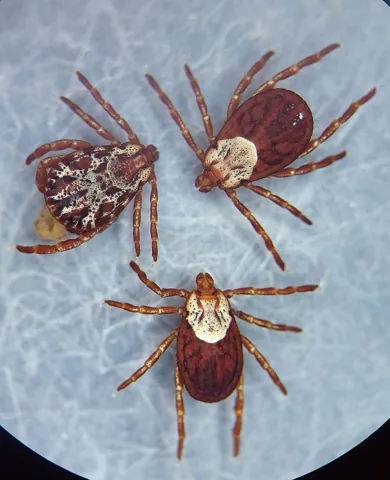 Rocky Mountain Wood Tick
Dermacentor andersoni
The Rocky Mountain wood tick is the tick most often found on people and pets in Colorado and Utah. It is most active in spring, then goes dormant as the weather turns hot and dry, and it is the vector of Colorado tick fever.
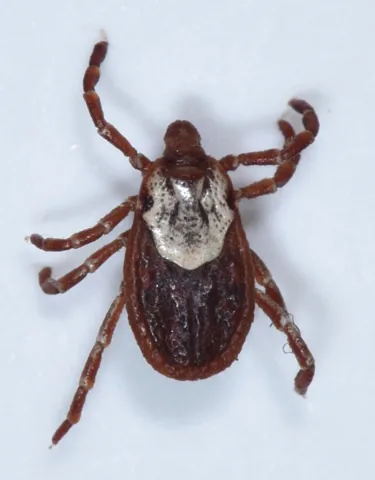 American Dog Tick
Dermacentor variabilis
The American dog tick, also called the wood tick, is widely distributed east of the Rocky Mountains. Adult females are the stage most likely to bite people, especially in spring and summer, and adults commonly climb to the crown of the head.
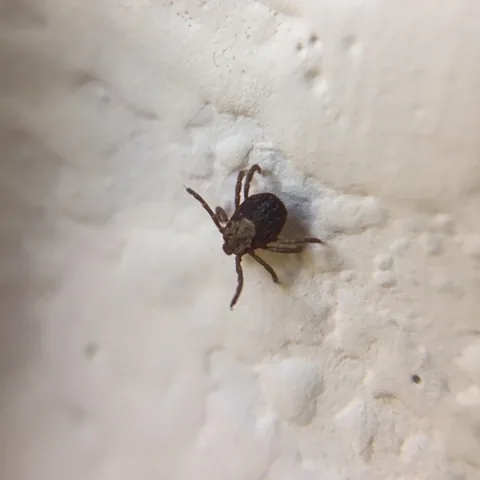 Pacific Coast Tick
Dermacentor occidentalis
The Pacific Coast tick is one of the most widespread ticks in California and a frequently reported human biter. It is the primary vector of Pacific Coast tick fever, a spotted fever related to Rocky Mountain spotted fever.
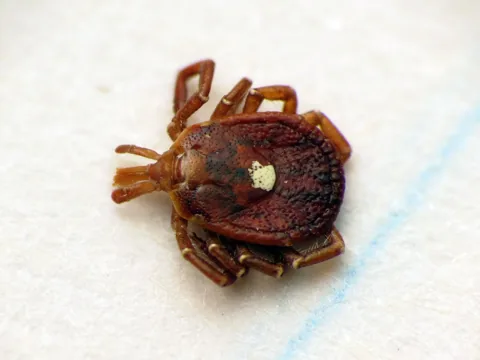 Lone Star Tick
Amblyomma americanum
The lone star tick is a very aggressive tick that readily bites people and pets across the Northeast, South and Midwest; its bite is linked to alpha-gal syndrome, a red meat allergy.
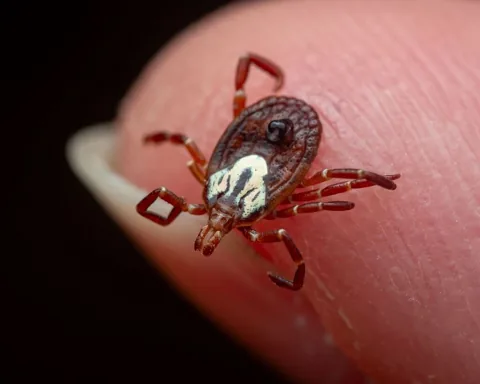 Gulf Coast Tick
Amblyomma maculatum
The Gulf Coast tick is a hard tick of grass prairies, coastal uplands and shrubby, recently disturbed ground with little or no tree cover. Adults bite people, and it is the principal carrier of Rickettsia parkeri, which causes a form of spotted fever, and of the parasite behind American canine hepatozoonosis in dogs.
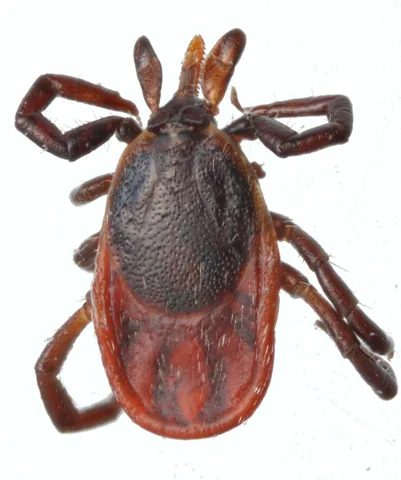 Blacklegged Tick
Ixodes scapularis
The blacklegged tick, often called the deer tick, is widely distributed across the eastern United States and spreads the bacteria that cause Lyme disease along with several other infections.
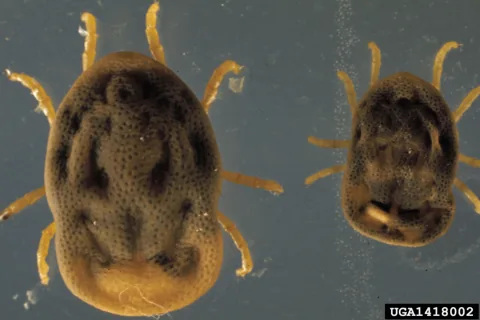 Spinose ear tick
Otobius megnini
The spinose ear tick is a soft tick whose larvae and nymphs live deep in the ear canals of cattle, horses and other animals, sometimes for months. The adults never feed. Heavy infestations irritate and inflame the ears and invite infections, though the tick isn't known to transmit any disease agents.
What tick paralysis is
A toxin, not a germ. CDC's DPDx page describes tick paralysis as an acute, ascending, flaccid motor paralysis believed to be caused by toxins in tick saliva, which can result in death if the tick is not removed. Because no infection is involved, a review in Current Treatment Options in Neurology notes that antimicrobials are not indicated.[4][10]
It is caused by a feeding female tick. CDC's 1996 Washington report says it follows the attachment of and feeding by the female of several tick species, and that symptoms usually start after the tick has fed for several days. CDC's 2006 Colorado report puts onset usually after 4--7 days of feeding.[2][1]
The weakness climbs. CDC says paralysis progresses over several hours or days, sensory loss does not usually occur and pain is absent. That pattern is why it can look like Guillain-Barré syndrome or botulism, CDC notes.[1][3]
It is often missed at first. A 60-year review of 50 well-documented US cases (1946-2006) in the Journal of Medical Toxicology found it was increasingly misdiagnosed as Guillain-Barré syndrome, which delayed tick removal. A later review in Clinical Toxicology found the same pattern in the US.[8][9]
Which US ticks cause it, where and when
Two wood ticks do most of it. CDC and the Merck Veterinary Manual name the Rocky Mountain wood tick (Dermacentor andersoni) and the American dog tick (Dermacentor variabilis) as the most common causes in North America. For how to tell ticks apart, see the types of ticks guide.[1][11]
- Other US ticks linked to it: CDC's 1996 report adds the lone star tick, the Gulf Coast tick (Amblyomma maculatum), the blacklegged tick and the western blacklegged tick.[2]
- In animals, Merck adds Dermacentor albipictus, the brown dog tick and the spinose ear tick (Otobius megnini).[11]
- Where: CDC says most North American cases occur in the western US and Canada, most commonly in the Rocky Mountain and northwestern regions.[1][2]
- When: most North American cases occur from April to June, CDC says, when adult Dermacentor ticks come out of hibernation and seek hosts. Merck ties the peak in animals to female tick activity in spring and early summer.[1][11]
- Travel: Merck notes that ticks carried on people, animals or plant material can cause cases far from where those ticks normally live, and the diagnosis may be delayed there.[11]
Signs in children and adults
Children, especially girls, are hit most. CDC says most reported patients have been children, particularly girls, and the 1996 report notes most cases among girls under 10. Adults get it too: in CDC's 2006 Colorado cluster, two of the four patients were over 70.[1][2][8]
MedlinePlus describes the usual course in a child: an unsteady walk, then several days later weakness in the lower legs that gradually moves up to the arms. The child may also have mild flu-like symptoms such as muscle aches and tiredness.[7]
CDC's case reports show what parents may notice: a 6-year-old girl who woke with weakness in both legs and later had trouble speaking and swallowing; an adult with tingling in the hands and numbness around the mouth who then collapsed.[1]
When it's an emergency
Go now if a child suddenly becomes unsteady or weak: MedlinePlus says to have the child examined right away, and that breathing difficulties require emergency care. Call 911 for any trouble breathing.[7]
The danger is the breathing muscles. MedlinePlus says paralysis can cause respiratory failure, and CDC says untreated tick paralysis can progress to respiratory failure and death. A neurology review notes that some patients need a ventilator in intensive care while the toxin clears.[7][2][10]
Tell the doctor about ticks. CDC asks health-care providers to consider tick paralysis in anyone with symmetrical paralysis who lives in or has visited tick areas in spring or early summer. A review in Current Treatment Options in Neurology says Guillain-Barré syndrome should never be diagnosed without first searching the entire body for a tick.[2][10]
Finding the hidden tick
Search the whole body, starting with the head. CDC's 1996 report says the tick can be attached to the scalp or neck and concealed by hair, and MedlinePlus says the tick is often found only after thoroughly searching the hair. In CDC's Colorado report, the tick on one girl was found along her hairline by a nurse bathing her.[2][7][1]
A review in Current Treatment Options in Neurology notes that many cases have been found by chance, by a mother stroking her child's head or a nurse bathing a patient. Part the hair in small sections and feel as well as look.[10]
CDC's tick-check list for you and your child covers the places ticks hide:[5]
- In and around the hair, including the hairline and the back of the neck.[5][2]
- In and around the ears.[5]
- Under the arms, inside the belly button, behind the knees, between the legs and around the waist.[5]
- Check more than once: in CDC's Colorado cluster, ticks were on the neck or back, and health-care workers found the ticks on two of the patients by chance.[1]
Removing the tick, and what to expect after
Use fine tweezers. CDC says to grasp the tick as close to the skin as possible and pull with even pressure so the mouthparts do not break off, to wear gloves if you must use your hands, and to wash your hands with soap and water afterward. The full steps are in what to do after a tick bite; for pets, see how to remove a tick from a dog.[2]
Improvement is usually quick. CDC says symptoms usually resolve within 24 hours of removal in North American cases, and Merck says dogs usually improve greatly within 24 hours. A review in Clinical Toxicology found weakness lasted longer after removal in Australian cases than in US cases.[1][12][9]
If weakness does not improve, keep looking and get medical care. Merck says more ticks may still be attached or another condition may be the cause. MedlinePlus advises writing down the details of any tick found on your child, because other tick-borne diseases can show up later.[12][7]
Tick paralysis in dogs
In the US it is seen mostly in dogs. The Merck Veterinary Manual says US cases are, at least anecdotally, seen more often in dogs, and an affected horse has been reported. Sheep and cattle can also be affected.[11]
Merck lists the early signs in dogs as a change or loss of voice, wobbly hind legs, a change in breathing rate and effort, gagging or coughing, vomiting and dilated pupils. Signs start 3–5 or 5–9 days after the tick attaches, depending on the tick.[12]
The weakness climbs, as in people. Merck says it often shows first when the dog turns, walks away, climbs stairs or jumps up; as it progresses the dog cannot stand, cannot sit up and finally cannot lift its head. Many dogs lose the ability to swallow normally, and food or saliva can be inhaled into the lungs.[11]
Call your vet now, or go to an emergency vet if the dog is struggling to breathe. Merck says sudden leg weakness or breathing trouble together with a tick is diagnostic, and that a tick 'crater' (a small hole with a raised red rim) can confirm it if the tick has already dropped off.[12]
Your vet will search and remove every tick. Merck says all ticks must be removed or the dog can die from paralysis of the breathing muscles; dogs may get worse for the first 24 hours after removal, so they are best kept quiet under watch at a veterinary hospital. Never wait at home with a dog that is weak and breathing hard.[12]
Where ticks hide on dogs
Merck says ticks attached deep in the ear, between the toes, or in the mouth or anus may be missed. Long-haired dogs need an especially careful search, Merck adds. The spinose ear tick prefers the ears and is often overlooked by owners.[11][12][13]
CDC's pet guidance says ticks can be hard to spot on breeds with long and dark fur, and to check pets daily after time outdoors and remove ticks right away. Merck adds keeping the hair short and routine tick checks rather than relying on chemical control alone. Ask your vet which tick preventive suits your dog; never use a dog product on a cat without asking.[6][12]
Common questions
- What does tick paralysis look like in a child?
- An unsteady walk, then leg weakness that moves up to the arms over hours to days, MedlinePlus says. It is usually painless. Search the scalp and hairline for a tick and get the child seen right away.[7][1]
- Which ticks cause tick paralysis?
- In the US, mainly the Rocky Mountain wood tick and the American dog tick, CDC and Merck say. The lone star, Gulf Coast and blacklegged ticks have also been linked to it.[1][11][2]
- How fast does someone recover after the tick is removed?
- Usually within 24 hours in North America, CDC says, with full recovery expected according to MedlinePlus. If weakness does not improve, more ticks may be attached or something else may be going on.[3][7][12]
- Is tick paralysis contagious or an infection?
- No. CDC says it is thought to be caused by a toxin in the saliva of an attached tick, so it ends once the tick is gone.[3][10]
- Can my dog get tick paralysis?
- Yes. The Merck Veterinary Manual says US cases are seen more often in dogs. Watch for a changed bark, wobbly back legs and changes in breathing, and call your vet right away.[11][12]
- Can the same tick give my child Lyme disease or another infection?
- Tick paralysis itself is not an infection, but ticks can also carry germs. MedlinePlus suggests writing down the details of any tick found on your child, because many tick-borne diseases do not show symptoms right away.[7][3]
Photo credits
- Rocky Mountain Wood Tick: (c) Toby, some rights reserved (CC BY) — via iNaturalist, CC BY 4.0
- American Dog Tick: (c) Don Loarie, some rights reserved (CC BY) — via iNaturalist, CC BY 4.0
- Pacific Coast Tick: Stanley, public domain (CC0), via iNaturalist
- Lone Star Tick: (c) Katja Schulz, some rights reserved (CC BY) — via iNaturalist, CC BY 4.0
- Gulf Coast Tick: (c) Zachary Dankowicz, some rights reserved (CC BY) — via iNaturalist, CC BY 4.0
- Blacklegged Tick: (c) Christian Back, some rights reserved (CC BY) — via iNaturalist, CC BY 4.0
- Spinose ear tick: Mat Pound, USDA Agricultural Research Service, Bugwood.org (image 1418002), via Wikimedia Commons (CC BY 3.0 US) — via Wikimedia Commons, CC BY 3.0
Sources
- Centers for Disease Control and Prevention, “Cluster of Tick Paralysis Cases, Colorado, 2006. MMWR 55(34).” www.cdc.gov/mmwr/preview/mmwrhtml/mm5534a1.htm (accessed 2026-11-15)
- Centers for Disease Control and Prevention, “Tick Paralysis, Washington, 1995. MMWR 45(16).” www.cdc.gov/mmwr/preview/mmwrhtml/00040975.htm (accessed 2026-11-15)
- Centers for Disease Control and Prevention, “About Ticks and Tickborne Disease.” www.cdc.gov/ticks/about/index.html (accessed 2026-11-15)
- Centers for Disease Control and Prevention, “DPDx: Ticks.” www.cdc.gov/dpdx/ticks/index.html (accessed 2026-11-15)
- Centers for Disease Control and Prevention, “Preventing Tick Bites.” www.cdc.gov/ticks/prevention/index.html (accessed 2026-11-15)
- Centers for Disease Control and Prevention, “Preventing Ticks on Pets.” www.cdc.gov/ticks/prevention/preventing-ticks-on-pets.html (accessed 2026-11-15)
- MedlinePlus, U.S. National Library of Medicine, “Tick paralysis (Medical Encyclopedia).” medlineplus.gov/ency/article/001359.htm (accessed 2026-11-15)
- PubMed, “Diaz JH. A 60-year meta-analysis of tick paralysis in the United States. J Med Toxicol 2010;6(1):15-21.” pubmed.ncbi.nlm.nih.gov/20186584/ (accessed 2026-11-15)
- PubMed, “Diaz JH. A Comparative Meta-Analysis of Tick Paralysis in the United States and Australia. Clin Toxicol 2015;53(9):874-83.” pubmed.ncbi.nlm.nih.gov/26359765/ (accessed 2026-11-15)
- PubMed, “Edlow JA. Tick paralysis. Curr Treat Options Neurol 2010;12(3):167-77.” pubmed.ncbi.nlm.nih.gov/20842579/ (accessed 2026-11-15)
- Merck Veterinary Manual, “Tick Paralysis in Animals.” www.merckvetmanual.com/nervous-system/tick-paralysis/tick-paralysis-in-animals (accessed 2026-11-15)
- Merck Veterinary Manual, “Tick Paralysis in Dogs (Pet Owner Version).” www.merckvetmanual.com/dog-owners/brain-spinal-cord-and-nerve-disorders-of-dogs/tick-paralysis-in-dogs (accessed 2026-11-15)
- Merck Veterinary Manual, “Ticks of Dogs (Pet Owner Version).” www.merckvetmanual.com/dog-owners/skin-disorders-of-dogs/ticks-of-dogs (accessed 2026-11-15)