On this page
How to identify it
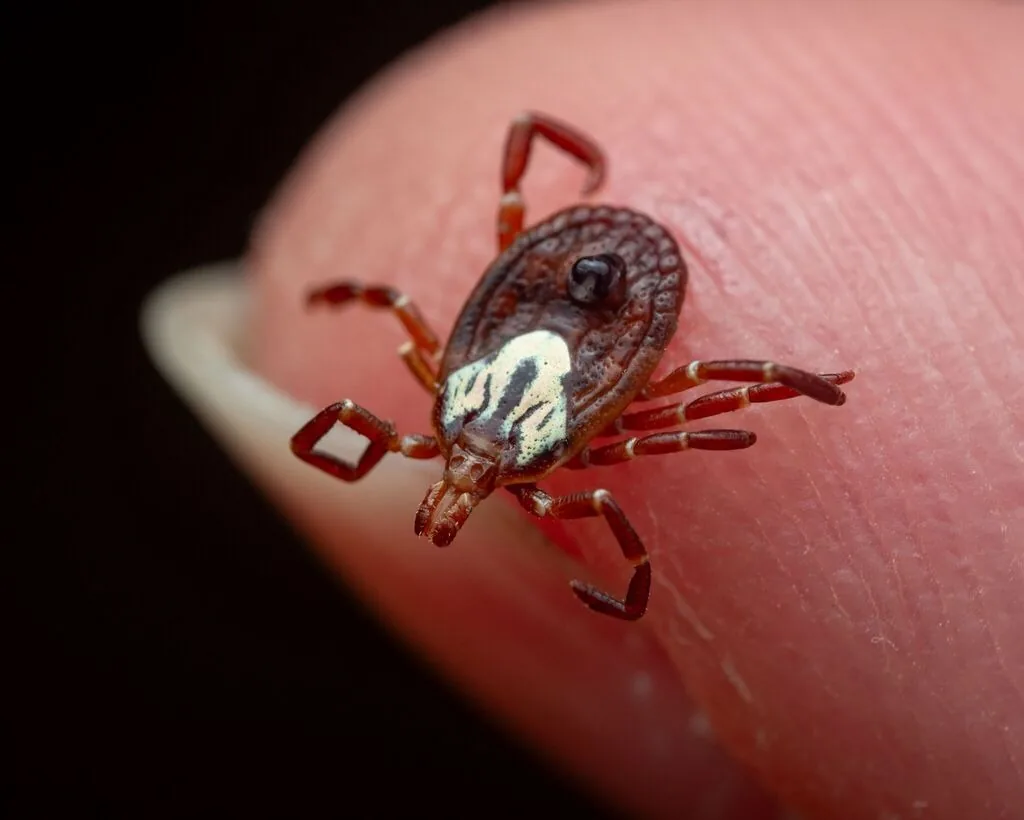
- Adults are about 3 to 7 millimeters long and 2 to 4 millimeters wide, with reddish-brown bodies, ornate whitish markings and eight legs. After a blood meal they are larger and may look gray. UF/IFAS gives about 6 mm (about 1/4 inch) for adults, and NCIPM compares them to the width of a pencil.[1][5][6]
- On males the shield (scutum) covers the whole back and carries the ornate pattern; on females it covers only the front half of the back. UF/IFAS describes the female's small dark brown shield as carrying silvery white stripes, one down the middle and two broken ones at the sides, and the male's as dark brown with a connected network of silvery white lines.[1][5]
- The mouthparts are long and slender, and the University of Rhode Island adds that the shield is more angular than an American dog tick's.[1][7]
- Nymphs are eight-legged and about the size of a poppy seed, roughly 1.33 by 0.75 millimeters unfed; larvae have six legs and are less than 1 millimeter wide. UF/IFAS says larvae are about 0.5 mm and look pink, dull white or gray when engorged; thousands at once, called seed ticks, usually mean an egg clutch has just hatched. Nymphs are shiny, dark bluish gray to dull white, and can look three times larger after feeding.[1][5]
Look-alikes
| Look-alike | How to tell them apart |
|---|---|
| American dog tick | Similar reddish-brown body and ornate markings, but American dog ticks have short, stout mouthparts, while Gulf Coast ticks have long, slender ones and a more angular shield. UF/IFAS calls the American dog tick's mouthparts short and pyramid-shaped and the Gulf Coast tick's long and rectangular, and NCIPM notes the two are commonly mistaken for each other.[1][7][5][6] |
| Lone star tick | Female lone star ticks have a single white dot in the center of a brown body, and males have white spots or streaks around the outer edge, instead of an ornate pattern across the shield. UF/IFAS says the male lone star tick's silvery marks are six separate, symmetrical spots on the outer edges of the shield, while the Gulf Coast tick's pattern is connected and covers most of the back.[8][1][5] |
Where it lives
Found mainly in the southeastern United States, with focal populations in the Northeast, Midwest and Southwest. The University of Rhode Island describes it along the Atlantic and Gulf coasts from New Jersey to Texas and inland into Oklahoma and Kansas, and Ohio State notes it is also common in the Great Plains. It also occurs in several countries of Central and South America. UF/IFAS says stray records reach as far as Maine and Iowa without known established populations, that cattle moved from the Southeast in the 1950s started populations across more than half of Oklahoma and a quarter of Kansas, and that populations in Delaware and Maryland appear established. In Florida it occurs statewide, with higher densities in the south.[3][9][7][1][4][5]
Biology and life cycle
It is a three-host tick that feeds on a different host at each life stage: larvae and nymphs on birds, including ground-dwelling birds, and small mammals, and adults on larger mammals such as deer, cattle and other livestock, and on people. UF/IFAS says it has been collected from 71 species of birds and mammals in the United States. Immatures may favor ground birds such as bobwhite quail and meadowlarks, adults also feed on dogs, coyotes, skunks, panthers and bears, and only coyotes and domestic sheep have had all three active stages collected from them.[1][7][2][5]
It favors grass prairies and shrubby grasslands with little tree cover, recently disturbed ground with shrubs and long grass, and, according to the University of Rhode Island, shady wooded edges.[1][2][7]
Indiana's health department calls it an aggressive feeder that can quest for a host for long periods when temperatures are right. UF/IFAS calls it xerophilic, a lover of drier places, able to quest for long periods in the hottest weather, and says it holds moisture so well that it has survived prescribed burns.[2][5]
A single female lays an average of more than 8,000 eggs.[7]
Adults are active from April to October, with the highest risk of encounters in July and August where the tick occurs. In Ohio adults turn up mostly in warm summer months and larvae and nymphs in fall and spring.[7][1]
Adults prefer the outer ears of their hosts, and larvae and nymphs the head and neck. On the host, a male feeds for about eight days and then releases a pheromone that draws females to feed and mate near him; males stay on to mate with more females.[5]
A fed female drops off and lays her single clutch over up to 26 days. UF/IFAS gives about 10,000 eggs per clutch, with a record of 18,497. Eggs hatch within about three weeks under ideal conditions, 27°C (80.6°F) and 70% to 98% humidity, and the larvae climb vegetation to wait for a host.[5]
Ticks stay attached until fully fed, which takes immatures up to 10 days. Under good lab conditions, UF/IFAS says larvae can live up to six months, nymphs up to seven months and unfed adults as long as 16 months.[5]
Seasons vary by region. UF/IFAS reports coastal Texas populations active from May through March, with adults peaking in August; inland Oklahoma and Kansas populations active February through October, with adults peaking in April; Mississippi collections from March through November, with adults peaking in late July to early August; and activity in northern Florida from February to September.[5]
Damage and signs
- On livestock, heavy feeding causes inflammation, swelling, abscesses, anemia and secondary infection. It can also cause gotch ear, mainly in ruminants: crusting, hair loss, swelling and drooping or curling of the ear, sometimes with loss of the ear. Gotch ear comes from the mechanical damage of feeding, not from a germ. UF/IFAS adds that bites can predispose livestock to screwworm where that pest occurs, that severe infestations cause lethargy and debilitation, and that the drooping 'gotched' ears of infested cattle once lowered their sale value.[1][10][5]
- Dogs get American canine hepatozoonosis mainly by swallowing an infected tick while grooming, not from the bite itself; the infection can cause severe lethargy and death.[1][4]
Health risk
Adult Gulf Coast ticks spread Rickettsia parkeri rickettsiosis. Its first sign is usually a dark scab (eschar) at the bite a few days to a week later, followed by fever, headache, rash and muscle aches. It is less severe than Rocky Mountain spotted fever but hard to tell apart early, and doxycycline is the recommended treatment for people of all ages. See a healthcare provider if you develop a rash or fever within several days to weeks of a tick bite.[3][9][11][12]
Control
Prevention
In tall grass and brush, walk in the center of trails, tuck pants into socks, and use an EPA-registered repellent containing DEET, picaridin, IR3535, oil of lemon eucalyptus, PMD or 2-undecanone. Treat clothing and gear, not skin, with 0.5% permethrin.[13][1]
After coming indoors, tumble dry clothes on high heat for 10 minutes, shower within two hours, and check under the arms, in and around the ears, inside the belly button, behind the knees, in the hair, between the legs and around the waist.[13]
Check dogs and cats that go outdoors for ticks every day, and use a tick preventive product on dogs; talk to your veterinarian about which one. For livestock, use a product labeled for tick control and follow its withdrawal times. For cattle, UF/IFAS lists acaricide-impregnated ear tags, sprays and pour-ons; follow the label and ask your Extension office or veterinarian.[14][1][5]
Keep them out
Fencing can keep larger tick-carrying mammals out, but UF/IFAS notes it won't stop birds and small animals from bringing in immature ticks, so keep inspecting livestock and pets routinely.[5]
Sanitation
Around the home, the CDC's landscaping steps (written for blacklegged ticks) are to clear tall grass and brush at lawn edges, mow often and keep a 3-foot strip of wood chips or gravel between lawns and wooded areas. NCIPM's Gulf Coast tick alert suggests keeping lawns shorter than 3 inches, trimming back overhanging shrubs and keeping a gravel or wood-chip barrier between lawn and natural areas.[13][6]
On larger properties, UF/IFAS lists habitat modification: mowing and brush control remove tick harborage, and prescribed burning kills ticks and clears litter, though it has given variable long-term results and Gulf Coast ticks have survived burns. Check local rules and consult prescribed-burn professionals before considering fire, and keep monitoring ticks afterward.[5]
Traps and physical control
Remove an attached tick right away with fine-tipped tweezers: grasp it close to the skin and pull away with steady, even pressure without twisting or jerking, then clean the bite and your hands with soap and water, rubbing alcohol or hand sanitizer. Don't use petroleum jelly, heat or nail polish to make it let go.[12][1]
Ohio State suggests writing down the date of the bite and saving the tick in rubbing alcohol, a sealed bag or the freezer in case symptoms develop. UF/IFAS suggests submitting a tick removed from you or your animals to your local Cooperative Extension office for identification.[1][5]
Pesticides
Pesticides can reduce ticks in treated parts of a yard, but the CDC says not to rely on spraying to prevent infection; follow the label and check with local health or agricultural officials first.[13]
A tick on the move
The recognized range of the Gulf Coast tick is far larger than it was described 70 years ago, and Ohio State says it has expanded dramatically across the eastern United States since around 2000.[11][4][1]
It was first found in Ohio in 1990 and now has established populations in at least three Ohio counties; in Indiana it occurs mostly in southern counties, and South Dakota recorded it for the first time in 2021 and 2022.[1][2][15]
Rickettsia parkeri has been found in Gulf Coast ticks in southern Indiana, although no human cases had been reported there when the state's page was last updated. A CDC report found five cases at a single Georgia urgent care practice in three years and called the disease probably underrecognized.[2][11]
NCIPM says it was once confined mainly to coastal regions but has spread much more widely, can be carried by migratory grassland birds, and that restoration of native grasslands and warmer winters could be two factors in its spread.[6]
Where sources disagree
Life cycle: a 2010 review calls the Gulf Coast tick univoltine (one generation a year), while Ohio State gives a 1- to 2-year life cycle.[10][1]
Range: the CDC describes it as mainly southeastern with focal populations in the Northeast, Midwest and Southwest, while the University of Rhode Island describes a coastal range from New Jersey to Texas plus Oklahoma and Kansas.[3][7]
Eggs: the University of Rhode Island gives an average of more than 8,000 per female, while UF/IFAS gives about 10,000 per clutch, with a record of 18,497.[7][5]
Season: the University of Rhode Island gives adult activity from April to October, with the highest risk in July and August, while UF/IFAS reports activity from February to September in northern Florida and from May through March on the Texas coast.[7][5]
Common questions
- What is Rickettsia parkeri rickettsiosis?
- A spotted fever spread by Gulf Coast ticks. It usually starts with a dark, scabbed sore at the bite, followed by fever, headache, muscle aches and a sparse rash. It is less severe than Rocky Mountain spotted fever, and doxycycline is the recommended treatment.[11][9]
- Is the Gulf Coast tick only found along the Gulf Coast?
- No. It is most common in the Southeast, but it is also found in the Great Plains and has populations in parts of the Northeast, Midwest and Southwest, including Ohio and southern Indiana.[3][1][2]
- How do I tell a Gulf Coast tick from an American dog tick?
- Look at the mouthparts: long and slender on the Gulf Coast tick, short and stout on the American dog tick. Both are reddish brown with ornate markings.[1][7]
- Can my dog get sick from Gulf Coast ticks?
- Yes. Dogs that swallow infected ticks while grooming can get American canine hepatozoonosis, and the CDC recommends daily tick checks and a tick preventive product for dogs.[1][4][14]
- Why do I keep finding these ticks in my dog's ears?
- Adult Gulf Coast ticks prefer to attach on and around the outer ears of their hosts, according to UF/IFAS, so check ears closely after time in grassy areas.[5]
Sources
- The Ohio State University, CFAES (Ohioline), “Gulf Coast Tick (Amblyomma maculatum), ENT-0105 (Sabet, Pesapane, McDermott, Short and Ramoutar, Nov. 25, 2025).” ohioline.osu.edu/factsheet/ent-0105 (accessed 2026-11-11)
- Indiana Department of Health, Infectious Disease Epidemiology and Prevention Division, “Amblyomma maculatum (Gulf Coast tick), last updated Sept. 27, 2024.” www.in.gov/health/idepd/zoonotic-and-vectorborne-epidemiology-entomology/vector-borne-diseases/tick-borne-diseases/amblyomma-maculatum-gulf-coast-tick/ (accessed 2026-11-11)
- Centers for Disease Control and Prevention, “Where Ticks Live.” www.cdc.gov/ticks/about/where-ticks-live.html (accessed 2026-11-11)
- Journal of Medical Entomology, via PubMed, “Paddock and Goddard (2015), The evolving medical and veterinary importance of the Gulf Coast tick (Acari: Ixodidae).” pubmed.ncbi.nlm.nih.gov/26336308/ (accessed 2026-11-11)
- University of Florida IFAS Extension (EDIS), “Gulf Coast Tick, Amblyomma maculatum Koch, EENY603/IN1062 (J. C. Hertz and P. E. Kaufman; Featured Creatures).” ask.ifas.ufl.edu/publication/IN1062 (accessed 2026-11-14)
- North Central IPM Center, Public Tick IPM Working Group, “Gulf Coast Tick (Pest Alert).” www.ncipmc.org/communications/pest-alerts/gulf-coast-tick/ (accessed 2026-11-14)
- University of Rhode Island, TickEncounter Resource Center, “Gulf Coast Tick (TickEncounter species page).” web.uri.edu/tickencounter/species/gulf-coast-tick/ (accessed 2026-11-11)
- University of Rhode Island, TickEncounter Resource Center, “Lone Star Tick (TickEncounter species page).” web.uri.edu/tickencounter/species/lone-star-tick/ (accessed 2026-11-11)
- Centers for Disease Control and Prevention, “About Other Spotted Fever Rickettsioses (May 14, 2024).” www.cdc.gov/other-spotted-fever/about/index.html (accessed 2026-11-11)
- Journal of Medical Entomology, via PubMed, “Teel, Ketchum, Mock, Wright and Strey (2010), The Gulf Coast tick: a review of the life history, ecology, distribution, and emergence as an arthropod of medical and veterinary importance.” pubmed.ncbi.nlm.nih.gov/20939363/ (accessed 2026-11-11)
- Centers for Disease Control and Prevention, “Notes from the Field: Rickettsia parkeri Rickettsiosis, Georgia, 2012-2014 (MMWR 65:718-719, 2016).” www.cdc.gov/mmwr/volumes/65/wr/mm6528a3.htm (accessed 2026-11-11)
- Centers for Disease Control and Prevention, “What to Do After a Tick Bite (June 9, 2026).” www.cdc.gov/ticks/after-a-tick-bite/index.html (accessed 2026-11-11)
- Centers for Disease Control and Prevention, “Preventing Tick Bites (Aug. 28, 2024).” www.cdc.gov/ticks/prevention/index.html (accessed 2026-11-11)
- Centers for Disease Control and Prevention, “Preventing Ticks on Pets (May 15, 2024).” www.cdc.gov/ticks/prevention/preventing-ticks-on-pets.html (accessed 2026-11-11)
- Journal of Medical Entomology, via PubMed, “Wojahn, Black, Warner and Britten (2026), Range expansion of Amblyomma americanum and Ixodes scapularis in South Dakota, and new record for Amblyomma maculatum.” pubmed.ncbi.nlm.nih.gov/41117664/ (accessed 2026-11-11)
- iNaturalist, “Amblyomma maculatum taxon page (order and family).” www.inaturalist.org/taxa/180017 (accessed 2026-10-06)