The short answer
- Dogs mostly catch it by mouth. Merck says eating infected kissing bugs, or material soiled with their droppings, is a major way dogs are infected; the parasite can also get in through wounds.[1][2]
- Early signs are vague: swollen lymph nodes, poor appetite, low energy, weakness, vomiting, diarrhea and an enlarged liver or spleen. Merck says acute infection can also cause no signs at all.[2][1]
- The heart is the real danger. Merck says infected dogs may die suddenly or develop inflammation of the heart muscle, and long-term infection can lead to life-threatening heart failure.[2][1]
- Call your vet now if your dog collapses or turns suddenly weak, and call soon about any illness if you have seen kissing bugs around the kennel or yard. Only a veterinarian can test for and diagnose the infection.[2][1]
- Fewer kissing bugs means less risk. Bring dogs in at night, turn off yard lights near where they sleep, and clean up kennels and the brush and rock piles around them.[5][7][1]
If someone may be poisoned
Kissing bugs and their wild hosts
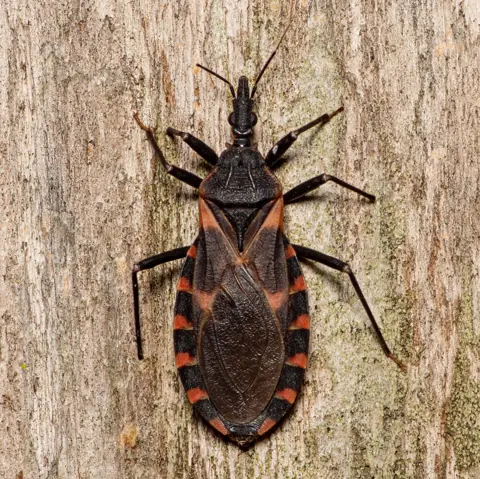 Eastern Bloodsucking Conenose
Triatoma spp. (shown: T. sanguisuga)
Kissing bugs are blood-feeding insects, active mostly at night, that can carry Trypanosoma cruzi, the parasite that causes Chagas disease. They have been found in 29 U.S. states, and studies of bugs collected in the United States have found the parasite in roughly one in six to nearly two in three of those tested, depending on the place.
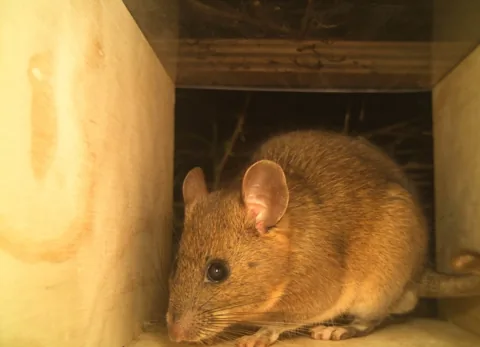 Woodrats
Neotoma species (e.g., N. fuscipes, N. lepida, N. floridana)
Woodrats, also called pack rats or trade rats, are native rats about the size of a Norway rat. They are a nuisance mainly around cabins, sheds and other little-used buildings and in parked vehicles, where they shred furnishings for nests and chew wires.
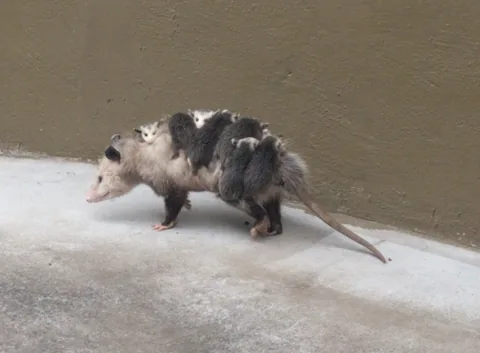 Virginia opossum
Didelphis virginiana
The Virginia opossum is North America's only marsupial, a cat-sized animal with a pointed face and a long, hairless tail. Around homes it raids pet food, garbage and fruit and dens under decks, sheds and houses.
How dogs get Chagas disease
Kissing bugs pick up the parasite when they feed on an infected animal, and infective forms pass out in the bug's droppings. Merck notes that most of the more than 130 kissing bug species in the Americas are considered capable of spreading it.[1]
Dogs eat bugs, and that is the main problem. Merck calls eating infected kissing bugs, or material contaminated with their droppings, a major mode of transmission in insect-eating animals, dogs included. Texas A&M's kissing bug program also says dogs can be infected by eating kissing bugs.[1][8]
Droppings in a bite or a scratch are another route. Merck's dog-owner page says people and dogs become infected when bug droppings contaminate wounds or when they eat food contaminated with those droppings.[2]
Infected mothers can pass it on. Merck lists passage across the placenta, blood transfusion and organ transplant as additional routes, and says breeding of infected females is discouraged.[1]
Wild animals keep the parasite going. Merck names opossums, armadillos, raccoons and woodrats as wildlife reservoirs, and says opossums can even shed infective parasites in their feces or urine without any bug involved.[1]
Where dogs are at risk in the U.S.
Merck says Chagas disease is endemic in 21 countries of South America, Central America and Mexico and is increasingly reported in the southern USA. Its dog-owner page lists the southern U.S. among the places it occurs.[1][2]
Texas has the most attention. Texas A&M says dog kennels in Texas and other southern states may have problems with kissing bugs, because the bugs can be drawn to the heat and smells of places with many dogs. Our main kissing bug page has the Texas health department's notes on which states have reported infected dogs.[8]
Kennels near wild land are hardest to protect. Texas A&M says keeping kissing bugs away can be difficult where kennels are surrounded by natural areas with lots of wild animals.[8]
Dogs can bring the problem closer to people. Merck's dog-owner page says infected dogs may introduce the parasite into houses where kissing bugs are present.[2]
Signs of Chagas disease in dogs
Merck divides the disease into an acute phase and a chronic phase, and the chronic phase into a silent (latent) stage and a symptomatic stage. Illness usually starts 5 to 42 days after infection, and acute infection may cause no signs at all.[1]
Acute signs, when they show, are those of a general illness: fever, swollen lymph nodes, poor appetite, tiredness, vomiting, diarrhea and an enlarged liver or spleen. Merck says acute inflammation of the heart muscle is rare in this stage.[1][2]
The silent stage can last months to years, Merck says. During that time the parasite has moved out of the blood and into tissues, with a preference for heart muscle.[1]
Chronic disease shows up as generalized weakness or sudden death. Merck says dogs with symptoms commonly have right-sided congestive heart failure that can progress to heart-muscle inflammation, irregular heart rhythms and enlargement of both sides of the heart, and death from heart failure is common.[1]
These signs overlap with many other heart and stomach problems in dogs, so they do not mean your dog has Chagas disease. Tell your veterinarian if your dog lives or spends nights outdoors in kissing bug country, or if you have found the bugs near where it sleeps.[2][8]
How veterinarians test for it
Merck's dog-owner page says the disease is diagnosed by finding the parasite or antibodies against it in the dog's blood.[2]
Early on, the parasite itself may be seen. Merck says parasites in the blood peak 2 to 3 weeks after infection, when they can show up on an ordinary blood smear, and then fade after the first month. PCR and culture can also detect it, but are uncommon in the field.[1]
Later, antibody tests matter most. Merck lists rapid dipstick tests, immunofluorescent antibody tests and ELISA, and warns that these can cross-react with Leishmania, a related parasite. Because of that, it recommends testing with at least two different methods or antigens.[1]
Testing and any treatment decisions belong to your veterinarian. Merck notes that the drugs used against the parasite are not FDA-approved in the U.S. and require CDC permission under investigational protocols, and that care for heart failure and abnormal rhythms is also part of treatment. There is no vaccine.[1][2]
Cutting kissing bugs around kennels and yards
Know where the bugs hide. CDC lists outdoor dog houses and kennels among their outdoor hiding places, along with spaces under porches, rock, wood and brush piles, rodent nests and chicken coops. Indoors they are often near where pets sleep.[4]
Bring dogs in at night. CDC advises having pets sleep indoors, especially at night, and regularly cleaning pet resting areas while watching for bugs.[5]
Turn off lights that draw bugs in. Texas DSHS says to turn off outdoor lights at night, CDC says to keep yard lights away from the house, and Merck lists turning off outdoor lighting at night as a way to make dwellings less attractive to the bugs.[7][5][1]
Clean up the kennel and the ground around it. Texas DSHS advises keeping yard and kennel areas clean, removing brush piles, rock piles and heavy leaf litter, keeping dog houses clean and filling crevices where bugs might hide.[7]
Insecticides need expert help. CDC says no insecticides are approved specifically for kissing bugs in the U.S. and to talk with a pest control expert before using any. Texas DSHS suggests considering appropriate use of long-lasting pesticides in and around dog houses. If you use a product, follow its label and keep pets away as it directs.[5][7]
Handle bugs safely. Texas A&M says not to touch a kissing bug with bare hands, to use a glove or small plastic bag, and to consider cleaning the spot with a bleach solution. Merck adds that dead infected bugs can stay infective for days to months depending on temperature, so don't leave dead bugs where a dog can eat them.[8][9][1]
What an infected dog means for your family
The same bugs bite people. Texas DSHS says humans, dogs and many other animals can be infected, and the parasite and its bugs are present across the southern half of the U.S., including all regions of Texas. Human cases acquired in Texas do occur but are uncommon.[7]
You won't catch it by petting your dog. CDC says Chagas disease does not spread through casual contact with people or animals who are infected; it spreads mainly through the droppings of kissing bugs.[3]
An infected dog is a sign that infected bugs may be nearby. Merck says dogs may introduce the parasite into houses where kissing bugs are present, so check sleeping areas and the house perimeter, and follow the kissing bug steps on our main Chagas page.[2]
In people, CDC says early infection often has mild symptoms or none, while long-term infection can lead to serious heart and digestive problems in some people. Only a healthcare provider can diagnose it, and lab tests use a small blood sample; see one if you think you were exposed.[3][6]
Common questions
- Can my dog get Chagas disease from eating a kissing bug?
- Yes. Merck says eating infected kissing bugs or material contaminated with their droppings is a major way dogs become infected. Tell your vet if your dog has eaten one.[1]
- Can Chagas disease kill a dog?
- Yes. Merck says dogs may die suddenly or develop heart-muscle inflammation, and long-term infection can cause life-threatening heart failure.[2][1]
- Is there a vaccine for Chagas disease in dogs?
- No. Merck says no vaccine is available, so control depends on reducing the kissing bugs that spread the parasite.[1][2]
- Can I catch Chagas disease from my dog?
- Not by ordinary contact. CDC says it does not spread through casual contact with infected people or animals. The risk to people comes from the same kissing bugs, so control them around the home.[3]
- Can cats get Chagas disease?
- Merck says all mammals are considered susceptible and cats can be infected, but their role in spreading it to people is limited.[1]
Photo credits
- Eastern Bloodsucking Conenose: (c) Justin Williams, some rights reserved (CC BY) — via iNaturalist, CC BY 4.0
- Woodrats: Andy Kleinhesselink, public domain (CC0), via iNaturalist
- Virginia opossum: (c) Millie Basden, some rights reserved (CC BY) — via iNaturalist, CC BY 4.0
Sources
- Merck Veterinary Manual, “Trypanosomiasis in Animals (Chagas Disease section).” www.merckvetmanual.com/circulatory-system/blood-parasites/trypanosomiasis-in-animals (accessed 2026-11-15)
- Merck Veterinary Manual, “Blood Parasites of Dogs (Dog Owners).” www.merckvetmanual.com/dog-owners/blood-disorders-of-dogs/blood-parasites-of-dogs (accessed 2026-11-15)
- Centers for Disease Control and Prevention, “About Chagas Disease.” www.cdc.gov/chagas/about/index.html (accessed 2026-11-15)
- Centers for Disease Control and Prevention, “How Chagas Disease Spreads.” www.cdc.gov/chagas/spreads/index.html (accessed 2026-11-15)
- Centers for Disease Control and Prevention, “Preventing Chagas Disease.” www.cdc.gov/chagas/prevention/index.html (accessed 2026-11-15)
- Centers for Disease Control and Prevention, “Treatment of Chagas Disease.” www.cdc.gov/chagas/treatment/index.html (accessed 2026-11-15)
- Texas Department of State Health Services, “Chagas Disease.” www.dshs.texas.gov/chagas-disease (accessed 2026-11-15)
- Texas A&M University Kissing Bugs & Chagas Disease program, “Frequently Asked Questions - Kissing Bugs & Chagas Disease.” kissingbug.tamu.edu/faq/ (accessed 2026-11-15)
- Texas A&M University Kissing Bugs & Chagas Disease program, “Found a Bug? - Kissing Bugs & Chagas Disease.” kissingbug.tamu.edu/found-a-bug/ (accessed 2026-11-15)