On this page
How to identify it
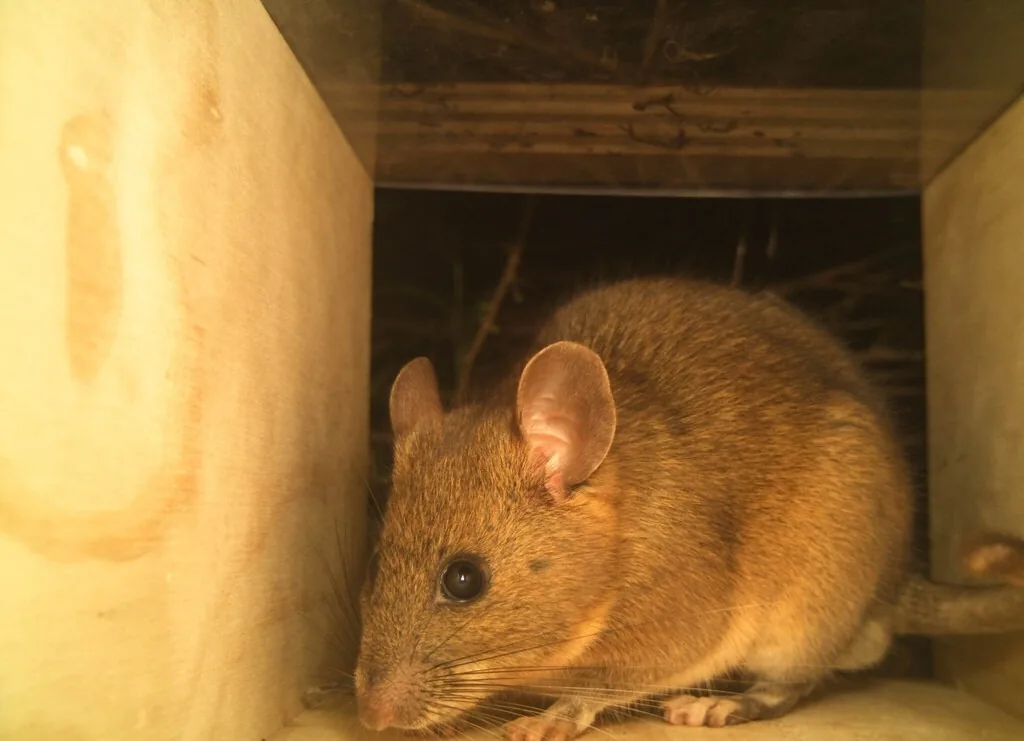
- A hairy tail rather than a scaly one, plus soft, fine fur and large ears, separates woodrats from Norway and roof rats.[1][3]
- They usually have light-colored feet and bellies.[1]
- Large houses or dens of sticks, built on the ground, in trees or among rocks, with a nest of finely shredded plant material inside.[4]
- Piles of collected objects near the den, called middens, often including shiny items such as can tabs, utensils or jewelry.[4][2]
- Trails 3 to 4 inches wide may run from a building where they nest to their outdoor feeding areas.[4]
Look-alikes
| Look-alike | How to tell them apart |
|---|---|
| Norway rat | Similar in size, but the Norway rat has a scaly, mostly hairless tail and coarser fur.[1][3] |
| Roof rat | Also has a scaly, mostly hairless tail, unlike the furry tail of a woodrat.[3] |
Where it lives
Eight woodrat species occur in North America, from low, hot deserts to rocky slopes above timberline; in California the dusky-footed and desert woodrats are the most common.[1][4][3]
Biology and life cycle
Woodrats climb readily and are usually active at night.[4]
Breeding usually happens in spring, with 1 to 4 young per litter and sometimes more than one litter a year in the southern U.S.[4]
Each den is usually occupied by one animal or a female and her young, and one woodrat may use several dens.[4]
Diets differ by species, from green plants, twigs and shoots to seeds, fruits, acorns and cactus, and they may raid human food in buildings.[4]
They show little fear of new objects, which makes them easy to trap.[5]
Damage and signs
- They pack away small objects such as jewelry, utensils and can tabs, which can annoy cabin owners and backpackers.[2]
- They shred upholstered furniture and mattresses to line their nests.[2]
- They move into parked vehicles and gnaw on wires and other mechanical parts.[2]
- In some areas they clip twigs and strip bark from citrus, fruit trees and young conifers, sometimes killing trees.[2]
Health risk
CDC lists wood rats among the rodents that plague can affect in rural and semi-rural parts of the western U.S.; people usually get plague from the bite of an infected rodent flea or by handling an infected animal.[6]
Control
Keep them out
Exclusion is the most effective way to stop damage in buildings: seal every gap larger than 1/2 inch, including attic vents, broken shingles and gaps near the eaves, because woodrats climb well.[5]
Plug holes with coarse steel wool, wire screen or light sheet metal, not plastic or wood, which they gnaw through, and fit doors, windows and screens tightly.[5]
Make sure no woodrat is shut inside; a hinged one-way flap over the entry lets it push out but not return.[5]
Sanitation
Store food in rodent-proof containers and keep garbage and refuse properly stored.[5]
Traps and physical control
Most problems in buildings can be solved with one or a few standard rat snap traps baited with nuts, peanut butter and oatmeal, or dried fruit tied to the trigger.[5]
Releasing live-trapped woodrats is not recommended and may break local wildlife rules; relocated animals often die anyway.[5]
Burrow-entrance traps such as the No. 110 Conibear set in nest openings, and glue boards, can also catch woodrats, with care to avoid other animals.[5]
Pesticides
Anticoagulant baits made for Norway and roof rats generally control woodrats; ICWDM recommends meal or paraffin block baits fastened down, since woodrats cache pellets, and names chlorophacinone and diphacinone. Keep baits away from children and pets.[5]
ICWDM says anticoagulants and zinc phosphide for woodrats are registered under state Special Local Needs (24(c)) labels that vary by state, and second-generation anticoagulants such as brodifacoum or bromadiolone, or cholecalciferol, may be permitted in some cases; check with the state pesticide agency.[5]
Legal status
Woodrats are nongame animals that most states allow landowners to control when they damage property, but some subspecies are protected, such as the federally endangered Key Largo woodrat.[1]
Check with your state wildlife or agriculture department before starting control.[1]
In New York the Allegheny woodrat is listed as endangered, and DEC reports the last known site in the state was lost in 1987.[7]
What doesn't work
No woodrat repellents are registered by the EPA, and repellents in general aren't a practical fix.[5]
Tearing apart nests is time-consuming and of limited value, though it can help discourage new woodrats once the residents are controlled.[5]
Common questions
- How can I tell a packrat from a regular rat?
- Look at the tail. Woodrats, or pack rats, have furry tails, while Norway and roof rats have scaly, mostly hairless tails.[3][1]
- Why are rats chewing wires in my parked car?
- Woodrats often move into parked vehicles, especially at cabins and other little-used sites, and gnaw on wires and other parts.[2]
- Do woodrats carry plague?
- They can. CDC lists wood rats among the wild rodents plague can affect in the western U.S., and people usually catch it from flea bites or by handling infected animals, so don't handle dead or dying woodrats.[6]
Sources
- Internet Center for Wildlife Damage Management, “Woodrats: Identification.” icwdm.org/species/rodents/woodrats/ (accessed 2026-11-12). Run by university wildlife damage specialists (maintained at the University of Wisconsin-Stevens Point); species modules are based on Prevention and Control of Wildlife Damage (University of Nebraska Cooperative Extension, 1994).
- Internet Center for Wildlife Damage Management, “Woodrat Damage Identification.” icwdm.org/species/rodents/woodrats/woodrat-damage-identification/ (accessed 2026-11-12). Run by university wildlife damage specialists (maintained at the University of Wisconsin-Stevens Point); species modules are based on Prevention and Control of Wildlife Damage (University of Nebraska Cooperative Extension, 1994).
- University of California Statewide IPM Program, “Pest Notes: Rats, Publication 74106 (revised June 2024).” ipm.ucanr.edu/legacy_assets/PDF/PESTNOTES/pnrats.pdf (accessed 2026-11-12)
- Internet Center for Wildlife Damage Management, “Woodrat Biology.” icwdm.org/species/rodents/woodrats/woodrat-biology/ (accessed 2026-11-12). Run by university wildlife damage specialists (maintained at the University of Wisconsin-Stevens Point); species modules are based on Prevention and Control of Wildlife Damage (University of Nebraska Cooperative Extension, 1994).
- Internet Center for Wildlife Damage Management, “Woodrat Damage Prevention and Control Methods.” icwdm.org/species/rodents/woodrats/woodrat-damage-prevention-and-control-methods/ (accessed 2026-11-12). Run by university wildlife damage specialists (maintained at the University of Wisconsin-Stevens Point); species modules are based on Prevention and Control of Wildlife Damage (University of Nebraska Cooperative Extension, 1994).
- Centers for Disease Control and Prevention, “How Plague Spreads (updated May 15, 2024).” www.cdc.gov/plague/causes/index.html (accessed 2026-11-12)
- New York State Department of Environmental Conservation, “Allegheny Woodrat.” dec.ny.gov/nature/animals-fish-plants/allegheny-woodrat (accessed 2026-11-12)
- iNaturalist, “Neotoma taxon page (order and family).” www.inaturalist.org/taxa/44737 (accessed 2026-11-12)