On this page
How to identify it
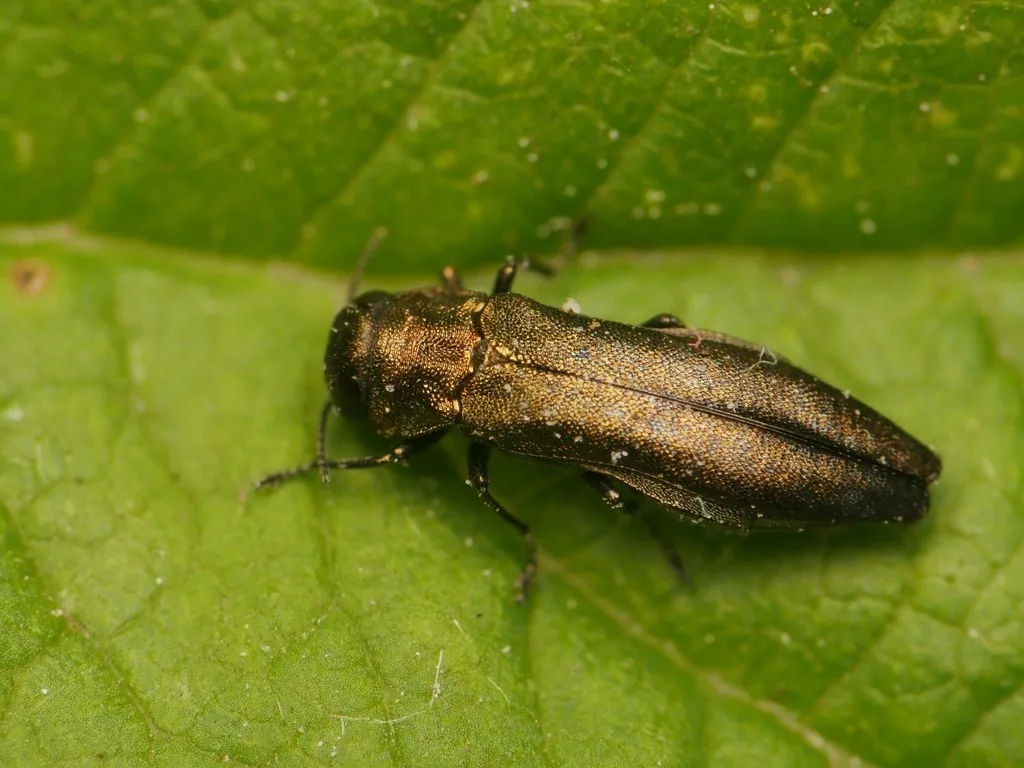
- Adults are slender, flattened metallic beetles slightly less than 1/4 inch (4-5 mm) long, tapering toward the tip of the abdomen. The PNW Handbook calls them copper-green; Utah State says the wing covers are copper and males have a metallic green face.[2][3][1]
- Mature larvae are creamy white and flat-headed, about 1/2 inch (12-15 mm) long; their feeding leaves spiral scars or gall-like swellings on canes.[2][1]
- Emerging adults leave a D-shaped exit hole in the cane.[1]
Where it lives
A European beetle now found across much of North America. Utah State says it came to the eastern U.S. in infested roses in the early 1900s and was first reported in Utah, at American Fork, in 1955; Oregon State says it is thought to have been established in the U.S. sometime in the 1870s. In the Pacific Northwest it was confirmed at Olympia, Washington, in June 2014 and trapped near Portland in 2015, after an earlier 1994 detection in Oregon east of the Cascades; damage was first confirmed in Willamette Valley caneberries in August 2017. GBIF's U.S. records since 1990 are most numerous from Minnesota, Oregon and Washington.[2][3][4]
Biology and life cycle
In the Pacific Northwest, pupation needs average daytime temperatures above 50°F and humidity above 60%, and adults may stay in the canes for 1 to 3 weeks until daytime temperatures average above 65°F. Emergence is most commonly in early June there; peak activity lasts 2 to 3 weeks, with some adults active for up to 8 weeks or longer.[1]
There is one generation a year. Larvae spend the winter in the cane pith and pupate in spring when daytime temperatures average about 55°F; in Utah adults emerge in May to June.[2][3]
Each adult lives about a week and must feed on leaves before laying eggs, on the lower third of new canes or higher on older canes; adults are most active in the morning and rest on foliage in the evening.[1][3]
Oregon State gives four to fourteen days for eggs to hatch depending on temperature; the PNW Handbook says within two weeks. Larvae feed in the cane's vascular tissue through early summer and move into the pith by early fall, staying until the next year.[3][1]
Hosts are brambles (Rubus) and roses (Rosa); Oregon State says older reports from currants (Ribes) appear to be mistaken identity with a similar Agrilus.[2][3]
Damage and signs
- Girdled canes wilt from midsummer through fall and snap easily, especially under ripening berries, and damaged canes are more prone to winter injury.[1]
- Losses are worst in young plantings and fall-bearing primocane varieties, and damage can be mistaken for normal cane dieback or Phytophthora root rot.[1]
Health risk
It is a borer of rose and bramble canes. The PNW Insect Management Handbook, Utah State and Oregon State describe it only as a plant pest; none of them mentions bites, stings or any effect on people or pets.[1][2][3]
Control
Prevention
Avoid planting raspberries and blackberries near infested wild or cultivated roses, and keep plants unstressed with proper fertility and irrigation, since healthy plants are less susceptible.[2]
It often arrives on infested nursery stock, and wild roses and brambles along roads and waterways keep it around.[1]
Sanitation
Thoroughly prune out and destroy damaged canes, which can cut populations by up to 80 percent; larvae rarely survive in canes pruned before late summer.[1]
Canes pruned later, after larvae reach the pith, should be destroyed or tilled more than 2 inches under.[1]
Biological control
Parasitoid wasps build up after an infestation and kill larvae. Oregon State reports that in a Hungarian raspberry planting one, Tetrastichus agrili, caused 57.6% mortality of larvae, and that another Tetrastichus larval parasite caused 43-92% mortality.[1][3]
Pesticides
Sprays cannot reach larvae inside canes, so they must target adult beetles, and applications made before adults emerge are ineffective. The PNW Handbook says no insecticides are specifically labeled for rose stem girdler and suggests weekly full-cover sprays, including the base of the canes, beginning at adult emergence and continuing while adults are present. Utah State says to begin in early May or just before bloom and repeat through early June, and to spray near dusk if bees are working the bloom.[1][2]
For home-garden brambles, Utah State lists carbaryl, malathion, gamma-cyhalothrin, permethrin, acetamiprid, neem oil and pyrethrin among caneberry insecticides. Follow the label's bee-protection rules and the wait before harvest.[2]
More from Utah State University Extension
Utah State says it came to the eastern U.S. from Europe in infested roses in the early 1900s and was first reported in Utah in American Fork in 1955. It advises against planting raspberries and blackberries near infested wild or garden roses, or removing nearby roses before planting brambles.[2]
Where the sources disagree
Arrival in North America: Utah State says the early 1900s, in infested roses; Oregon State says it is thought to have been established sometime in the 1870s.[2][3]
Adult color: the PNW Handbook says copper-green; Utah State and Oregon State describe copper-colored beetles, with Utah State adding a metallic green face on males.[1][2][3]
Adult timing: Utah State says adults emerge in May to June; the PNW Handbook says emergence is most commonly in early June, with adults most often seen from late May to mid-June in the western Pacific Northwest.[2][1]
Spray start: Utah State says early May or just before bloom; the PNW Handbook says at adult emergence, repeated weekly while adults are present.[2][1]
Egg hatch: Oregon State gives four to fourteen days depending on temperature; the PNW Handbook says within two weeks.[3][1]
Common questions
- Why are my raspberry canes wilting with spiral scars?
- Rose stem girdler larvae feeding under the bark leave spiral scars and swellings and girdle the canes.[1]
- Does pruning help with rose stem girdler?
- Yes. Thoroughly pruning out and destroying damaged canes can cut populations by up to 80 percent.[1]
- When should I spray for rose stem girdler?
- Only when adults are out: applications made before emergence or aimed at larvae inside canes do not work. Utah State says from early May or just before bloom through early June; in the western Pacific Northwest adults are most often seen between late May and mid-June, and the PNW Handbook suggests weekly sprays from emergence while adults are present.[2][1]
Sources
- Pacific Northwest Pest Management Handbooks (OSU, WSU, University of Idaho), “Emerging Insect Pests in the Pacific Northwest: Rose stem girdler (2014; revised March 2025).” pnwhandbooks.org/insect/emerging-insect-pests/emerging-insect/rose-stem-girdler-2014 (accessed 2026-11-13)
- Utah State University Extension, “Rose Stem Girdler.” extension.usu.edu/planthealth/research/rose-stem-girdler.php (accessed 2026-11-13)
- Oregon State University, College of Agricultural Sciences (Nursery Pest), “Rose Stem Girdler.” agsci.oregonstate.edu/nurspest/insects/rose-stem-girdler (accessed 2026-11-13)
- Global Biodiversity Information Facility (GBIF), “Agrilus cuprescens: U.S. occurrence records since 1990 by state (GBIF occurrence search).” api.gbif.org/v1/occurrence/search?taxonKey=4432626&country=US&hasGeospatialIssue=false&occurrenceStatus=PRESENT&year=1990%2C2026&facet=stateProvince&facetLimit=400&limit=0 (accessed 2026-11-13)
- Global Biodiversity Information Facility (GBIF), “Agrilus cuprescens (Ménétriés, 1832) (GBIF Backbone Taxonomy).” api.gbif.org/v1/species/4432626 (accessed 2026-11-13)
- iNaturalist, “Agrilus cuprescens taxon page (order and family).” www.inaturalist.org/taxa/212817 (accessed 2026-10-06)