On this page
How to identify it
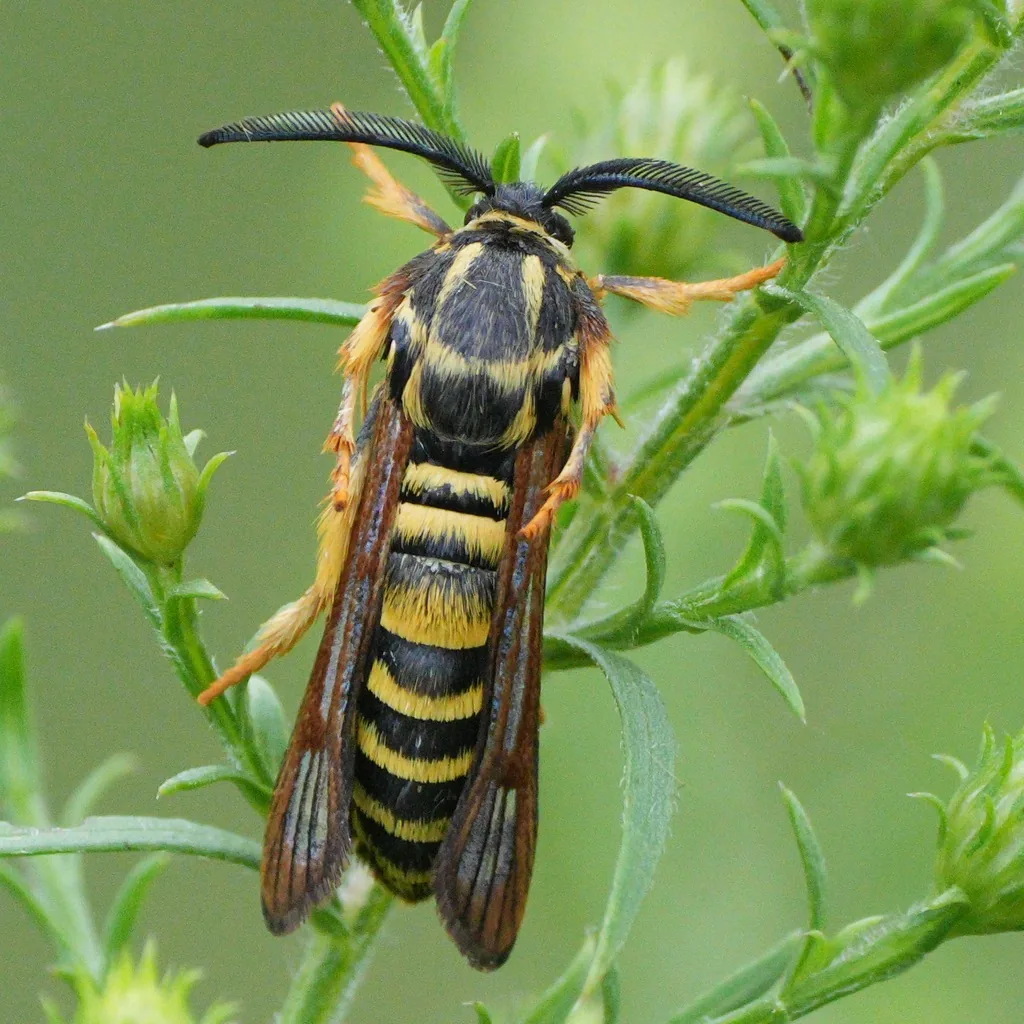
- Adults are day-flying clearwing moths that look like a medium-sized yellowjacket, with a black-and-yellow banded body, clear forewings with brown borders and a wingspan of about 1 to 1 1/4 inches. Unlike yellowjackets, they have noticeable scales on the body and wings.[1][2]
- Signs include sawdust-like frass pushed out at cane bases near the soil, swelling at the base of canes (most noticeable in October), and 1/4-inch tunnels seen when pruning.[1][2]
- Grown larvae are dull white with a reddish-brown head and reach 1 to 1 1/4 inches. They look much like other clearwing borer larvae. Eggs are reddish brown and about 1/16 inch.[2][1]
Look-alikes
| Look-alike | How to tell them apart |
|---|---|
| Yellowjackets | Kentucky says yellowjackets have few hairs and no scales, while the moth has noticeable scales on its body and wings. UC IPM notes that clearwing moths are not wasps.[1][3] |
| Other clearwing borer larvae | Squash vine borer, peachtree borer, dogwood borer and grape root borer larvae look very similar. Host plant is the easiest clue.[1] |
Where it lives
A native North American insect first reported from New England in the mid-1800s. It is a common pest of blackberries and raspberries throughout Kentucky, and in northern Utah, where it damages raspberry, a survey found it at 36% of plantings, though at low infestation levels.[2][1]
Biology and life cycle
Moths fly by day and lay eggs singly on the undersides of leaves, often near the margins; a female lays 25 to 200 eggs. Kentucky gives a flight from July through September, Utah State August and September.[1][2]
Eggs hatch after one to two months, and young larvae crawl down the cane to spend the winter in a small blister-like cell just below the soil line. The next spring they tunnel into the cane, crown and upper roots, spend a second winter there and pupate in the cane in the second summer.[1][2]
Life-cycle length varies by region: one year in Arkansas, according to McKern and colleagues, and two years in Ohio, British Columbia and Utah. Kentucky thinks it takes two years there.[4][1][2]
All brambles (Rubus) are potential hosts, including blackberry, loganberry, boysenberry, thimbleberry and salmonberry, but in Utah it is known to damage only raspberry.[2]
Damage and signs
- Canes die early, grow spindly and have smaller leaves. Damaged canes wilt in late spring and early summer and may break off at the crown, and surviving canes are more likely to winter-kill.[1][2]
- Tunneling in crowns and roots reduces vigor and yield and can kill whole plants, and the tunnels let in secondary pathogens. Utah State cites yield losses of up to 30% as populations build.[2]
Health risk
It is a borer of bramble crowns. Kentucky and Utah State describe it only as a pest of raspberry and blackberry plants; neither reports bites, stings or any other effect on people or pets.[1][2]
Control
Prevention
Start with clean planting stock, don't move canes between fields, and keep plants healthy and unstressed.[2]
Sanitation
Remove wild brambles near the planting, and dig out and destroy infested canes and crowns, in late summer and fall per Utah State.[1][2]
Biological control
Insect-killing nematodes have given mixed results. Kentucky reports some successful soil-drench trials, and Utah State cites 33 to 65% fewer larvae in Colorado. In Arkansas tests, nematodes cut larvae by 33 to 53% and did less well than insecticides. They need moist soil and warm temperatures, typically late June and July.[1][2][4]
Pesticides
In Arkansas trials, treatments between October and early April, before larvae tunneled into the crowns, worked; a May treatment did not. Utah State targets mid-October and early spring before bud break. Kentucky says the only registered products there are restricted-use pesticides for commercial plantings, applied in September or October or at bud swell; fall treatment may be more effective, it won't reach second-year larvae, and several seasons may be needed.[4][2][1]
Monitoring
Look for brittle, hollow canes when pruning in spring and for wilted or dead canes hollowed out at the base in mid- to late summer. Cut open lower canes to confirm tunnels. Pheromone lures were short-lived in Utah field tests and impractical for field use.[2]
Where the sources disagree
Flight period: Kentucky says moths emerge from July through September; Utah State says they fly in August and September.[1][2]
Life cycle: one year in Arkansas (McKern and colleagues); two years in Utah and, Kentucky thinks, in Kentucky.[4][2][1]
Severity: Kentucky calls it the most devastating pest of blackberry and raspberry in the state; Utah State says infestations are usually not severe and found plant infestation levels of about 1% at infested sites.[1][2]
Spring timing: Utah State gives early spring as April to early May; in Arkansas a May 6 application did not reduce larvae, and the optimum window ended in early April.[2][4]
Fall or spring: Kentucky says fall applications may be more effective than spring ones; Utah State recommends both a mid-October drench and one in early spring before bud break.[1][2]
Common questions
- Why are my blackberry canes dying?
- Raspberry crown borer larvae in the crown and roots are a common cause. Look for frass at the cane base and hollow, tunneled canes.[1][2]
- Is the yellow-and-black flier a wasp?
- It may be the raspberry crown borer moth, a day-flying clearwing moth that resembles a yellowjacket. Kentucky says you can tell it by the noticeable scales on its body and wings, which yellowjackets lack, and UC IPM notes that clearwing moths are not wasps.[1][3]
- When is the best time to treat raspberry crown borer?
- Fall (around mid-October) or early spring before bud break, when young larvae are near the soil surface and not yet deep in the crown.[2][4]
Sources
- University of Kentucky Entomology (ENTFACT), “Raspberry Crown Borer (ENTFACT-226).” entomology.mgcafe.uky.edu/ef226 (accessed 2026-11-13)
- Utah State University Extension, “Raspberry Crown Borer.” extension.usu.edu/planthealth/research/raspberry-crown-borer.php (accessed 2026-11-13)
- University of California Statewide IPM Program, “Pest Notes: Pitch Moths (Publication 7479).” ipm.ucanr.edu/PMG/PESTNOTES/pn7479.html (accessed 2026-11-13)
- Journal of Economic Entomology (via PubMed), “Biology and control of the raspberry crown borer (McKern, Johnson and Lewis, 2007) (abstract).” pubmed.ncbi.nlm.nih.gov/17461064/ (accessed 2026-11-13)
- Global Biodiversity Information Facility (GBIF), “Pennisetia marginatum (Harris, 1839) (GBIF Backbone Taxonomy).” api.gbif.org/v1/species/10402067 (accessed 2026-11-13)