On this page
How to identify it
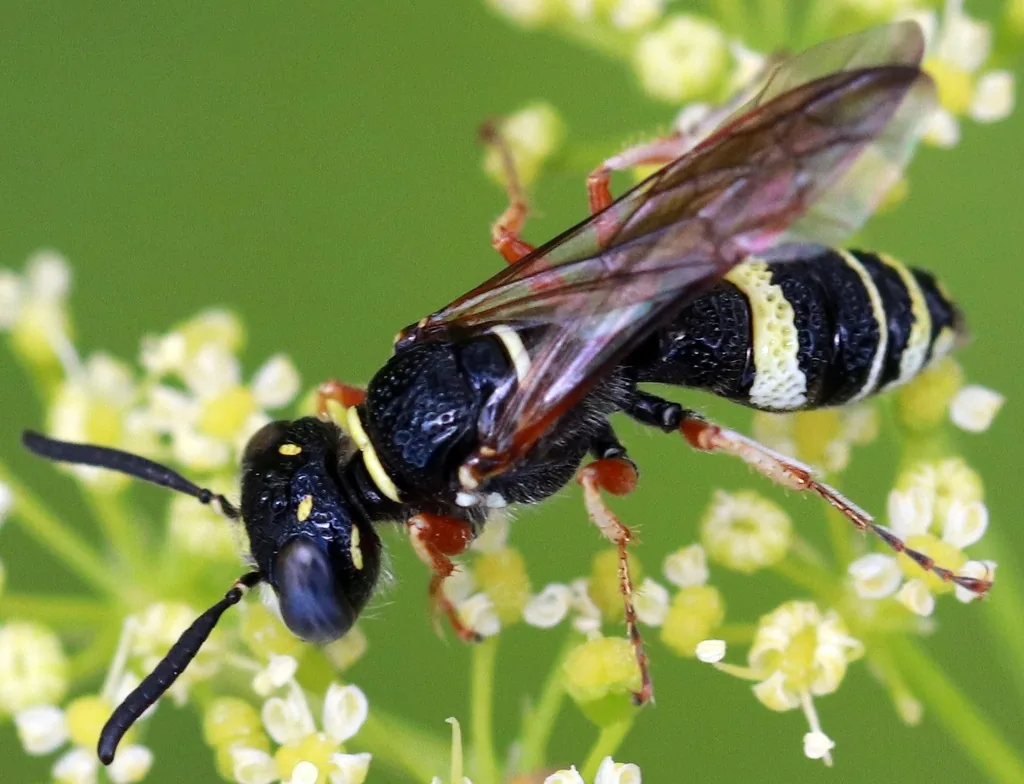
- A stout black and yellow wasp one-half to three-quarters of an inch long with small brown wings and a small yellow collar at the front of the thorax, just behind the head.[1]
- The abdomen and thorax are marked with small pits or indentations.[1]
- Females are larger and paler than males and have more complex markings.[1]
- Look for it on bare sandy ground along dirt roads, paths and gravel pits in high summer, and at flowers.[1]
- University of Minnesota Extension describes bee wolves (Philanthus) as about 3/4 inch long with a black head, a black thorax with yellow markings and a black abdomen with yellow bands. Unlike bees, solitary wasps are smooth and shiny with few hairs.[4]
Look-alikes
| Look-alike | How to tell them apart |
|---|---|
| Yellowjackets | The beewolf is a black and yellow wasp but a solitary one: each male and female digs an individual nest in sandy soil, and the female hunts bees rather than foraging for a colony.[1] |
| Weevil wasps (Cerceris) | Cerceris wasps are digger wasps in the same subfamily (Philanthinae) and are also hosts of Hedychrum cuckoo wasps, but their head glands are small and simple and prey embalming is restricted to the beewolf tribe.[2][3] |
| Cuckoo wasps (Hedychrum) | Brood parasites of Philanthus and Cerceris nests that mimic the cuticular hydrocarbon profiles of their hosts; they do not hunt bees themselves.[3] |
Where it lives
One of the most widely distributed North American wasps; common and native throughout Illinois, where it is seen statewide in prairie and edge habitats. GBIF holds 7762 U.S. records since 1990, the most from Massachusetts (1117), New York (937), Maryland (532) and Virginia (502).[1][9]
Biology and life cycle
Beewolves nest in sandy soils on dirt roads, paths and gravel pits and are most active during the hottest part of summer. Males and females each dig individual nests before mating, which shelter them from parasites and predators, and a nest may be reused several times.[1]
Adults are pollinators, but the larvae are carnivores. A female stalks and stings other pollinating bees, immobilizing them, carries them to a cell in her underground nest, lays an egg beside the live but paralyzed prey and seals the cell. The egg hatches in about two days and the larva feeds on the stored bees.[1]
Like the Afro-European beewolf Philanthus triangulum, North American Philanthus gibbosus females have a large postpharyngeal gland and embalm their paralyzed bees with its secretion, mostly unsaturated hydrocarbons; the coating keeps water from collecting on the prey and makes it a poor surface for fungal growth, an antimicrobial defense for the larval food supply.[2]
Larvae overwinter in the nest and pupate in spring or early summer. Males emerge before females and live up to 49 days; females live slightly shorter lives.[1]
Cuckoo wasps of the genus Hedychrum are brood parasites of Philanthus and Cerceris nests and mimic the cuticular hydrocarbons of their hosts; because beewolves use hydrocarbons to preserve their prey, they cannot easily change their chemical signature to shake off the mimics.[3][2]
Prey includes honey bees and sweat bees, and bee wolves are active from June to September.[4]
Fun fact: beewolf mothers grow their own antibiotics. Females of the beewolf tribe keep Streptomyces bacteria in special glands in their antennae and place them in the brood cell before laying an egg; the fully grown larva spreads them on its cocoon, where they make antibiotics that protect it from fungi. The bacteria have been detected in the antennae of 38 beewolf species, and a 2022 study examined the glands of 14 more Philanthus species, including North American ones.[5]
The partnership is ancient: beewolves picked up these bacteria from a soil-dwelling ancestor at least 68 million years ago, and three beewolf genera (Philanthus, Trachypus and Philanthinus) still carry them. In the European beewolf the bacteria make at least nine antimicrobial substances, all within the first two weeks after the cocoon is spun, and the compounds stay on the cocoon through the whole winter.[6][7]
Damage and signs
- Beewolves do no damage to property or plants. Their only victims are the bees they hunt to feed their larvae, and the adults pollinate flowers.[1]
Health risk
Beewolves use their sting on the bees they hunt. University of Minnesota Extension says solitary wasps like these are not aggressive, do not defend their nests and rarely sting, though they can sting to protect themselves if physically handled; yellowjackets, which defend their nests, are much more likely to sting. If someone is stung by any wasp, MedlinePlus advises washing the site well with soap and water and putting ice wrapped in a washcloth on it for 10 minutes, then off for 10 minutes, repeating as needed. Some people have life-threatening allergic reactions (anaphylaxis), with symptoms such as difficulty breathing; for a severe reaction call 911 or the local emergency number and use the person's EpiPen or other emergency kit if they carry one.[1][4][8]
Control
Prevention
No control is needed. Beewolves are solitary, native digger wasps that pollinate flowers as adults and nest alone in bare sandy ground, and are most active in the hottest part of summer; leave the nesting patches alone.[1]
Tolerate them when you can: solitary wasps are active for just a few weeks and live only one season.[4]
Traps and physical control
Where nests are in a sandbox or play area, pesticides are not recommended; frequent raking of the nesting area, or laying a tarp over the nests for several days, may make the wasps nest somewhere else.[4]
Pesticides
If nests in a lawn truly can't be tolerated, University of Minnesota Extension says the best option is to treat each nest with an insecticidal dust labeled for ground-nesting insects, such as permethrin; spraying a liquid over the nest area is not very effective. Follow the label.[4]
Where sources disagree
Nesting soil: the Illinois DNR says beewolves nest in sandy soils on dirt roads, paths and gravel pits, while University of Minnesota Extension says bee wolves nest in soil that is not too sandy or with too much clay.[1][4]
Reusing nests: the Illinois DNR says a beewolf nest may be re-occupied several times, while University of Minnesota Extension says solitary wasps in general do not reuse nests year after year.[1][4]
Common questions
- A black and yellow wasp keeps carrying bees into a hole in my sandy path. What is it?
- A female beewolf. She stings bees to paralyze them, carries them into a burrow in sandy soil, and lays an egg on each one for her larva to eat. The nests are individual and most active in the hottest part of summer.[1]
- Will it hurt my honey bees?
- It can take some. University of Minnesota Extension lists honey bees and sweat bees among bee wolf prey, UC ANR's Bug Squad describes a California beewolf that preys on bees including honey bees, and the Illinois DNR says the females stalk and sting other pollinating bees. The sources give no evidence of harm to managed hives, and the beewolf is a common native part of prairie and edge habitats.[4][10][1]
- Why does it coat the bees it catches?
- Research on Philanthus gibbosus showed the females embalm their paralyzed prey with a secretion of unsaturated hydrocarbons from a large gland in the head; the coating keeps the bees from getting damp and moldy while the larva feeds.[2]
- Will a beewolf sting me?
- Very unlikely. Solitary wasps are not aggressive and don't defend their nests; they can sting only to protect themselves if handled.[4]
- What should I do if a beewolf stings me?
- Stings are unlikely unless you handle one. MedlinePlus advises washing any wasp sting with soap and water and using ice wrapped in a washcloth, 10 minutes on and 10 off; call 911 for signs of a severe allergic reaction such as difficulty breathing.[4][8]
Sources
- Illinois Department of Natural Resources, “Beewolf (Philanthus gibbosus), Wild About Illinois Wasps.” dnr.illinois.gov/education/wildaboutpages/wildaboutinvertebrates/wildaboutwasps/wabwbeewolf.html (accessed 2026-11-12)
- BMC Evolutionary Biology (Springer Nature), abstract via PubMed, “Weiss K, Strohm E, Kaltenpoth M, Herzner G. Comparative morphology of the postpharyngeal gland in the Philanthinae (Hymenoptera, Crabronidae) and the evolution of an antimicrobial brood protection mechanism. BMC Evolutionary Biology 15:291 (2015).” pubmed.ncbi.nlm.nih.gov/26690740/ (accessed 2026-11-12)
- BMC Ecology and Evolution (Springer Nature), abstract via PubMed, “Castillo R, Wurdack M, Pauli T, Keller A, Feldhaar H, Polidori C, Niehuis O, Schmitt T. Evidence for a chemical arms race between cuckoo wasps of the genus Hedychrum and their distantly related host apoid wasps. BMC Ecology and Evolution 22:138 (2022).” pubmed.ncbi.nlm.nih.gov/36443667/ (accessed 2026-11-12)
- University of Minnesota Extension, “Solitary wasps.” extension.umn.edu/yard-and-garden-insects/solitary-wasps (accessed 2026-11-12)
- Front Physiol 2022;13:815494, via PubMed, “Comparative Morphology of the Symbiont Cultivation Glands in the Antennae of Female Digger Wasps of the Genus Philanthus (Hymenoptera: Crabronidae).” pubmed.ncbi.nlm.nih.gov/35153837/ (accessed 2026-11-12)
- Proc Natl Acad Sci U S A 2014;111(17):6359-6364, via PubMed, “Partner choice and fidelity stabilize coevolution in a Cretaceous-age defensive symbiosis.” pubmed.ncbi.nlm.nih.gov/24733936/ (accessed 2026-11-12)
- Front Zool 2013;10(1):3, via PubMed, “Dynamics of symbiont-mediated antibiotic production reveal efficient long-term protection for beewolf offspring.” pubmed.ncbi.nlm.nih.gov/23369509/ (accessed 2026-11-12)
- NIH National Library of Medicine, MedlinePlus, “Insect bites and stings (Medical Encyclopedia).” medlineplus.gov/ency/article/000033.htm (accessed 2026-11-12)
- Global Biodiversity Information Facility (GBIF), “Philanthus gibbosus: U.S. occurrence records since 1990 by state (GBIF occurrence search).” api.gbif.org/v1/occurrence/search?taxonKey=7582634&country=US&hasGeospatialIssue=false&occurrenceStatus=PRESENT&year=1990%2C2026&facet=stateProvince&facetLimit=400&limit=0 (accessed 2026-11-12)
- University of California Agriculture and Natural Resources (UC Davis Department of Entomology), “Why Beauty Is in the Eye of the Bee-Holder (Bug Squad).” ucanr.edu/blog/bug-squad/article/why-beauty-eye-bee-holder (accessed 2026-11-12)
- iNaturalist, “Philanthus gibbosus taxon page (order and family).” www.inaturalist.org/taxa/133268 (accessed 2026-11-12)