On this page
How to identify it
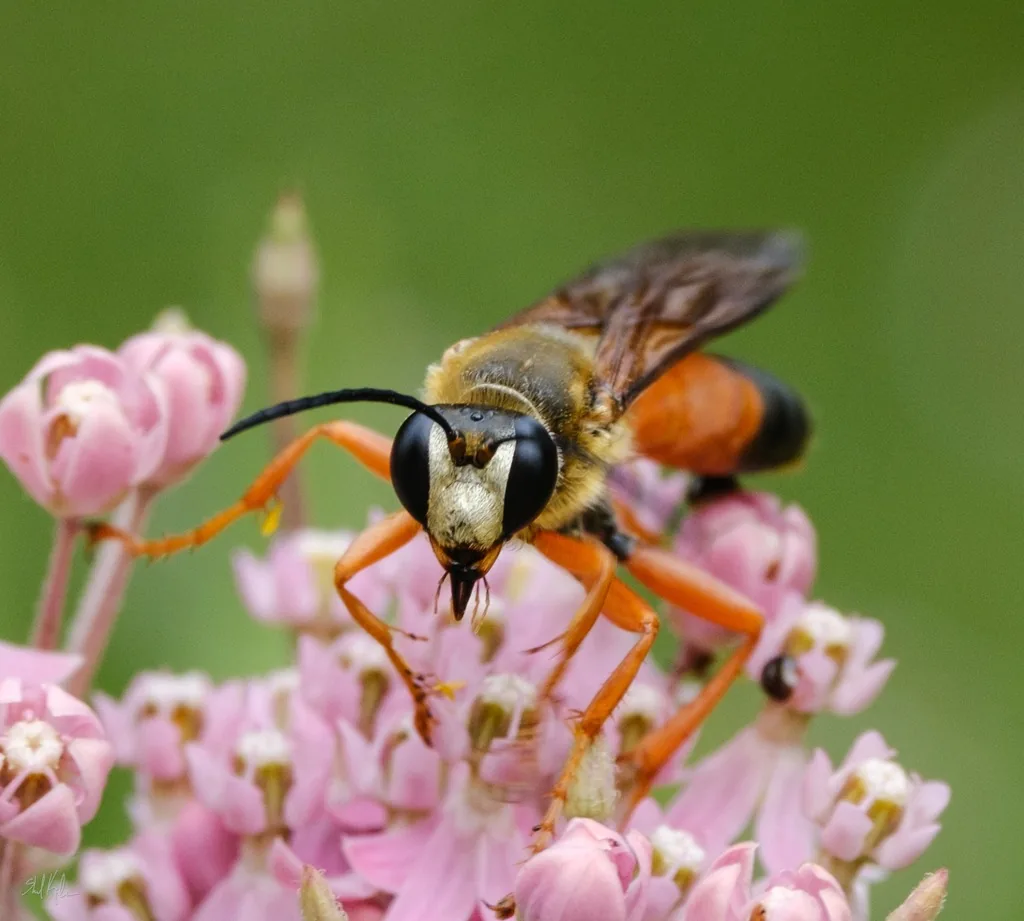
- About 1 inch long, up to roughly 1 1/2 inches; females are larger than males.[2][1]
- The black head and thorax are covered with short golden hairs.[2][1]
- The abdomen is orange to rusty red at the front and black toward the tip, and the legs are reddish orange.[2][1]
- Look for it feeding on flowers in gardens, fields and prairies, especially near sandy areas, throughout the summer.[2]
Look-alikes
| Look-alike | How to tell them apart |
|---|---|
| Cicada killer | Larger: UKY says female cicada killers are 1.5 to nearly 2 inches and males up to 1.5 inches, with three light-yellow stripes on a dark abdomen. They stock their burrows with cicadas.[4] |
Where it lives
Nests from southern Canada through the United States and south to Brazil and Peru; in Missouri it occurs statewide.[3][1]
Biology and life cycle
Each female digs a nearly vertical burrow 3 to 12 inches deep with side cells and stocks each cell with paralyzed katydids, also called long-horned grasshoppers.[3]
She lays an egg on one of the prey insects; eggs hatch in 2 to 3 days and the larvae feed for 6 to 9 days.[3]
Although each nest has one female, nests are often clustered, from a few to rarely hundreds of females in open, sunny sites with the right soil.[1][3]
Young spend the winter underground in the burrows and emerge as adults the next year; there is one generation a year in cold areas and two or more where it's warmer.[1][3]
Adults live about 1 to 2 months and feed on flower nectar.[1]
Damage and signs
Health risk
The Missouri Department of Conservation says it isn't aggressive toward people and, like other solitary wasps, lacks the nest-defending behavior of yellowjackets; University of Minnesota Extension says it doesn't harm people. For wasp stings in general, MedlinePlus says venom can cause an allergic reaction in some people, and CDC NIOSH says a sting may cause mild discomfort or pain but can cause anaphylaxis, a life-threatening reaction that needs immediate emergency care, in people allergic to venom.[1][2][5][6]
Control
Prevention
Usually none is needed. The Missouri Department of Conservation says it catches grasshoppers that eat garden plants, aerates the soil and pollinates flowers, and isn't aggressive.[1][2]
UKY says burrowing solitary wasps look for sparse, sandy soil, and that thick, well-fertilized and watered turf could discourage them from digging in a lawn.[7]
Where the sources disagree
Prey: the Missouri Department of Conservation says females stock nests with katydids and crickets; the University of Arkansas describes katydids (long-horned grasshoppers), with studies showing a preference for cone-headed and meadow grasshoppers.[1][3]
Nest size: the Missouri Department of Conservation says most nests have 2 or 3 cells; the University of Arkansas gives 2 to 7 side cells.[1][3]
Size: University of Minnesota Extension gives about 1 inch; the Missouri Department of Conservation says up to about 1 1/2 inches, with females larger than males.[2][1]
Common questions
- Will a great golden digger wasp sting me?
- It's unlikely. The Missouri Department of Conservation says it isn't aggressive, and University of Minnesota Extension says it doesn't harm people. If anyone stung develops swelling of the throat, lips or tongue, MedlinePlus lists these as allergic symptoms, and CDC NIOSH says anaphylaxis needs immediate emergency care.[1][2][5][6]
- Is it a cicada killer?
- No. Cicada killers are bigger, up to nearly 2 inches, with yellow-striped abdomens, and they hunt cicadas. Great golden diggers have orange-and-black abdomens and hunt katydids.[4][2][1]
Sources
- Missouri Department of Conservation, “Great Golden Digger Wasp (Field Guide).” mdc.mo.gov/discover-nature/field-guide/great-golden-digger-wasp (accessed 2026-11-13)
- University of Minnesota Extension, “Great Golden Digger Wasp (What Insect Is This?).” apps.extension.umn.edu/garden/diagnose/insect/general-curiosity-insects/flies/medium/greatgoldendiggerwasp.html (accessed 2026-11-13)
- University of Arkansas Arthropod Museum, “Golden Digger Wasp, Great Golden Digger (Insect of the Week).” arthropod.uark.edu/golden-digger-wasp-great-golden-digger/ (accessed 2026-11-13)
- University of Kentucky Entomology, “ENTFACT-004: Cicada Killer Wasps.” entomology.mgcafe.uky.edu/ef004 (accessed 2026-11-13)
- NIH National Library of Medicine, MedlinePlus, “Bee, wasp, hornet, or yellow jacket sting (Medical Encyclopedia).” medlineplus.gov/ency/article/002847.htm (accessed 2026-11-13)
- CDC, National Institute for Occupational Safety and Health, “Insects and Scorpions at Work (Sept. 28, 2026).” www.cdc.gov/niosh/outdoor-workers/about/insects-and-scorpions.html (accessed 2026-11-13)
- University of Kentucky Entomology, “ENTFACT-411: Yard Wasps.” entomology.mgcafe.uky.edu/ef411 (accessed 2026-11-13)
- Global Biodiversity Information Facility (GBIF), “Sphex ichneumoneus (Linnaeus, 1758) (GBIF Backbone Taxonomy).” api.gbif.org/v1/species/1347459 (accessed 2026-11-13)
- iNaturalist, “Sphex ichneumoneus taxon page (order and family).” www.inaturalist.org/taxa/85362 (accessed 2026-10-06)