On this page
How to identify it
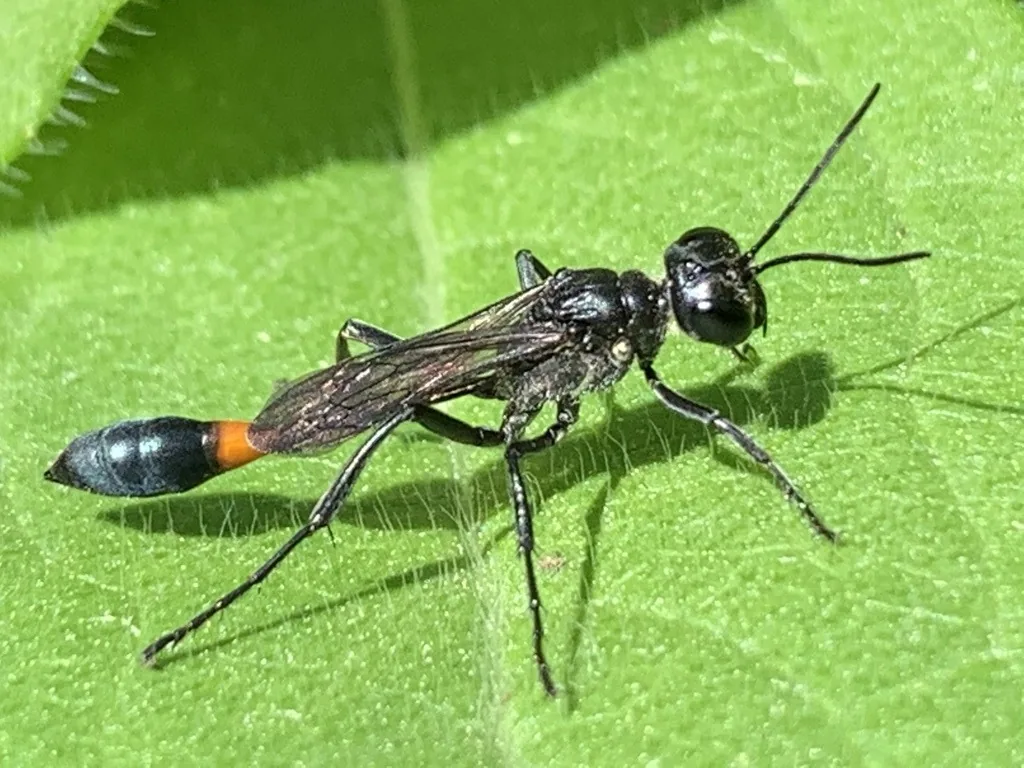
- They are medium-sized, slender wasps, usually 3/4 to 1 inch long, with some species reaching 1 1/2 inches.[1][4]
- The body is generally black with some orange on the abdomen, joined to the thorax by a very long, thread-like waist. The tip of the abdomen is straight or points down, never up.[1][4]
- Males are more slender than females and usually show less orange or red.[1][4]
- Females fly fast and low over the ground and flick their wings nervously; their wispy bodies can make them look like damselflies or ichneumon wasps at first glance.[1]
- More than 60 North American species are hard to tell apart. One of the larger ones, Ammophila procera, has silvery stripes on the thorax and ranges from southern Canada to Guatemala.[1][4]
Look-alikes
| Look-alike | How to tell them apart |
|---|---|
| Mud daubers | Mud daubers (Sceliphron and Chalybion) are close relatives in the same thread-waisted wasp family that build mud nests; Ammophila females nest in burrows dug into the ground.[1][4] |
| Great golden digger wasp | Sphex digger wasps such as the great golden digger wasp belong to the same family and hunt katydids and crickets. Ammophila is slender and generally black with some orange on the abdomen and hunts caterpillars.[1][3] |
| Ichneumon wasps | Ammophila's nervous wing flicking can make it seem like an ichneumon; the female's fast, low flight over bare ground and her digging are good clues.[1] |
Where it lives
More than 60 species live in North America, and they are hard to tell apart. In Missouri they occur statewide, and UW-Milwaukee notes they turn up wherever there are flowers and soil to dig in. GBIF holds 6137 U.S. records of the genus since 1990, the most from California (915), Florida (774) and Texas (713).[1][4][8]
Biology and life cycle
Each female nests alone. To dig, she presses her head to the soil and vibrates her flight muscles with a soft buzz, then carries it out with her jaws. She hides the entrance, hunts a caterpillar or sawfly larva, stings it, drags it into the burrow and lays a single egg on it.[1][4][2]
Species differ in how they feed their young: some give one large caterpillar per nest, while others keep returning with many smaller live caterpillars as the larva grows.[2][5]
Some close their nest with a small pebble held in their jaws, pressing the soil flat, one of the few examples of tool use in insects.[2][4]
They have good memories. In a field study in England, mothers that fed their young over several days remembered the locations of up to 9 separate nests at once and fed the offspring in order of age.[6]
Females of the European species Ammophila pubescens sometimes take over another female's nest, replacing her egg with their own and then helping to provision it.[7]
Adults drink nectar from flowers, including white sweetclover, and can carry pollen on their facial hairs. At night they may sleep clamped to a plant stem by their jaws, sometimes in groups. The larva overwinters in its cell and emerges in spring, and there can be several broods a year.[1][2][4]
They have enemies of their own: cuckoo wasps and a flesh fly sneak eggs or larvae into their nests, and tiny twisted-winged parasites (Strepsiptera) ride on the mother to her nest. Species that make many caterpillar deliveries carry a higher risk of that parasite reaching their young.[4][5]
Damage and signs
- They cause no damage. The caterpillars they hunt generally feed on plant leaves, and their digging aerates and mixes the soil and opens places for rainwater to soak in.[1]
- WSU calls thread-waisted wasps valuable in the home garden as predators of other, often pest, insects and frequent flower visitors.[3]
Health risk
Ammophila wasps live alone rather than in colonies, so they do not defend nests the way paper wasps and yellow jackets do. MDC says they are not aggressive and sting only when mishandled, and the CU Museum contrasts nest-building females with territorial, aggressive wasps such as yellowjackets. WSU says hunting wasps may look fearsome but are an asset in the garden.[1][2][3]
Control
Prevention
Leave them be. MDC encourages gardeners to appreciate these wasps because they reduce leaf-eating caterpillars, and WSU suggests native plants and avoiding regular use of broad-spectrum pesticides to keep beneficial insects around.[1][3]
Traps and physical control
Do not handle them, the only time they sting. If one is nesting in a spot you need to use, simply give it room; each burrow belongs to a single female.[1]
Pesticides
None recommended: WSU's HortSense lists no chemical management for thread-waisted wasps.[3]
Common questions
- Will Ammophila wasps sting me?
- Only if mishandled. They are solitary, have no colony to defend and are not aggressive.[1][2]
- What is the wasp dragging a caterpillar across the ground?
- It may be a female Ammophila. She paralyzes the caterpillar with her sting and drags it into a burrow she has dug, where she lays an egg on it as food for her larva.[1][2][4]
- Are they good for the garden?
- Yes. They hunt caterpillars that feed on plant leaves, visit flowers for nectar, and their digging aerates and mixes the soil. WSU calls these hunting wasps a definite asset to pest control in the home garden.[1][2][3]
- Do Ammophila wasps really use tools?
- Some do: females tamp down the soil over a finished nest with a small pebble held in their jaws. Scientists still debate whether that is instinct or something more.[2][4]
Sources
- Missouri Department of Conservation, “Ammophila Wasps (Field Guide).” mdc.mo.gov/discover-nature/field-guide/ammophila-wasps (accessed 2026-11-12)
- University of Colorado Museum of Natural History, “Sand Wasp (specimen feature: Ammophila pruinosa, 2021).” www.colorado.edu/cumuseum/node/1339 (accessed 2026-11-12)
- Washington State University HortSense, “Sphecidae: Thread-waisted Wasps (HortSense).” hortsense.cahnrs.wsu.edu/?p=6083 (accessed 2026-11-12)
- University of Wisconsin-Milwaukee Field Station, “Thread-wasted Wasps (Family Sphecidae) (Bug of the Week).” uwm.edu/field-station/thread-wasted-wasp/ (accessed 2026-11-12)
- Biol Lett 2022;18(6):20220007, via PubMed, “A double-edged sword: parental care increases risk of offspring infection by a maternally vectored parasite.” pubmed.ncbi.nlm.nih.gov/35642382/ (accessed 2026-11-12)
- Curr Biol 2025;35(11):2740-2745.e3, via PubMed, “Memory and the scheduling of parental care in an insect population in the wild.” pubmed.ncbi.nlm.nih.gov/40347945/ (accessed 2026-11-12)
- Am Nat 2023;202(5):655-666, via PubMed, “Brood Parasites That Care: Alternative Nesting Tactics in a Subsocial Wasp.” pubmed.ncbi.nlm.nih.gov/37963121/ (accessed 2026-11-12)
- Global Biodiversity Information Facility (GBIF), “Ammophila (genus): U.S. occurrence records since 1990 by state (GBIF occurrence search).” api.gbif.org/v1/occurrence/search?taxonKey=1346141&country=US&hasGeospatialIssue=false&occurrenceStatus=PRESENT&year=1990%2C2026&facet=stateProvince&facetLimit=400&limit=0 (accessed 2026-11-12)
- iNaturalist, “Ammophila taxon page (order and family).” www.inaturalist.org/taxa/83951 (accessed 2026-11-09)