On this page
How to identify it
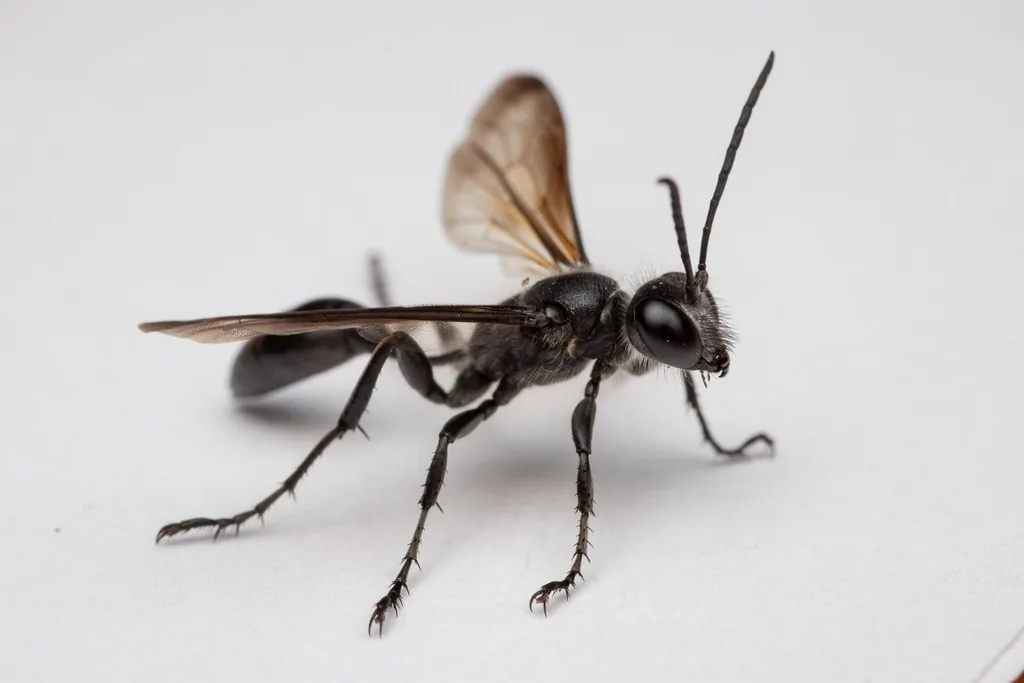
- Adults are about 0.7 inch (18 mm) long by Penn State's measure, about ¾ inch by Mississippi State's, black or reddish brown, with the abdomen on a long, thin stalk. The wings are smoky black or red-brown and may have blue reflections, and long pale, dark or golden hairs cover the thorax.[1][2]
- Nests are packed and plugged with grass that can stick out two inches; females may be seen carrying long grass blades.[1]
Look-alikes
| Look-alike | How to tell them apart |
|---|---|
| Carpenter bees | Grass-carrying wasps often reuse abandoned carpenter bee holes rather than drilling their own.[1] |
| Mud daubers | Close relatives with similar habits, but mud daubers build nests of mud and hunt spiders, while grass-carrying wasps use dried grass and hunt tree crickets, katydids and some grasshoppers.[2] |
Where it lives
Six species occur in North America, five of them in Pennsylvania. The Mexican grass-carrying wasp, Isodontia mexicana, is native to North America and has spread in Europe since it was first detected in France in 1960. GBIF holds 2757 U.S. records of I. mexicana since 1990, the most from Minnesota (335), Massachusetts (287), Washington (232) and New York (230).[1][5][6][7]
Biology and life cycle
Adults emerge in early summer, and females nest in window runners, bee hotels, hollow branches and similar spaces.[1]
Females paralyze tree crickets, katydids and other orthopterans to feed their young.[1]
Mississippi State says they use holes about ¼ to ½ inch across, horizontal or vertical: hollow plant stems and old beetle holes in nature, and drill holes, empty carpenter bee galleries, bolt holes and the tracks around aluminum windows and doors near homes. Each cell gets several paralyzed prey and a single egg.[2]
The legless larvae eat the paralyzed crickets, then spin papery cocoons in which they spend the winter, often right in a storm-window track. Adults feed on nectar and pollen. Penn State says Isodontia mexicana typically has two generations a year in Pennsylvania, and a University of Maryland entomologist says two in the mid-Atlantic.[1][3]
Fun fact: more crickets make bigger wasps. Scientists have found that cells stocked with more prey produce larger wasps.[3]
Damage and signs
- They're a minor nuisance; nests can block window tracks or folded patio umbrellas.[1]
Health risk
Females can sting if handled but aren't aggressive and don't defend their nests. If someone is stung by any wasp, MedlinePlus advises washing the site well with soap and water and putting ice wrapped in a washcloth on it for 10 minutes, then off for 10 minutes, repeating as needed. Some people have life-threatening allergic reactions (anaphylaxis), with symptoms such as difficulty breathing; for a severe reaction call 911 or the local emergency number and use the person's EpiPen or other emergency kit if they carry one.[1][4]
Control
Prevention
The same wasps don't come back: they live only one season. But Penn State notes that a spot that suited them one year will stay suitable, and may be nested in again, unless something changes.[1]
Traps and physical control
Leave nests that can stay; remove ones in window tracks or tubes by hand. Mississippi State pushed nests out of wind-chime tubes with a long, slender stick. Pesticides aren't needed or recommended, and a University of Maryland entomologist says there is no need to harm these wasps or treat them with pesticides.[1][2][3]
More from Mississippi State Extension
Mississippi State University Extension describes nests packed into wind-chime tubes: plugs of dry grass around cells stocked with paralyzed green tree crickets. These close relatives of mud daubers hunt tree crickets, katydids and some grasshoppers rather than spiders.[2]
Common questions
- Why is there grass sticking out of my window track?
- A grass-carrying wasp has likely built its nest there and plugged it with grass.[1]
- Will grass-carrying wasps sting me?
- Only if handled; they aren't aggressive and don't defend nests.[1]
- Will the wasps come back to my window next year?
- Not the same wasps, since each lives only one season, but Penn State says a spot that was suitable one year will stay suitable and may be used by new wasps unless something changes.[1]
- Are grass-carrying wasps invasive?
- Not in North America, where they are native. The Mexican grass-carrying wasp has become an introduced species in Europe since 1960.[5][6]
Sources
- Penn State Extension, “Grass-Carrying Wasp.” extension.psu.edu/grass-carrying-wasp (accessed 2026-11-12)
- Mississippi State University Extension, “Grass-carrying Wasp, Vol. 8, No. 7.” extension.msstate.edu/newsletters/bugs-eye-view/2022/grass-carrying-wasp-vol-8-no-7 (accessed 2026-11-12)
- Bug of the Week (Michael J. Raupp, University of Maryland), “Window wasps: Grass-carrying wasps, Isodontia spp. (Bug of the Week, Michael J. Raupp, Professor of Entomology, University of Maryland).” bugoftheweek.com/blog/2017/10/24/window-wasps-grass-carrying-wasps-iisodontiai-spp (accessed 2026-11-12)
- NIH National Library of Medicine, MedlinePlus, “Insect bites and stings (Medical Encyclopedia).” medlineplus.gov/ency/article/000033.htm (accessed 2026-11-12)
- BMC Ecol 2018;18(1):36, via PubMed, “Environmental niche unfilling but limited options for range expansion by active dispersion in an alien cavity-nesting wasp.” pubmed.ncbi.nlm.nih.gov/30236094/ (accessed 2026-11-12)
- Ecol Evol 2024;14(6):e11537, via PubMed, “Extracting secondary data from citizen science images reveals host flower preferences of the Mexican grass-carrying wasp Isodontia mexicana in its native and introduced ranges.” pubmed.ncbi.nlm.nih.gov/38882531/ (accessed 2026-11-12)
- Global Biodiversity Information Facility (GBIF), “Isodontia mexicana: U.S. occurrence records since 1990 by state (GBIF occurrence search).” api.gbif.org/v1/occurrence/search?taxonKey=1346919&country=US&hasGeospatialIssue=false&occurrenceStatus=PRESENT&year=1990%2C2026&facet=stateProvince&facetLimit=400&limit=0 (accessed 2026-11-12)
- iNaturalist, “Isodontia mexicana taxon page (order and family).” www.inaturalist.org/taxa/203340 (accessed 2026-10-06)