On this page
How to identify it
- Females are larger than males. Illinois gives females 1.0 to 1.3 inches and males 0.7 to 1.1 inches; Missouri gives about 1 to nearly 1 1/2 inches for the species.[2][1]
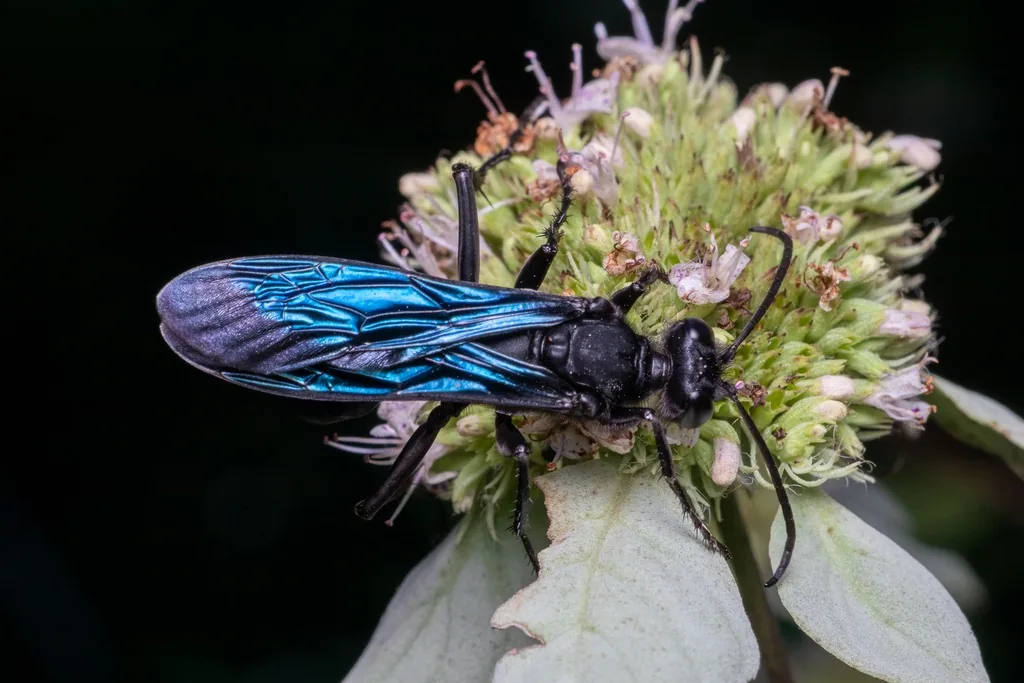
- The body is satiny black and the smoky black wings have a blue iridescence and are usually folded lengthwise down the back.[1][2]
- It has a narrow 'thread waist' between thorax and abdomen, long spiny legs and large sickle-shaped jaws with an extra prong in the middle of each curve.[1]
Look-alikes
| Look-alike | How to tell them apart |
|---|---|
| Great golden digger wasp | A very close relative in the same genus. Its abdomen is orange or rusty red in front and black at the end, and the head and thorax have golden hairs.[1][4] |
| Mud daubers | Relatives in the same family of thread-waisted digger wasps.[1] |
| Cicada killer | Another large solitary wasp that digs nests in the ground, but larger (females nearly 2 inches) and colored dark orange on the head and thorax, with pale yellow stripes on a black abdomen. It hunts annual cicadas rather than katydids.[6] |
Where it lives
Missouri finds it statewide, and Illinois lists it as common and native in prairie and edge habitats. GBIF's public U.S. records since 1990 (about 10,500) come from 40 states on the map, most from Massachusetts, Illinois and New York.[1][2][9]
Biology and life cycle
Adults are seen on flowers in open areas from July through September; Illinois describes it as active in late summer.[1][2]
Females hunt grasshoppers, katydids and crickets, sting each to paralyze it (three times, Illinois says) and carry it back to an underground nest; a single female can catch 16 hoppers a day. Illinois says she puts two to six prey with one egg in each cell; Missouri describes three hoppers per egg.[1][2]
The larva feeds on the paralyzed prey for about 10 days; catbirds and sparrows have been seen stealing prey from returning females.[2][1]
It is solitary and does not live in colonies. Thread-waisted wasps in general hunt specific prey, from spiders to caterpillars, and Washington State calls them a definite asset to pest control in the home garden.[1][5]
Damage and signs
Health risk
Only females have a stinger, which they use on prey. With no colony to defend, they do not sting people unless mistreated, and Missouri says the sting is reportedly painful. A sting may cause mild discomfort or pain, but people allergic to venom can have anaphylaxis, a severe reaction that needs emergency care.[1][5][7][8]
Control
Prevention
No control is needed. Missouri calls it a friend to gardeners and asks people not to kill these wasps out of fear, and Washington State recommends no treatment for thread-waisted wasps.[1][5]
Common questions
- What is the huge black wasp with blue wings on my flowers?
- Likely a great black wasp: a large satiny black wasp with smoky wings that shine blue, common on flowers from July to September.[1][2]
- Will it sting me?
- Rarely. Solitary wasps lack the defensive behavior of yellowjackets, and females sting people only if mistreated.[1][4]
- What does it eat?
- Adults eat nectar and pollen; larvae eat paralyzed grasshoppers, katydids and crickets.[1][2]
- What should I do if a great black wasp stings me?
- Wash the site with soap and water and apply ice wrapped in a cloth, 10 minutes on and 10 off. Have someone stay with the person to watch for an allergic reaction. Call 911 for signs of a severe reaction such as trouble breathing or swelling of the face or throat. People with a history of severe reactions should carry their emergency allergy kit.[8][7]
Sources
- Missouri Department of Conservation, “Great Black Wasp (Field Guide).” mdc.mo.gov/discover-nature/field-guide/great-black-wasp (accessed 2026-11-11)
- Illinois Department of Natural Resources, “great black wasp, Sphex pensylvanicus (Biodiversity of Illinois).” dnr.illinois.gov/education/wildaboutpages/wildaboutinvertebrates/wildaboutwasps/wabwgreatblackwasp.html (accessed 2026-11-11)
- iNaturalist, “Sphex pensylvanicus taxon page (order and family).” www.inaturalist.org/taxa/48738 (accessed 2026-11-11)
- Missouri Department of Conservation, “Great Golden Digger Wasp.” mdc.mo.gov/discover-nature/field-guide/great-golden-digger-wasp (accessed 2026-11-11)
- Washington State University Extension, Hortsense, “Sphecidae: Thread-waisted Wasps.” hortsense.cahnrs.wsu.edu/fact-sheet/sphecidae-thread-waisted-wasps/ (accessed 2026-11-11)
- University of Kentucky Entomology, “Cicada Killer Wasps (ENTFACT-004).” entomology.mgcafe.uky.edu/ef004 (accessed 2026-11-11)
- Centers for Disease Control and Prevention, NIOSH, “Insects and Scorpions at Work.” www.cdc.gov/niosh/outdoor-workers/about/insects-and-scorpions.html (accessed 2026-11-11)
- MedlinePlus, U.S. National Library of Medicine, “Insect bites and stings (Medical Encyclopedia 000033).” medlineplus.gov/ency/article/000033.htm (accessed 2026-11-11)
- Global Biodiversity Information Facility (GBIF), “Sphex pensylvanicus: occurrence records in the U.S., 1990-2026 (GBIF occurrence search).” api.gbif.org/v1/occurrence/search?taxonKey=1347505&country=US&hasGeospatialIssue=false&occurrenceStatus=PRESENT&year=1990%2C2026&facet=stateProvince&facetLimit=400&limit=0 (accessed 2026-11-11). State counts are records reported (iNaturalist research-grade, museum specimens, surveys), not abundance.