On this page
How to identify it
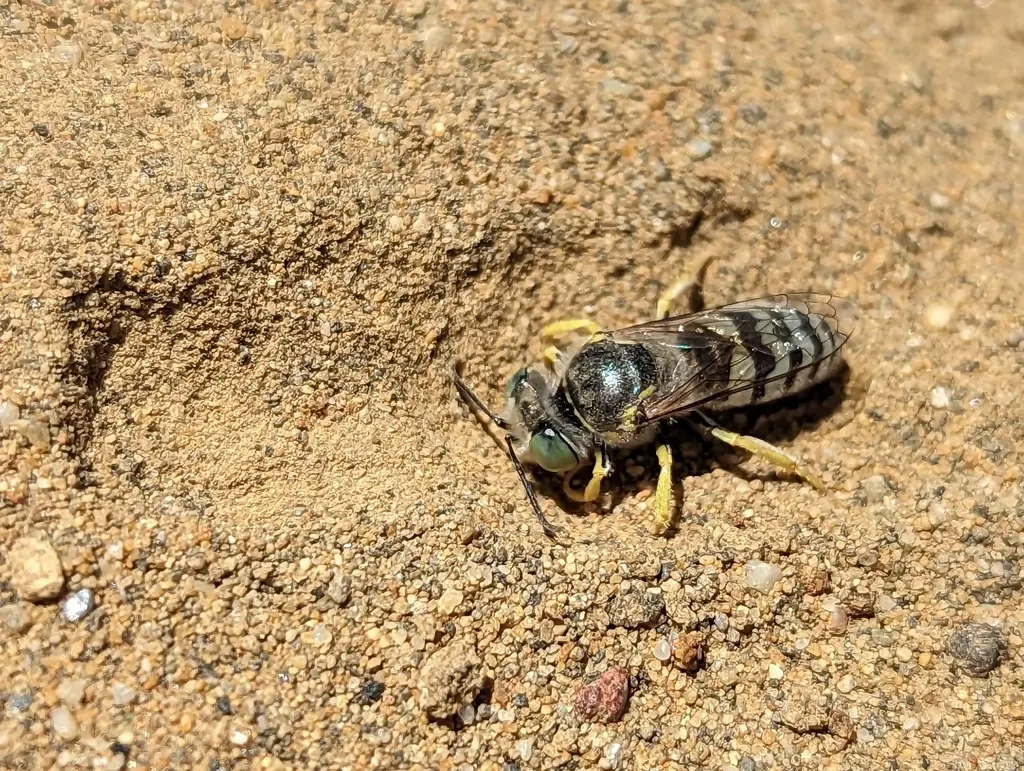
- A black-and-white wasp with green eyes. UMN Extension describes a black head and thorax, mostly yellow legs and five white to yellow bands on a black abdomen; Washington State adds a hairy gray thorax and blue-gray markings on the abdomen.[3][4][2]
- Many females often dig nests in the same small sandy patch, but each nest belongs to one female. They are not social the way paper wasps and yellowjackets are.[1][2][3]
- Adults are active from June to August and are fast, agile fliers that often catch flies in mid-air.[3][1]
Look-alikes
| Look-alike | How to tell them apart |
|---|---|
| Cicada killer | A larger ground-nesting wasp that Utah State groups with sand wasps and the Missouri Department of Conservation lists as a similar species; both often nest in bare sandy spots.[2][1] |
| Yellowjackets | Banded sand wasps are sometimes mistaken for yellowjackets. A yellowjacket ground nest has one opening with many workers going in and out, while each sand wasp burrow belongs to a single female. Yellowjackets defend their nests and are much more likely to sting.[1][3] |
Where it lives
Extension guides from Minnesota and Washington State both cover it, Washington State calling it common, and the Missouri Department of Conservation lists sand wasps statewide in Missouri, most often in open, sandy areas along rivers.[3][4][1]
Biology and life cycle
Sand wasp stings usually kill their prey rather than just paralyzing it, so the female lays her egg first and then brings fresh flies as the larva grows, like a bird feeding chicks. A single larva may eat about two dozen flies.[1][4]
When the larva has finished feeding, the female seals the nest. The larva spins a cocoon and spends the winter in it, and the new adult emerges the following year.[4][1]
Damage and signs
- Sand wasps specialize in true flies: females hunt house flies, deer flies, mosquitoes and other flies, and their hunting peaks in summer, about when flies become most bothersome.[1]
- Large numbers nesting in a lawn, garden or sandbox can be a nuisance and worry people, especially where children play.[3]
Health risk
They are not aggressive and rarely sting. They don't defend their nests, but a female can sting if handled or stepped on barefoot, and the sting is painful. Their habit of hovering close to people is hunting flies drawn to the person, not aggression.[1][2][3]
Control
Prevention
Bare sandy soil is what draws them. Renovate bare spots with turf or other cover; in a sandbox or play area, frequent raking or a tarp laid over the nests for several days may push them to nest somewhere else.[2][3]
Biological control
Leave them be where you can: they catch pest flies, they are active for just a few weeks, and they don't reuse old nests the next year.[1][3]
Pesticides
Don't use pesticides where children play. In a lawn, if the nests can't be tolerated, UMN Extension says the best option is an insecticidal dust labeled for ground-nesting insects applied to each nest; spraying the area with a liquid is not very effective.[3]
If you are stung
Wash the sting with soap and water and apply ice wrapped in a cloth, 10 minutes on and 10 minutes off. An antihistamine or an anti-itch cream can help, and someone should stay with the person to watch for an allergic reaction.[5][6]
Call 911 for trouble breathing or wheezing, swelling of the face or mouth, throat tightness or trouble swallowing, weakness, or turning blue. People with a history of severe sting reactions should carry their prescribed epinephrine auto-injector.[5][6]
Where sources disagree
Size: UMN Extension gives 1/2 to 5/8 inch and Washington State about 1/2 inch for the American sand wasp. The Missouri Department of Conservation lists about 3/4 to 1 inch for sand wasps as a group and calls this species one of the largest.[3][4][1]
Prey: Washington State says crabronid wasps paralyze their prey; the Missouri Department of Conservation says sand wasp stings generally kill the flies outright.[4][1]
Common questions
- Why are wasps hovering around me in the yard?
- Sand wasps often hover near people to catch flies attracted to them; it isn't aggression.[1]
- Will sand wasps sting kids in the sandbox?
- They rarely sting and don't defend their nests, but one can sting if grabbed or stepped on. Skip pesticides where children play; raking the sand often or covering it with a tarp for several days may move them along.[3][1]
Sources
- Missouri Department of Conservation, “Sand Wasps (Field Guide).” mdc.mo.gov/discover-nature/field-guide/sand-wasps (accessed 2026-11-11)
- Utah State University Extension (Integrated Pest Management), “Sand Wasps / Cicada Killer (nuisance pest fact sheet).” extension.usu.edu/planthealth/ipm/notes_nuisance/sand-wasp-cicada-killer.php (accessed 2026-11-11)
- University of Minnesota Extension, “Solitary wasps.” extension.umn.edu/garden-and-home/yard-and-garden/yard-and-garden-insects/solitary-wasps (accessed 2026-11-11)
- Washington State University Extension, “Crabronidae: Square-headed wasps, Sand wasps (HortSense).” hortsense.cahnrs.wsu.edu/fact-sheet/crabronidae-square-headed-wasps-sand-wasps/ (accessed 2026-11-11)
- MedlinePlus, U.S. National Library of Medicine, “Insect bites and stings (Medical Encyclopedia).” medlineplus.gov/ency/article/000033.htm (accessed 2026-11-11)
- Centers for Disease Control and Prevention, NIOSH, “Insects and Scorpions at Work.” www.cdc.gov/niosh/outdoor-workers/about/insects-and-scorpions.html (accessed 2026-11-11)
- iNaturalist, “Bembix americana taxon page (order and family).” www.inaturalist.org/taxa/53072 (accessed 2026-11-11)