On this page
How to identify it
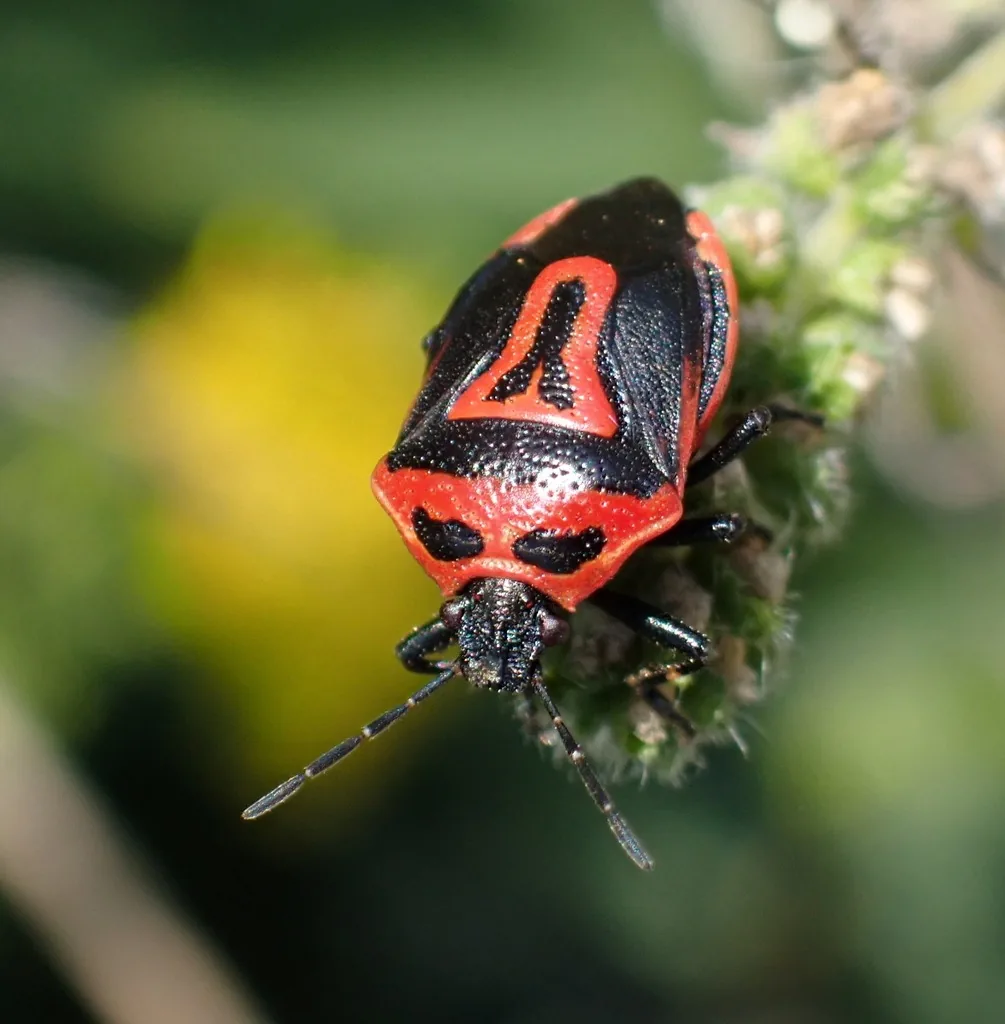
- Adults are shield shaped and black with a contrasting color, usually red-orange, pale green, white or yellowish. UC IPM gives their length as about 2/5 inch (10 mm); Oregon State gives 10 to 12 mm.[1][2]
- Two black marks on the segment just behind the head give the species its name.[1]
- Eggs are barrel shaped, green turning blackish, with a ring of short spines around the top.[1]
- Older nymphs are black with white and orange, red or yellow; the youngest have a black head and thorax and a mostly red abdomen. Oregon State notes a black Y-shaped mark on the nymph's pronotum, and grown nymphs reach 8 to 9 mm.[1][2]
Look-alikes
| Look-alike | How to tell them apart |
|---|---|
| Spined soldier bug | Its eggs have longer spines around the rim, and its first nymphs look much like those of the twospotted stink bug.[1] |
| Plant-feeding stink bugs | Predatory stink bugs hold the beak forward to feed; plant feeders point it downward.[1] |
Where it lives
In North America, adults and nymphs turn up in almost any crop and in gardens, landscapes and wildlands. Released in Europe against the Colorado potato beetle, it has small established populations in the Balkans, southern Russia and Türkiye, and after its first Hungarian record in October 2023 it was found across Hungary by June 2024.[1][3]
Biology and life cycle
UC IPM says a female lays about 200 eggs, which hatch in about a week. On potatoes, Oregon State describes compact double rows of 18 to 25 eggs on the upper sides of leaves, hatching in 5 to 8 days.[1][2]
The first nymphs stay by their egg shells and suck plant juices; later nymphs hunt.[1]
Egg to adult takes about a month in California, with several generations a year (UC IPM), or 25 to 30 days in a Northwest summer (Oregon State). Where winters are cold, adults overwinter in bark crevices, ground litter or soil at field edges, and some move into buildings.[1][2]
Damage and signs
- It has been recorded on more than 40 pest species, including caterpillars, beetle larvae and sawflies.[1]
- Counts differ a little. UC IPM says an adult eats about 80 leaf beetle larvae during its roughly six-week life; Oregon State says adults may eat up to 85 Colorado potato beetle larvae over six weeks.[1][2]
- Oregon State cites studies in which nymphs ate an average of 285 Colorado potato beetle eggs, 3.7 larvae and 5.1 adults while growing up, and the last two nymph stages ate up to 59 eggs a day at 24°C (75°F).[2]
Health risk
UC IPM and Oregon State describe it only as a predator of other insects. Neither mentions any risk to people or pets.[1][2]
Control
Prevention
Skip persistent, broad-spectrum insecticides, which are toxic to predators like this one.[1]
Biological control
Leave it be: several may feed together on one prey, and it attacks leaf beetle eggs and larvae.[1]
Grow flowering plants for adults and control ants, which attack natural enemies.[1]
Can it control Colorado potato beetle?
Sometimes, but rarely alone. Oregon State says it would take about 1.5 of these predators per plant to wipe out the beetle in a week, while potato fields typically have fewer than 0.5. It adds that killing every beetle isn't needed to avoid economic damage.[2]
Its use against the beetle goes back decades. Hungarian researchers say it was introduced in several European countries for that purpose, and the attempts were thought to have failed until small self-sustaining populations were found.[3]
The same study reports beetle larvae and moth caterpillars as other prey in Europe, which fits with its spread there.[3]
Common questions
- Is the black and red stink bug on my potatoes a pest?
- It may be the twospotted stink bug, a predator of beetle larvae; check for two black marks behind the head.[1]
- How much does it eat?
- UC IPM says a nymph can eat 300 to 400 leaf beetle eggs, and Oregon State recorded an average of 285 Colorado potato beetle eggs per nymph. Adults eat roughly 80 to 85 larvae in about six weeks.[1][2]
- Does it help against Colorado potato beetle?
- Yes. It eats the beetle's eggs, larvae and adults, but Oregon State says it rarely gets numerous enough to control the beetle by itself.[2][1]
Sources
- University of California Statewide IPM Program, “Twospotted Stink Bug (Natural Enemies Gallery).” ipm.ucanr.edu/natural-enemies/twospotted-stink-bug/ (accessed 2026-11-13)
- Oregon State University (Potato Pests of the Western States, adapted from WREP Pub. 64), “Two Spotted Stink Bug (Potato Insects of the Western States, adapted from Bishop et al. 1982, WREP Pub. 64).” hopper.science.oregonstate.edu/potato/stinkbugs.pdf (accessed 2026-11-13)
- Sci Rep 2024;14:21494, via PubMed, “Past, present and future of the two-spotted stink bug (Perillus bioculatus) in Europe revealed by citizen science (Kóbor & Brhane, 2024).” pubmed.ncbi.nlm.nih.gov/39277632/ (accessed 2026-11-13)
- Global Biodiversity Information Facility (GBIF), “Perillus bioculatus (Fabricius, 1775) (GBIF Backbone Taxonomy).” api.gbif.org/v1/species/2079151 (accessed 2026-11-13)
- iNaturalist, “Perillus bioculatus taxon page (order and family).” www.inaturalist.org/taxa/143548 (accessed 2026-10-06)