On this page
How to identify it
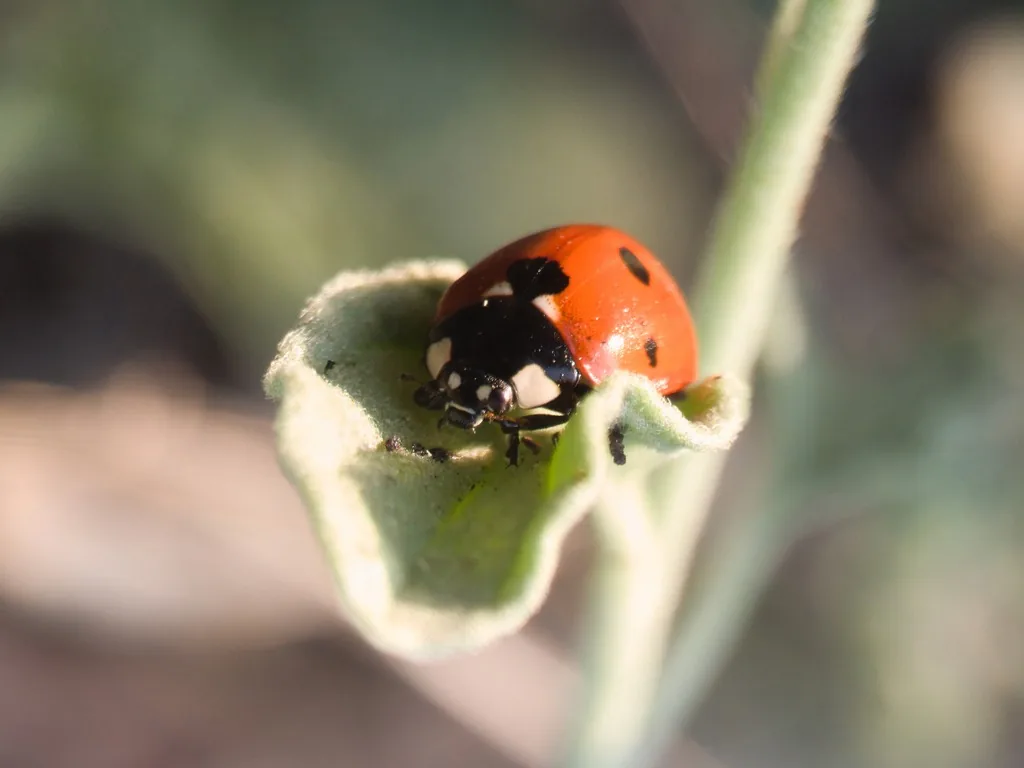
- Adults are large for a lady beetle, almost 1/3 inch (8 mm) long and about 1/6 inch (4 mm) wide: round from above, domed on top and flat underneath.[5][1]
- The orange or reddish wing covers carry seven black spots.[5][1][3]
- The head and thorax are black with a white blotch on each side, and there is white along the front edge of the wing covers too, six pale blotches in all.[5][1]
- Larvae look like tiny alligators, blackish, dark brown or dark gray with orange or yellowish spots, and grow to about 1/3 inch. Eggs are orange or yellowish, spindle shaped, about 1/25 inch long and stand on end in clusters of about 10 to 30.[5]
Look-alikes
| Look-alike | How to tell them apart |
|---|---|
| Other spotted lady beetles | Many aphid-eating lady beetles are orange with black spots. The seven spots plus the pale blotches on the head, thorax and front of the wing covers usually set this one apart, though UC IPM notes a sure identification takes an expert examining dissected males.[5] |
| Nine-spotted lady beetle | A native relative in the same genus, Coccinella novemnotata, which has declined sharply in North America since the sevenspotted lady beetle became established.[6][7] |
| Multicolored Asian lady beetle | Another lady beetle introduced for aphid control. Its adults range from heavily spotted to spotless, and overwintering adults often move into buildings, sometimes in very large numbers.[2][4] |
Where it lives
Native to Eurasia. It was introduced into North America in the middle of the 20th century and is now established on the continent: it is established in Colorado, Kentucky Extension calls it common on many crops, and it may be the most common of at least 12 Coccinella species in California. Researchers have also studied it in Missouri and eastern Washington.[1][2][3][5][8][4]
Biology and life cycle
A female lays about 200 to 300 eggs over a growing-season life of about two months.[5]
Egg to adult takes about six weeks in the growing season, with up to five generations a year.[5]
Egg laying stops as days shorten, and adults spend the winter in protected places.[5]
Adults fly well and move between plants and places all season wherever aphids build up.[5]
Young larvae pierce their prey and suck out the contents; older larvae and adults chew and can eat the whole insect.[5]
Damage and signs
- It eats aphids above all, plus mealybugs, psyllids, whiteflies and leaf beetle larvae.[5][3]
- Lab studies point to it as a threat to native lady beetles: native larvae paired with it were more often eaten than the eaters, and it ate eggs of the native nine-spotted lady beetle more often than its own.[4][6][7]
Health risk
It is a predator of soft-bodied insects, not a household pest, and no cited source describes any risk to people or pets.[5][1][3]
Control
Prevention
Leave it alone, and learn to recognize its larvae: the dark, alligator-like insects hunting aphids on your plants.[5][3]
Biological control
Add plants that provide pollen and nectar, and spray insecticides only when needed, choosing selective products or limited treatments so lady beetles survive.[3]
Pesticides
Systemic insecticides can reach flowers. In a lab study, imidacloprid applied to the soil at nursery rates moved into flowers and killed three other lady beetle species, though it did not significantly reduce survival of the sevenspotted lady beetle.[9]
Is it pushing out native lady beetles?
Native lady beetles such as the nine-spotted lady beetle declined in North America after the sevenspotted and multicolored Asian lady beetles were introduced for aphid control, and many researchers link the two.[6][4][8]
When aphids were scarce in lab tests, only 6 percent of nine-spotted larvae survived alongside sevenspotted larvae, against 61 percent when aphids were plentiful. The size gap between the two species seems to explain the difference.[7]
Not every study agrees on the cause. A Missouri study of 118 years of lady beetle records found the native community has changed, but gradually, with no abrupt shift after the exotic species arrived, and suggests land-use change may have mattered more.[8]
Where the sources disagree
Size: UC IPM calls the adult relatively large, almost 1/3 inch (8 mm) long, while Kentucky Extension calls it a medium-sized lady beetle.[5][3]
Identification: the Missouri Department of Conservation says to identify it by the white spot on each side of the head and the 7 black spots on the wing covers; UC IPM says those marks generally separate it from other common lady beetles, but positive identification requires an expert to dissect and examine males.[1][5]
Native declines: lab studies from Washington State and Cornell found native lady beetle larvae and eggs were eaten by the sevenspotted lady beetle more often than the reverse, and the Cornell authors describe precipitous declines of the nine-spotted lady beetle after it became established; a Missouri study of 118 years of records found gradual change with no abrupt shift after the exotic species arrived and suggests land-use change may have played a larger role.[4][6][7][8]
Common questions
- Is the sevenspotted lady beetle native?
- No. It is native to Eurasia and was introduced to North America to control aphids.[1][2][3]
- How do the larvae eat aphids?
- Young larvae pierce aphids and suck out the contents, while older larvae and adults chew and eat whole insects.[5]
- Is the 'C-7' lady beetle the same insect?
- Yes. Kentucky Extension notes the sevenspotted lady beetle is sometimes called C-7.[3]
Sources
- Missouri Department of Conservation, “Seven-Spotted Lady Beetle (Field Guide).” mdc.mo.gov/discover-nature/field-guide/seven-spotted-lady-beetle (accessed 2026-11-13)
- Colorado State University Extension, “Lady Beetles (Fact Sheet 5.594).” extension.colostate.edu/topic-areas/insects/lady-beetles-5-594/ (accessed 2026-11-13)
- University of Kentucky Entomology, “Ladybugs (ENTFACT-702).” entomology.mgcafe.uky.edu/ef702 (accessed 2026-11-13)
- Oecologia, via PubMed, “Snyder, Clevenger and Eigenbrode (2004), Intraguild predation and successful invasion by introduced ladybird beetles.” pubmed.ncbi.nlm.nih.gov/15179586/ (accessed 2026-11-13)
- University of California Statewide IPM Program, “Sevenspotted Lady Beetle (Natural Enemies Gallery).” ipm.ucanr.edu/natural-enemies/sevenspotted-lady-beetle/ (accessed 2026-11-13)
- PLoS One, via PubMed, “Turnipseed, Ugine and Losey (2015), Egg predation by the introduced lady beetle, Coccinella septempunctata, lowers mortality but raises relative risk for the native lady beetle, Coccinella novemnotata.” pubmed.ncbi.nlm.nih.gov/26090935/ (accessed 2026-11-13)
- Environmental Entomology, via PubMed, “Tumminello, Ugine and Losey (2015), Intraguild interactions of native and introduced coccinellids: the decline of a flagship species.” pubmed.ncbi.nlm.nih.gov/26308807/ (accessed 2026-11-13)
- Environmental Entomology, via PubMed, “Diepenbrock, Fothergill, Tindall, Losey, Smyth and Finke (2016), The influence of exotic lady beetle establishment on the species composition of the native lady beetle community in Missouri.” pubmed.ncbi.nlm.nih.gov/27271949/ (accessed 2026-11-13)
- PLoS One, via PubMed, “Krischik, Rogers, Gupta and Varshney (2015), Soil-applied imidacloprid translocates to ornamental flowers and reduces survival of adult Coleomegilla maculata, Harmonia axyridis, and Hippodamia convergens lady beetles, and larval Danaus plexippus and Vanessa cardui butterflies.” pubmed.ncbi.nlm.nih.gov/25799432/ (accessed 2026-11-13)
- Global Biodiversity Information Facility (GBIF), “Coccinella septempunctata Linnaeus, 1758 (GBIF Backbone Taxonomy).” api.gbif.org/v1/species/4990191 (accessed 2026-11-13)