On this page
How to identify it
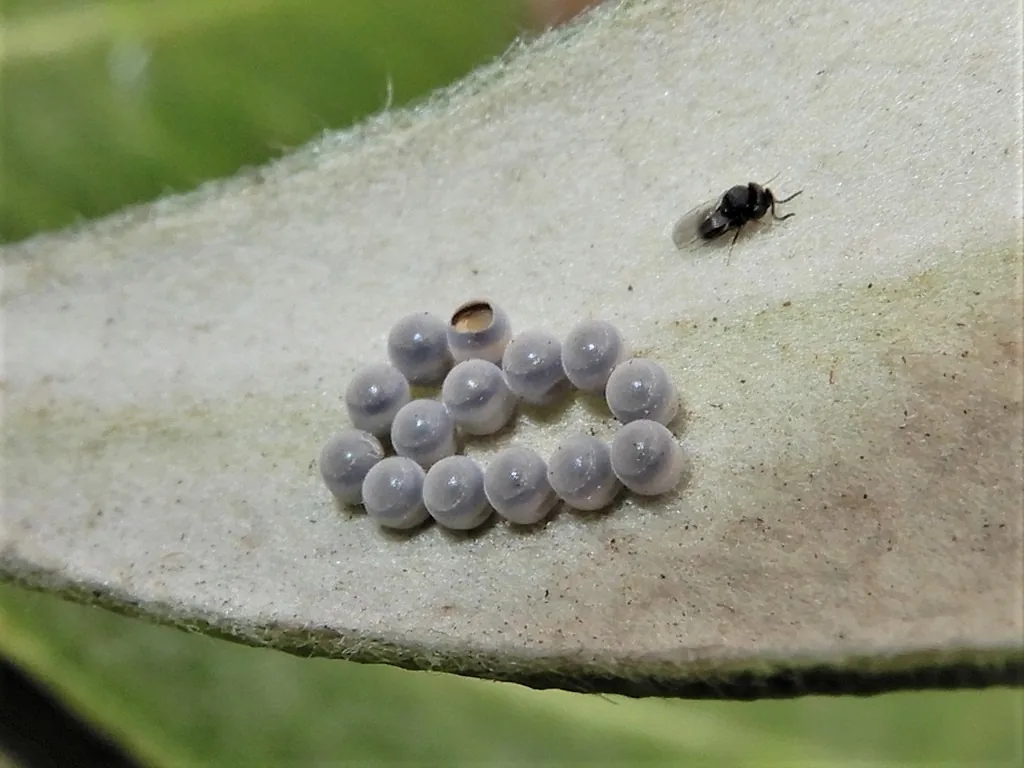
- Adults are mostly black, stout wasps about 1/16 inch (1.5 mm) long, with clear wings, elbowed antennae and a flat-topped abdomen.[1][2]
- Parasitized stink bug eggs darken, and the emerging wasp chews a rough-edged hole.[1][2]
- Hatched stink bug eggs stay pale, with a smooth round opening and the cap often still hinged on.[1]
Look-alikes
| Look-alike | How to tell them apart |
|---|---|
| Hatched stink bug eggs | A stink bug nymph leaves a pale shell with a clean round opening; a wasp leaves a darkened shell with a ragged hole.[1] |
| Anastatus wasps | Another wasp that parasitizes brown marmorated stink bug eggs; the samurai wasp is smaller and wider.[2] |
Where it lives
Six Trissolcus species occur in California, where T. basalis from Italy, France and Spain was released in 1987 to 1989. The samurai wasp, native to China, Japan and Korea, was first detected in North America in 2014; Oregon State records it in Vancouver, Washington, in 2015 and Portland in 2016, and Utah State Extension reports it was found in Salt Lake City in June 2019.[1][3][2][4]
Biology and life cycle
Adults mate as soon as they emerge, and the female puts one egg in each stink bug egg.[1]
A female lays about 200 eggs in a life of about a month, then marks parasitized eggs so others skip them.[1]
Females and males guard parasitized egg masses; adults overwinter in ground litter.[1]
Egg to adult takes two to three weeks in warm weather, with several generations a year.[1]
Damage and signs
- T. basalis parasitizes southern green stink bug eggs and those of other stink bugs, including conchuela, harlequin, redshouldered, Say and Uhler stink bugs. Sources differ on how choosy the samurai wasp is: Oregon State says it restricts egg laying to brown marmorated stink bug eggs, but a 2019 field study near Vancouver, Washington, found it also parasitized three native stink bugs at low rates, 0.4 to 8% of eggs versus 77% on brown marmorated stink bug, and judged the impact on them probably minimal.[1][2][3]
Health risk
Trissolcus wasps develop only inside stink bug eggs, and none of the UC IPM, Oregon State or Utah State fact sheets describes a risk to people.[1][2][4]
Control
Biological control
Southern green stink bug was first found in California in 1986. After T. basalis was introduced for classical biological control, UC IPM says it commonly parasitizes the majority of southern green stink bug egg masses.[1]
Plant nectar sources such as alyssum, in bloom by early April when the adults become active.[1]
Avoid broad-spectrum, persistent insecticides, which are toxic to these and other natural enemies.[1]
Utah State Extension calls the samurai wasp the most promising biological control agent for brown marmorated stink bug, describing it as uniquely evolved to lay its eggs inside that bug's eggs.[4]
Common questions
- What does the samurai wasp do?
- It lays eggs inside brown marmorated stink bug eggs, and wasps rather than stink bugs emerge.[2]
- How can I tell a parasitized stink bug egg mass?
- Parasitized eggs darken and show rough exit holes; hatched eggs are pale with smooth round openings.[1][2]
- What does a healthy brown marmorated stink bug egg mass look like?
- Utah State describes light green eggs, usually on the undersides of leaves, each showing a black triangle on its cap; nymphs hatch after five to seven days. Eggs parasitized by the samurai wasp turn dark gray or black with no triangle.[4]
Sources
- University of California Statewide IPM Program, “Stink Bug Trissolcus Parasitoids (Natural Enemies Gallery).” ipm.ucanr.edu/natural-enemies/stink-bug-trissolcus-parasitoids/ (accessed 2026-11-13)
- Oregon State University Extension Service, “Samurai Wasp: Promising egg parasitoid for management of Brown Marmorated Stink Bug (EM 9164).” extension.oregonstate.edu/sites/extd8/files/documents/em9164.pdf (accessed 2026-11-13)
- J Insect Sci 2019;19(4):15, via PubMed, “Trissolcus japonicus (Hymenoptera: Scelionidae) Causes Low Levels of Parasitism in Three North American Pentatomids Under Field Conditions (2019).” pubmed.ncbi.nlm.nih.gov/31393980/ (accessed 2026-11-13)
- Utah State University Extension, “The Samurai Wasp: New Hope in Fight Against BMSB.” extension.usu.edu/pests/research/brown-marmorated-stink-bug-samurai-wasp (accessed 2026-11-13)
- Global Biodiversity Information Facility (GBIF), “Trissolcus Ashmead, 1893 (GBIF Backbone Taxonomy).” api.gbif.org/v1/species/1402783 (accessed 2026-11-13)
- iNaturalist, “Trissolcus taxon page (order and family).” www.inaturalist.org/taxa/250421 (accessed 2026-10-06)