On this page
How to identify it
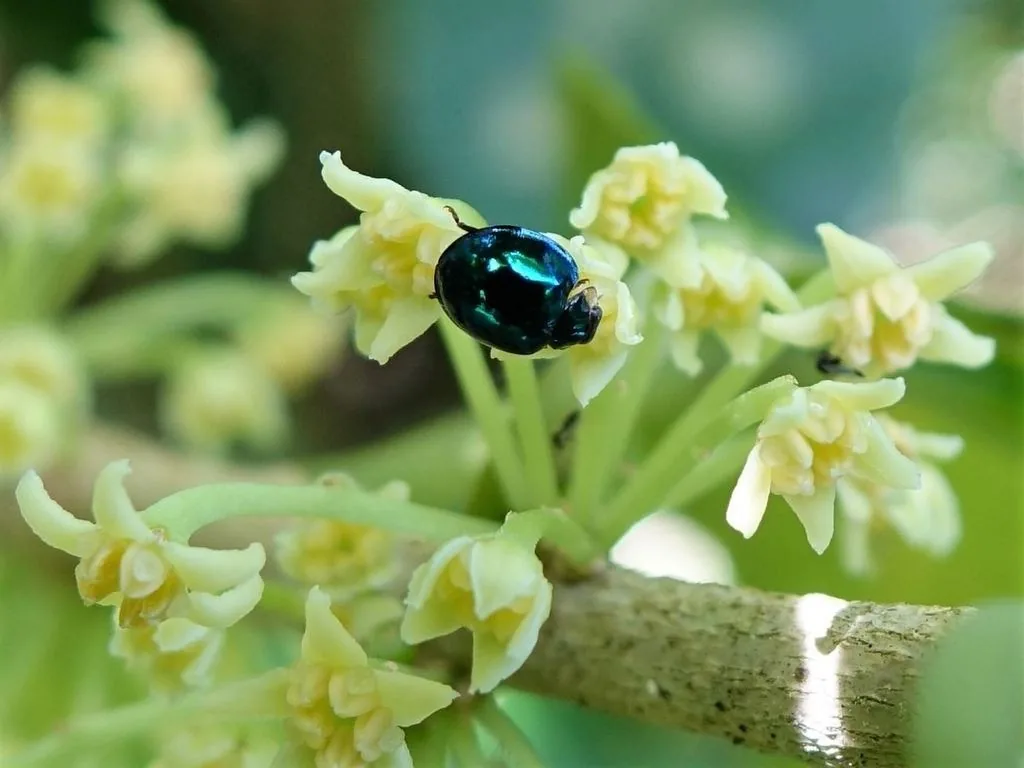
- Adults are metallic dark blue, green or purple, round and domed, about 1/8 to 1/6 inch long.[1]
- Females are uniformly dark; males have orange or yellow on the head and thorax edges.[1]
- The lower edges of the wing covers flare out into a ridge.[1]
- Larvae are pale yellow to whitish when they hatch and carry many short, branched spines; as they grow they develop blackish to dark gray blotches, and mature larvae are about 1/5 to 1/4 inch long.[1]
- Eggs are football-shaped, pale orange to yellow, a little under 1/25 inch long, and laid on end in a loose group.[1]
Look-alikes
| Look-alike | How to tell them apart |
|---|---|
| Exochomus metallicus | This dark metallic blue lady beetle is the same size but covered in fine short hairs; the steelblue lady beetle is smooth and hairless.[1] |
Where it lives
UC IPM says it was introduced from Australia into Southern California in 1892 to control mealybugs and scale insects on citrus and now occurs in at least coastal Central and Southern California. Studies have also found it in Hawaii, in macadamia orchards on the island of Hawaii and in an upland swamp on Kauai.[1][2][5]
Biology and life cycle
Females lay eggs near prey, mostly by scale insects, and larvae pupate in the open on plants.[1]
Egg to reproductive adult takes about five weeks in warm weather, with several generations a year.[1]
Adults often overwinter in groups in ground litter or dense lower foliage.[1]
Damage and signs
Health risk
It's a predator of scale insects and other small plant-feeding insects, and no cited source describes any risk to people or pets.[1]
Control
Prevention
No control is needed: UC IPM lists it as a natural enemy that eats scale insects, not as a pest.[1]
Biological control
UC IPM says to help it by controlling ants, which attack lady beetles, growing flowering plants that feed adult natural enemies, hosing dust off small plants, and avoiding broad-spectrum, persistent insecticides, which are toxic to natural enemies. In an Australian citrus study, keeping ants off the trees raised predation of red scale by this beetle and two other lady beetles.[1][4]
More from the research literature
In Hawaii, a 2018 study of macadamia orchards on the island of Hawaii infested with macadamia felted coccid, an invasive scale first found there in 2005, listed the steelblue lady beetle among the most abundant predatory beetles in the trees, and DNA tests of the gut contents of beetles collected in the orchards confirmed that it eats the coccid.[2]
Introduced predators can also spread into wild areas. A 2004 survey of an upland swamp on Kauai found the steelblue lady beetle was the most numerous introduced biocontrol beetle there; the authors noted it is known to eat moth eggs and developed DNA gut tests to study whether such predators feed on native Hawaiian moths.[5]
Common questions
- What is the shiny blue ladybug on my citrus?
- In coastal California it's likely the steelblue lady beetle, a scale predator.[1]
- Why do some have orange heads?
- Those are males; females are dark all over.[1]
- Should I get rid of steelblue lady beetles?
- No. UC IPM describes it as a natural enemy of scale insects and suggests protecting it by controlling ants and avoiding persistent broad-spectrum insecticides.[1]
Sources
- University of California Statewide IPM Program, “Steelblue Lady Beetle (Natural Enemies Gallery).” ipm.ucanr.edu/natural-enemies/steelblue-lady-beetle/ (accessed 2026-11-13)
- Peer-reviewed literature (PubMed), “PCR-Based Gut Content Analysis to Detect Predation of Eriococcus ironsidei by Coccinellidae Species in Macadamia Nut Orchards in Hawaii (Journal of Economic Entomology, 2018).” pubmed.ncbi.nlm.nih.gov/29474561/ (accessed 2026-11-13)
- Global Biodiversity Information Facility (GBIF), “Halmus chalybeus (Boisduval, 1835) (GBIF Backbone Taxonomy).” api.gbif.org/v1/species/1043714 (accessed 2026-11-13)
- Bulletin of Entomological Research (via PubMed), “Ant-coccid mutualism in citrus canopies and its effect on natural enemies of red scale, Aonidiella aurantii (Dao et al., 2014) (abstract).” pubmed.ncbi.nlm.nih.gov/23597035/ (accessed 2026-11-13)
- Molecular Ecology (via PubMed), “Infiltration by alien predators into invertebrate food webs in Hawaii: a molecular approach (Sheppard et al., 2004) (abstract).” pubmed.ncbi.nlm.nih.gov/15189227/ (accessed 2026-11-13)