On this page
How to identify it
- Greenhouse whitefly pupae parasitized by E. formosa turn black, and the wasp leaves a round exit hole in the dark case.[1]
- An unparasitized whitefly leaves a ragged or T-shaped slit in a clear to whitish, empty case.[1]
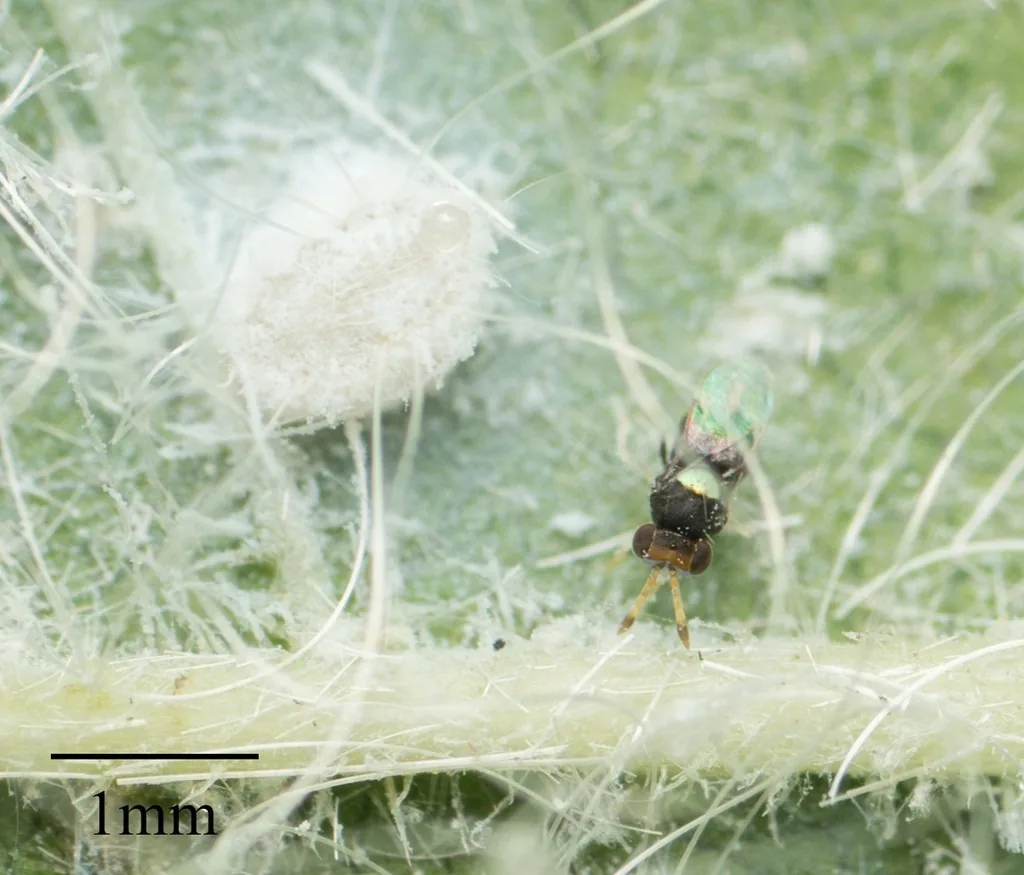
- E. formosa females have a black or dark-brown head and thorax and a yellow abdomen; the rare males are all dark. Size figures differ: UC IPM gives about 1/60 inch (0.4 mm), K-State 1/20 inch (1.0 mm), and NC State simply less than 1/16 inch.[1][3][2]
- The black color is clearest on greenhouse whitefly. NC State notes that silverleaf whitefly nymphs darken only slightly when parasitized.[2]
Look-alikes
| Look-alike | How to tell them apart |
|---|---|
| Whiteflies hit by other Encarsia | Hosts of E. pergandiella turn yellow then brown, and after that wasp leaves the empty case is pale, not black.[1] |
| Normal whitefly pupal cases | A whitefly that emerged on its own leaves a T-shaped slit in a clear, empty case.[1] |
Where it lives
UC IPM says E. formosa occurs naturally outdoors wherever greenhouse whitefly does, and at least 30 Encarsia species live in California. NC State calls it cosmopolitan, spread by greenhouse releases around the world.[1][2]
Biology and life cycle
Females lay one egg per whitefly, preferring third and fourth instar nymphs.[1]
The larva feeds inside for about 10 days, turns the host black at the pupal stage, then pupates and chews out.[1]
Over a two-week life a female parasitizes about five whiteflies a day and kills about three more by feeding on them.[1]
Females reproduce without mating. K-State puts egg laying at 10 to 15 a day and 150 to 300 in a lifetime, while NC State gives 5 to 10 a day; K-State adds that a female skips nymphs another female has already parasitized.[3][2]
Adults emerge over one to two weeks at 68 to 77°F, and K-State says females live 10 to 30 days, feeding on honeydew. Host feeding often kills the whitefly outright.[3][2]
Damage and signs
Health risk
NC State's fact sheet calls Encarsia formosa harmless to humans, and UC IPM and K-State describe it only as a parasite of whiteflies.[2][1][3]
Control
Biological control
Releases work best when started while whiteflies are still scarce, a few per plant.[1]
It is sold on release cards, each carrying about 50 parasitized whiteflies. K-State says to hang cards on lower leaves, keep them dry and take down yellow sticky cards before releasing; UC IPM lists ornamental and flower crops, tomatoes and strawberries as common release crops.[3][1]
Control ants and avoid broad-spectrum, persistent insecticides, which kill the wasps.[1]
The wasps need whiteflies to stay. NC State warns that without a resident whitefly population, released wasps disperse or die.[2]
Pesticides
If adult whiteflies need knocking down, NC State says insecticidal soap kills them without harming Encarsia developing inside the nymphs, and it leaves no residue.[2]
Common questions
- Why are some whitefly pupae turning black?
- Black greenhouse whitefly pupae usually mean Encarsia formosa is developing inside.[1]
- Can I buy Encarsia?
- Yes. E. formosa is reared commercially and released against whiteflies on ornamentals, tomatoes and strawberries.[1]
- Does greenhouse temperature matter?
- Yes, though sources set the line differently. K-State says E. formosa is most active above 64°F and does best at 68 to 81°F with 50 to 80% humidity, and that short days and cool, dry air reduce its effectiveness. NC State says it is less effective below 75°F.[3][2]
Sources
- University of California Statewide IPM Program, “Whitefly Encarsia formosa Parasitoid (Natural Enemies Gallery).” ipm.ucanr.edu/natural-enemies/whitefly-encarsia-formosa-parasitoid/ (accessed 2026-11-13)
- NC State Extension, “Encarsia formosa.” content.ces.ncsu.edu/iencarsia-formosai (accessed 2026-11-13)
- Kansas State University Research and Extension, “Encarsia formosa: Biological Control Agent of the Greenhouse Whitefly (MF3621).” bookstore.ksre.ksu.edu/download/encarsia-formosa-biological-control-agent-of-the-greenhouse-whitefly_MF3621 (accessed 2026-11-13)
- Global Biodiversity Information Facility (GBIF), “Encarsia Förster, 1878 (GBIF Backbone Taxonomy).” api.gbif.org/v1/species/1365255 (accessed 2026-11-13)
- iNaturalist, “Encarsia taxon page (order and family).” www.inaturalist.org/taxa/250144 (accessed 2026-10-06)