On this page
How to identify it
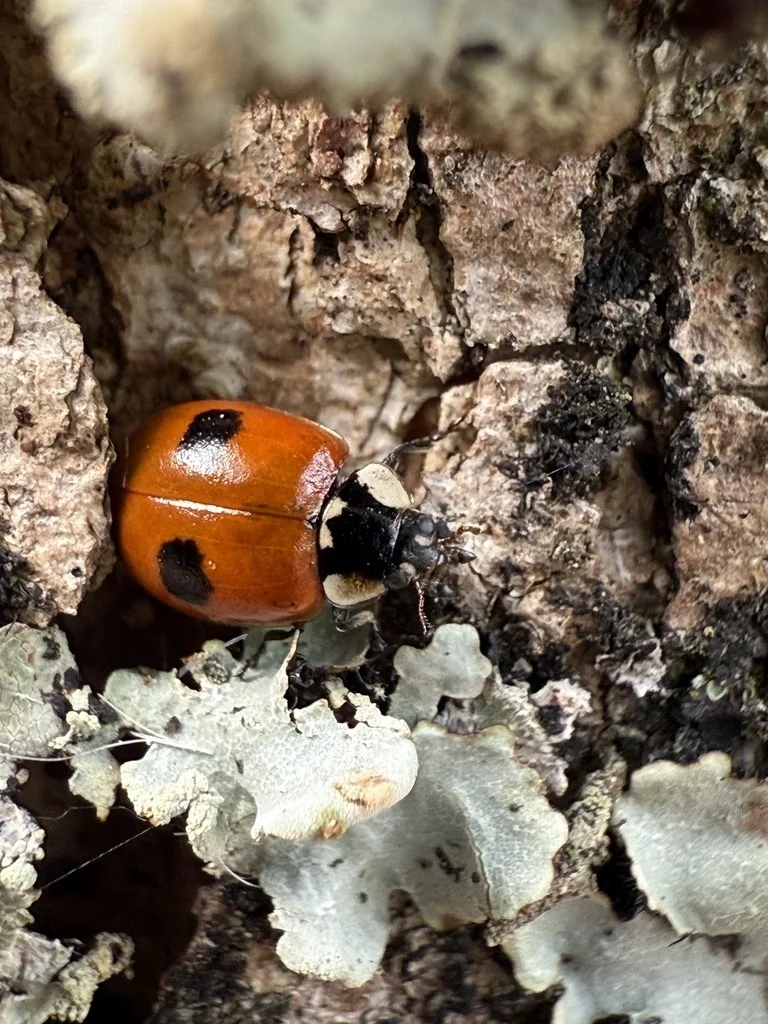
- Adults are 4 to 5 mm (1/6 to 1/5 inch) long and oblong from above.[1][3]
- The most common form in California has orange or red wing covers with two black spots and a black-and-white thorax.[1]
- Other forms are mostly black with four or six orange to red spots.[1]
- Eggs are orange to pale yellow and stand on end in groups; older larvae are black, gray and whitish with orange or yellow marks.[1]
Where it lives
UC IPM says it may be native to North America and finds it on almost any aphid-infested plant in California, from crops to wildlands. New York's conservation department calls it native and once common statewide, but recently known from only six sites in Erie, Monroe and Kings counties. It also lives in Europe, where it remains common.[1][3]
Biology and life cycle
Females lay egg groups mostly under aphid-infested leaves, and larvae pass through four stages.[1]
Egg to reproductive adult takes about three weeks in warm weather, with at least three generations a year. In New York, adults become active in early to mid spring.[1][3]
Adult lifespan is reported differently. UC IPM says about two months when flowers and prey are available, while New York's species assessment, citing earlier work, gives one to two years.[1][3]
Smell helps it find food. In lab tests, larvae and adults were drawn to crushed pea aphids and green peach aphids and to the aphid alarm pheromone (E)-beta-farnesene, but not to cabbage aphids. A separate study found larvae attracted to cues from damaged aphids.[7][6]
Damage and signs
Health risk
UC IPM and the New York sources discuss it only as a predator and a species of conservation concern; none mentions any risk to people or pets.[1][3][4]
Control
Prevention
Avoid broad-spectrum, persistent insecticides, which kill lady beetles. If a pesticide can't be avoided, New York's Natural Heritage Program advises one that targets only the pest, used only on the infested area and chosen because it doesn't persist.[1][4]
Biological control
To keep them around, grow flowering insectary plants; nectar and pollen help adults live longer and lay more eggs.[1]
Keep ants under control, since they attack lady beetles, and hose dust off small plants now and then, because dust disrupts natural enemies.[1]
Why it has become rare
Surveys since the 1980s show a steep decline in North America, and New York's 2014 status assessment says it is now considered rare across its North American range. New York ranks it S2, imperiled in the state, though it is secure worldwide (G5).[3][4]
USDA researchers sampling eight sites in western South Dakota and western Nebraska in 2008 found 9 twospotted lady beetles among 930 lady beetles, for a species that used to be common through much of North America.[5]
The cause isn't settled. New York's sources name possible factors including competition from non-native lady beetles (declines followed the arrival of the seven-spotted and multicolored Asian lady beetles), loss of farmland habitat, insecticides, pathogens and parasites.[3][4]
A 1994 Journal of Bacteriology study showed that some strains carry an inherited bacterium related to Rickettsia that kills male embryos.[2]
Common questions
- Is a black ladybug with red spots a twospotted lady beetle?
- It can be. Some twospotted lady beetles are mostly black with four or six red spots instead of red with two black spots.[1]
- Where should I look for them?
- On aphid-infested trees and shrubs, which this species prefers.[1]
- Is the twospotted lady beetle a pest?
- No. It preys on aphids and related insects, and New York's conservation department calls it a beneficial insect.[1][3]
- Is the twospotted lady beetle rare?
- In much of North America, yes. It was once one of the most common lady beetles, but surveys since the 1980s show a sharp decline, and New York ranks it as imperiled in the state.[3][4]
Sources
- University of California Statewide IPM Program, “Twospotted Lady Beetle (Natural Enemies Gallery).” ipm.ucanr.edu/natural-enemies/twospotted-lady-beetle/ (accessed 2026-11-13)
- Peer-reviewed literature (PubMed), “Rickettsial relative associated with male killing in the ladybird beetle (Adalia bipunctata) (Werren JH et al., Journal of bacteriology, 1994).” pubmed.ncbi.nlm.nih.gov/8288533/ (accessed 2026-11-13)
- New York State Department of Environmental Conservation, “Species Status Assessment: Twospotted lady beetle (Adalia bipunctata) (2014).” extapps.dec.ny.gov/docs/wildlife_pdf/sgcntwospotladybeet.pdf (accessed 2026-11-13)
- New York Natural Heritage Program, “Two-spotted Lady Beetle (Conservation Guide).” guides.nynhp.org/two-spotted-lady-beetle/ (accessed 2026-11-13)
- USDA Agricultural Research Service, “Recent records of Adalia bipunctata, Coccinella transversoguttata richardsoni and Coccinella novemnotata from South Dakota and Nebraska (Hesler et al., 2009).” www.ars.usda.gov/research/publications/publication/?seqNo115=240090 (accessed 2026-11-13)
- Journal of Insect Science (via PubMed), “Does social feeding improve larval survival of the two-spotted lady beetle, Adalia bipunctata? (Moore MP et al., Journal of Insect Science, 2012) (abstract).” pubmed.ncbi.nlm.nih.gov/23425121/ (accessed 2026-11-13)
- Journal of Chemical Ecology (via PubMed), “Olfactory responses to aphid and host plant volatile releases: (E)-beta-farnesene an effective kairomone for the predator Adalia bipunctata (Francis F et al., Journal of Chemical Ecology, 2004) (abstract).” pubmed.ncbi.nlm.nih.gov/15260221/ (accessed 2026-11-13)
- Global Biodiversity Information Facility (GBIF), “Adalia bipunctata (Linnaeus, 1758) (GBIF Backbone Taxonomy).” api.gbif.org/v1/species/1043097 (accessed 2026-11-13)