On this page
How to identify it
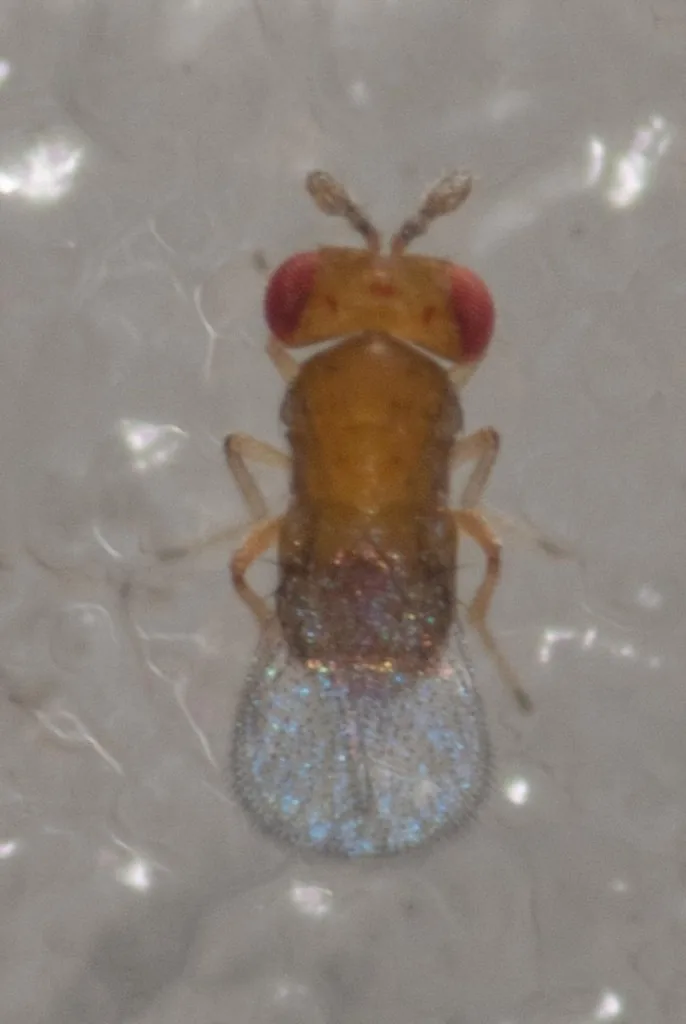
- Adults are orange to yellowish brown with red eyes and clear, hair-fringed wings. UC IPM gives a length of 1/100 to 1/25 inch (0.25 to 1 mm); NC State says about 0.5 to 1 mm.[1][2]
- Parasitized host eggs darken; NC State says they turn black within a week instead of hatching.[1][2]
- An emerging wasp leaves a round hole and dark specks inside the shell, while a hatched caterpillar leaves a ragged hole in an empty, pale shell.[1]
- Species are hard to tell apart because they are so small and similar.[1]
- You are most likely to see one by checking an insect egg mass for a tiny yellowish-brown insect on or near the eggs.[2]
Where it lives
Native throughout the United States, they turn up wherever their host eggs are found: field and tree crops, gardens, landscapes and wildlands, and even aquatic habitats.[1][2]
Biology and life cycle
A female lays one or more eggs inside a freshly laid host egg, and the wasp larvae eat the developing embryo, then pupate inside the egg.[1]
Each female can parasitize about 100 host eggs and kills more by puncturing and feeding on them.[1]
Egg to adult takes about 7 to 14 days in the growing season, so they often have more generations than their hosts.[1]
They overwinter as mature larvae inside host eggs and stay active all year in mild climates when hosts are present.[1]
Sugar matters to the adults. In a 2026 lab study of T. pintoi, females fed fructose or sucrose lived about 18 to 20 days and laid about 132 to 137 eggs each, against about 1.5 days and 13 eggs for females given only water.[3]
Females either search for insect eggs directly or ride on an insect that is about to lay eggs, so they can parasitize them when fresh.[2]
Their hosts go well beyond moths: they also parasitize eggs of butterflies, beetles, flies, true bugs and sawflies. Trichogramma platneri alone attacks the eggs of at least 28 moth species.[1]
At least 29 species occur in California. T. brassicae, T. minutum, T. platneri and T. pretiosum occur naturally and are also sold for mass release.[1]
Damage and signs
- They don't feed on plants; their hosts are the eggs of various insects, especially moths.[1]
Health risk
Trichogramma are solitary parasitoids that don't defend colonies, and NC State says they are harmless to humans.[2]
Control
Prevention
Avoid broad-spectrum and persistent insecticides, which are toxic to natural enemies, and control ants, which attack them.[1]
Biological control
Trichogramma are sold as immatures inside moth eggs glued to small cards that you hang on infested plants.[1]
Successful mass releases include T. platneri against codling moth in walnuts, tomato fruitworm in tomatoes and amorbia in avocado.[1]
UC IPM suggests growing flowering plants that supply nectar and pollen to adult natural enemies; in lab tests, sugar-fed Trichogramma lived far longer and laid more eggs than unfed ones.[1][3]
Common questions
- Why are some moth eggs on my plants turning black?
- They've probably been parasitized. Eggs attacked by Trichogramma darken, and NC State says they turn black within a week instead of hatching.[1][2]
- How are Trichogramma released?
- They're shipped as immature wasps inside moth eggs glued to cards, which are hung by hand on infested plants.[1]
- Do they sting?
- No. NC State says Trichogramma are harmless to humans.[2]
Sources
- University of California Statewide IPM Program, “Trichogramma Parasitoids (Natural Enemies Gallery).” ipm.ucanr.edu/natural-enemies/trichogramma-parasitoids/ (accessed 2026-11-12)
- NC State Extension, Biological Control Information Center, “Trichogramma Wasp.” entomology.ces.ncsu.edu/biological-control-information-center/beneficial-parasitoids/trichogramma-wasp/ (accessed 2026-11-12)
- J Econ Entomol 2026;119(4):2514-2523, via PubMed, “Nutrient additives boost fitness parameters and pest control potential in Trichogramma species (2026).” pubmed.ncbi.nlm.nih.gov/42089603/ (accessed 2026-11-12)
- iNaturalist, “Trichogramma taxon page (order and family).” www.inaturalist.org/taxa/250417 (accessed 2026-11-12)