On this page
How to identify it
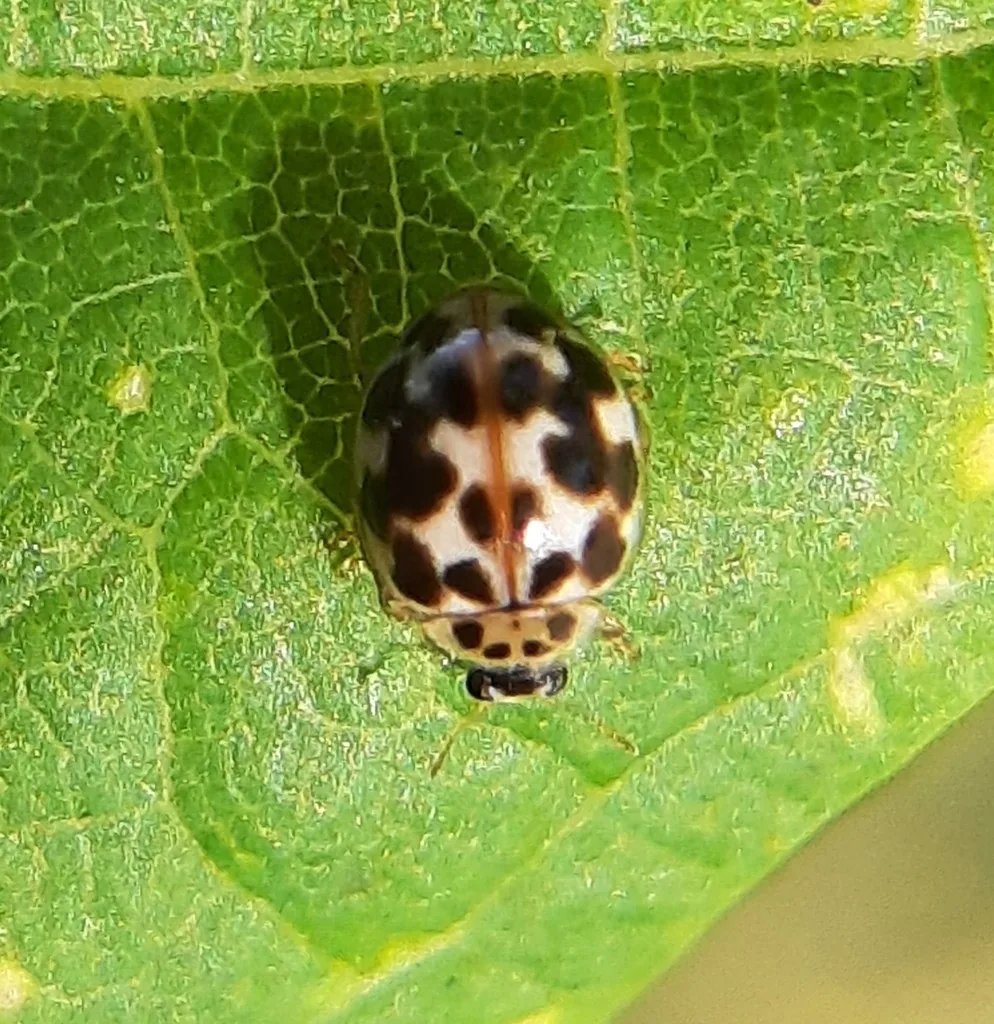
- Psyllobora vigintimaculata adults are 1/8 to 1/6 inch long, round and domed.[1]
- The thorax and wing covers are cream, pale gray or yellowish with four or five spots on the thorax and usually eight or nine on each wing cover.[1]
- In many individuals the spots run together, and some have orange marks.[1]
- Larvae are pale gray to whitish with dark markings that get bolder as they grow.[1]
- UC IPM notes that P. vigintimaculata is also called the small ashy gray lady beetle or twenty-spotted lady beetle.[1]
- Eggs are whitish and football shaped, about 1/32 inch (0.8 mm) long, and stand on end in a small group.[1]
- Newly hatched larvae are about 1/32 inch (0.8 mm) long; the fourth and last larval stage reaches about 1/7 inch (3.5 mm). Pupae are glued in the open to plant parts.[1]
Where it lives
UC IPM says P. vigintimaculata occurs throughout the contiguous United States, through western Canada into Alaska, and in Central America and northern South America; at least 4 Psyllobora species live in California. GBIF holds about 12,000 US records of the genus since 1990 from 45 states, most from California, Washington and Texas.[1][6]
Biology and life cycle
Females lay small egg groups mostly under leaves where powdery mildew grows.[1]
Egg to reproductive adult takes 3 weeks at an average of 77°F and 4 weeks at 68°F, with multiple generations a year.[1]
In California, adults can be active from at least February to mid-December; two years of weekly sampling in Davis found them from late February through mid-December.[1][3]
Members of its tribe (Halyziini) feed only on powdery mildew fungi. In Davis it was seen eating the powdery mildew of more than 25 plant species in 13 plant families, and UC IPM says it can turn up on almost any plant with powdery mildew, in crops, gardens, landscapes and wildlands.[3][1]
Damage and signs
Health risk
They feed only on powdery mildew, and none of the sources describes any risk to people.[1][3]
Control
Prevention
Treat the beetles as a sign of powdery mildew, not as a pest; their numbers rise as mildew spreads, and researchers have suggested using them as an indicator of the disease.[1][3]
Biological control
Flowering plants, ant control and avoiding persistent, broad-spectrum insecticides help keep these beetles around.[1]
Pesticides
Systemic insecticides can reach them through the fungus. In a lab study, imidacloprid applied to pumpkin plants turned up in the powdery mildew growing on the leaves, and every larva fed that mildew died within 120 hours; larvae kept on treated leaves but fed untreated mildew survived about as well as untreated ones.[4]
More from the research literature
A 2011 PLoS One study found that butternut squash plants infected with powdery mildew give off moldy-smelling compounds such as 1-octen-3-ol, and that twenty-spotted lady beetles preferred the odor of infected plants over healthy ones and were strongly drawn to 1-octen-3-ol alone.[2]
In California vineyards, the number of adults tracked early-season grape powdery mildew, which led researchers to suggest the beetle as an early sign of the disease when control matters most.[4]
In a survey of 19 urban gardens on California's Central Coast, P. vigintimaculata was the most common native lady beetle.[5]
Common questions
- Why are lady beetles on my mildewed squash?
- They may be Psyllobora, which eat powdery mildew and become more common as mildew increases.[1]
- Will they eat my aphids?
- No. Psyllobora species won't feed on insects.[1]
- Are the whitish spotted larvae a pest?
- No. They're Psyllobora larvae grazing on powdery mildew.[1]
- Can these beetles control powdery mildew?
- Each larva eats a measurable patch of mildew, and researchers have discussed their potential for biological control, but the sources present them mainly as a sign of the disease rather than a cure. Their numbers rise as mildew increases.[1][4][3]
Sources
- University of California Statewide IPM Program, “Fungus-Feeding Psyllobora Lady Beetles (Natural Enemies Gallery).” ipm.ucanr.edu/natural-enemies/fungus-feeding-psyllobora-lady-beetles/ (accessed 2026-11-11)
- Peer-reviewed literature (PubMed), “Olfactory cues from plants infected by powdery mildew guide foraging by a mycophagous ladybird beetle (Tabata J et al., PloS one, 2011).” pubmed.ncbi.nlm.nih.gov/21876772/ (accessed 2026-11-11)
- Annals of the Entomological Society of America (abstract via Crossref), “Biology and co-occurrence of Psyllobora vigintimaculata taedata and powdery mildews in an urban landscape of California (Sutherland & Parrella 2009).” doi.org/10.1603/008.102.0319 (accessed 2026-11-11). Cited from the published abstract.
- Insects (full text via PubMed Central), “Imidacloprid movement into fungal conidia is lethal to mycophagous beetles (Choudhury et al. 2020).” pmc.ncbi.nlm.nih.gov/articles/PMC7469163/ (accessed 2026-11-11). Cited from the full text in PubMed Central.
- Insects (full text via PubMed Central), “Promoting beneficial arthropods in urban agroecosystems: focus on flowers, maybe not native plants (Philpott et al. 2023).” pmc.ncbi.nlm.nih.gov/articles/PMC10380228/ (accessed 2026-11-11). Cited from the full text in PubMed Central.
- Global Biodiversity Information Facility (GBIF), “Psyllobora (genus): US occurrence records since 1990 by state (GBIF occurrence search API).” api.gbif.org/v1/occurrence/search?taxonKey=1043577&country=US&hasGeospatialIssue=false&occurrenceStatus=PRESENT&year=1990%2C2026&facet=stateProvince&facetLimit=400&limit=0 (accessed 2026-11-11). State counts are records reported (iNaturalist research-grade, museum specimens, surveys), not abundance.
- iNaturalist, “Psyllobora vigintimaculata taxon page (order and family).” www.inaturalist.org/taxa/118967 (accessed 2026-11-11)