On this page
How to identify it
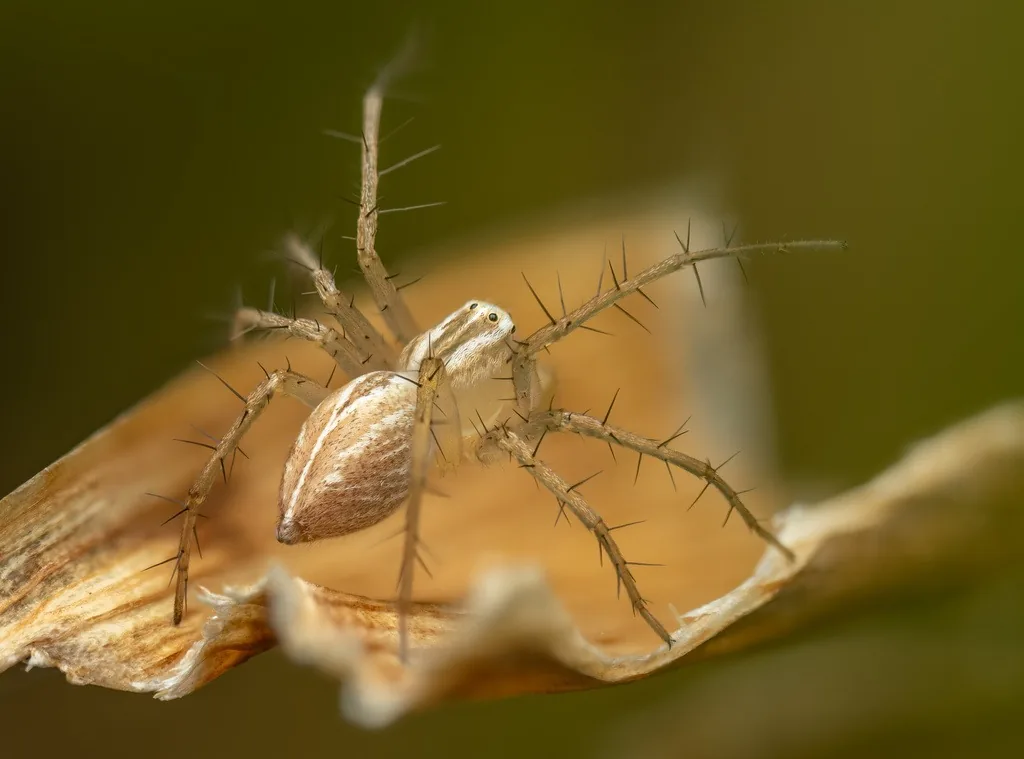
- Females are about 1/4 inch long. Males are slightly smaller; Illinois gives about 0.15 to 0.18 inch. UF/IFAS gives 4 to 7 mm overall: females 5.7 to 6.7 mm and males 4.0 to 4.5 mm.[1][3][9]
- The legs are long and slender with many long black spines.[1]
- Black lines run from the front middle eyes down to the mouthparts. UF/IFAS says the two thin black lines run from the small middle eyes to the tips of the fangs, and that thin black lines also run under the legs; these marks separate it from other lynx spiders.[3][9]
- Females are drab (greenish gray, tan, brown or rusty, often light green with white hairs) with brown, white or black stripes on the body. A 2017 review of the species found extreme variation in color pattern. UF/IFAS describes females with a pale yellow head and rows of white and dark bands along the top of the body.[1][3][4][9]
- Males have shiny, mostly unmarked bodies, an orange front body section and black, fuzzy-looking palps beside the mouthparts that look like little boxing gloves. UF/IFAS adds that the male's abdomen is covered in iridescent scales that can look silvery green or purple.[1][3][9]
- As in other lynx spiders, six of the eight eyes sit in a hexagon on a hump at the front of the body, and the other two, much smaller, face forward at the base of the hump.[1]
Look-alikes
| Look-alike | How to tell them apart |
|---|---|
| Green lynx spider | A different, bigger lynx spider that is bright green. Missouri's striped lynx spiders reach only about 1/4 inch and are drab, while some lynx spiders elsewhere reach about 1 inch and some are vivid green. UF/IFAS gives the green lynx spider as 12 to 16 mm, with a green body and no black face markings.[1][9] |
| Western lynx spider | Another Missouri lynx spider, Oxyopes scalaris, that is tan or yellowish with darker brown markings rather than striped. UF/IFAS calls it the striped lynx spider's closest North American relative: browner, with banded legs and without the black face stripes or iridescent body, and more common in the West.[1][9] |
| Jumping spiders | Jumping spiders have a very large forward-facing middle pair of eyes. Lynx spiders have six eyes in a hexagon on a hump, long spiny legs and an abdomen pointed at the rear.[1][7] |
Where it lives
Missouri calls it widely distributed in North America, with its range extending into Canada, and Illinois says it is found statewide. A 2017 taxonomic review found it widely distributed through the continental Americas and the Caribbean. UF/IFAS says it is native to North America, very common in the East and on the Pacific coast from Oregon south, and also found in Mesoamerica, South America and the West Indies, in farm fields, tall grass, prairies, backyards, gardens and old fields.[1][3][4][9]
Biology and life cycle
It hunts among grasses, flowers and low plants, running fast and jumping after prey; lynx spiders can catch flying insects by leaping into the air. Illinois calls striped lynx spiders frequent jumpers.[1][3]
In Illinois, adults are active in spring and early summer, in prairies and old fields.[3]
Females make egg sacs and guard them closely, often not eating during the vigil, even to the point of starvation.[1]
In a lab study, spiderlings fed only one kind of prey in their first week later preferred that prey, which the author read as the first evidence of food imprinting in a spider.[6]
It sits and waits in grass and low plants for small insects to land close by, then stalks and pounces. UF/IFAS says it can detect odors given off by prey and spends time where they are strongest. It uses silk to protect its eggs and to make resting supports, not to catch prey.[9]
The species name salticus comes from the Latin for jumping, fitting a spider that waves its front legs and jumps rapidly and often through vegetation.[9]
Females mate only once, while males court and mate with several females. About 7 to 33 days after mating, the female spins a flat egg sac 10 to 15 mm across, covered in white silk, under a leaf and tends it until the spiderlings emerge about 20 days later.[9]
Spiderlings stay on silk scaffolding on the plant for one to five days, then balloon away on silk threads carried by the wind. They take about nine months to mature and live about a year; breeding runs from spring to late summer in most of the range.[9]
Newly hatched spiderlings can feed on nectar, which UF/IFAS says helps them live longer and reduces cannibalism among unrelated spiderlings.[9]
Damage and signs
- No damage. Lynx spiders have been used as biological control agents because they eat crop pests, though Missouri notes they also catch bees and other pollinators.[1]
- In soybean fields next to cotton, gut-content DNA tests found striped lynx spiders among the native predators that had eaten the invasive kudzu bug.[5]
- UF/IFAS says it is especially common in cotton, soybean, grain sorghum and alfalfa, where it eats mostly true bugs, flies, and wasps, bees and ants, plus other spiders, and is considered a major predator of bollworm and tobacco budworm caterpillars in cotton and of southern green stink bugs in soybeans.[9]
Health risk
Lynx spiders subdue insects with a venomous bite, but UC IPM says the jaws of most spiders are too small to bite people, and MedlinePlus says most spider bites are harmless.[1][7][8]
Control
Biological control
No control is needed. It is a general predator in gardens and fields, eating whatever insects it can catch, pests and pollinators alike.[1]
Pesticides
UC IPM says insecticides give no long-term control and generally shouldn't be used against spiders outdoors. UF/IFAS adds that insecticides lower this spider's survival and even cut the time males spend courting.[7][9]
Where the sources disagree
Range: UF/IFAS, citing a field guide, says it is not found in the Rocky Mountains, the Great Basin or the Midwest, yet Missouri and Illinois both report it, Illinois statewide.[9][1][3]
Common questions
- Is the tiny spiny spider in my garden dangerous?
- A striped lynx spider is a small predator of garden insects. Most spiders' jaws are too small to bite people, and MedlinePlus says most spider bites are harmless.[1][7][8]
- Why does the male have black balls by its face?
- Those are the male's palps, which are black and fuzzy-looking, like little boxing gloves.[1][3]
- Does the striped lynx spider spin a web?
- No. Lynx spiders are running hunters that chase and jump on prey or wait near flowers for insects.[1]
Sources
- Missouri Department of Conservation, “Lynx Spiders (Field Guide).” mdc.mo.gov/discover-nature/field-guide/lynx-spiders (accessed 2026-11-11)
- iNaturalist, “Oxyopes salticus taxon page (order and family).” www.inaturalist.org/taxa/83844 (accessed 2026-11-11)
- Illinois Department of Natural Resources, “Striped lynx spider, Oxyopes salticus (Wild About Illinois Spiders: Family Oxyopidae).” dnr.illinois.gov/education/wildaboutpages/wildaboutinvertebrates/wildaboutspiders/family-oxyopidae.html (accessed 2026-11-11)
- Zootaxa, via PubMed, “Santos AJ (2017), The jumping lynx spider Oxyopes salticus Hentz, 1845 and its Neotropical relatives (Araneae: Oxyopidae), Zootaxa 4216(5).” pubmed.ncbi.nlm.nih.gov/28183107/ (accessed 2026-11-11). Cited from the PubMed abstract.
- Journal of Economic Entomology, via PubMed, “Greenstone MH, Tillman PG, Hu JS (2014), Predation of the newly invasive pest Megacopta cribraria in soybean habitats adjacent to cotton by a complex of predators, Journal of Economic Entomology 107(3):947-954.” pubmed.ncbi.nlm.nih.gov/25026652/ (accessed 2026-11-11). Cited from the PubMed abstract.
- Behavioural Processes, via PubMed, “Punzo F (2002), Food imprinting and subsequent prey preference in the lynx spider, Oxyopes salticus, Behavioural Processes 58(3):177-181.” pubmed.ncbi.nlm.nih.gov/12044694/ (accessed 2026-11-11). Cited from the PubMed abstract.
- University of California Statewide IPM Program, “Spiders (Pest Notes, Home and Landscape).” ipm.ucanr.edu/home-and-landscape/spiders/ (accessed 2026-11-11)
- MedlinePlus, U.S. National Library of Medicine, “Insect bites and stings (Medical Encyclopedia 000033).” medlineplus.gov/ency/article/000033.htm (accessed 2026-11-11)
- University of Florida IFAS Extension, EDIS, “Striped Lynx Spider, Oxyopes salticus (Hentz 1845), EENY-731/IN1259 (Featured Creatures).” ask.ifas.ufl.edu/publication/IN1259 (accessed 2026-11-14)