On this page
How to identify it
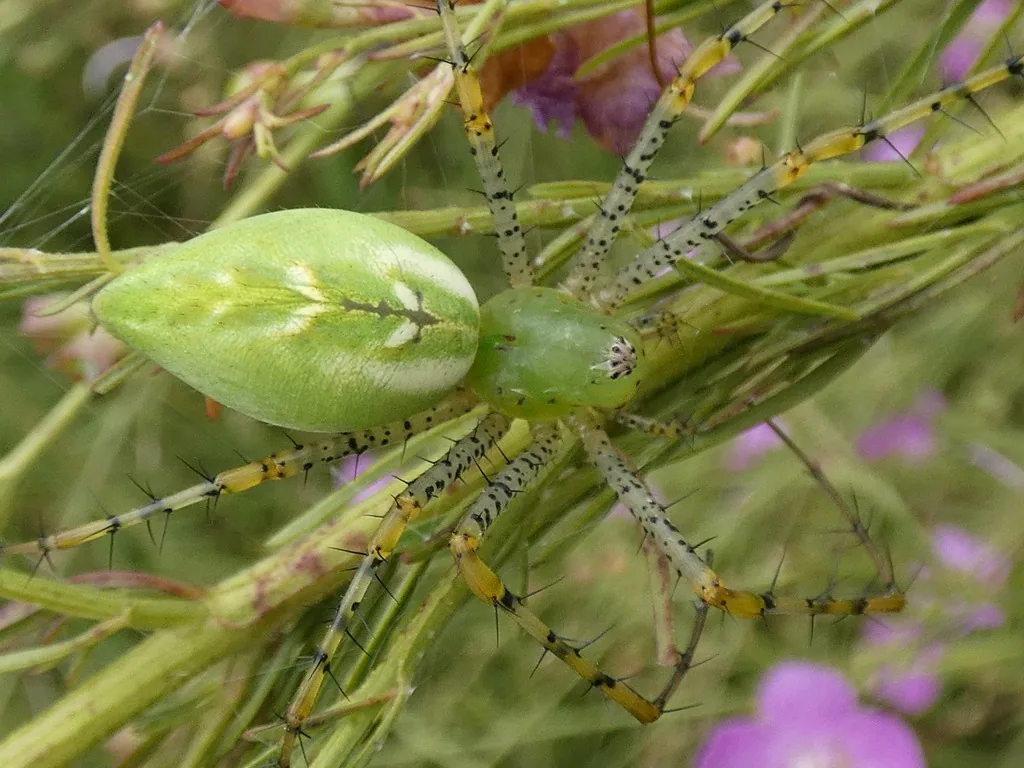
- Bright lime-green body with long, spindly legs covered in black bristles; Texas Parks and Wildlife says they are no bigger than a quarter.[3][4]
- Like other lynx spiders, the abdomen tapers sharply toward the rear and six of the eight eyes sit in a hexagon on a hump at the front of the head.[4][5]
- Females are often found hanging upside down on a messy, straw-colored egg sac in the top leaves or stems of a plant.[3]
Where it lives
Texas Parks and Wildlife calls it common across Texas, and reports place it in California and western Mexico. GBIF's U.S. records since 1990 come mostly from Texas, Florida, California, North Carolina and Georgia, with others across the South; Missouri's field guide notes most North American lynx spiders live in warmer southern states.[3][6][9][10][4]
Biology and life cycle
It hunts by sight, running and jumping on prey among foliage and flowers, and trails a dragline of silk for a quick escape.[3][4]
Studies on wild shrubs found it favors flowering plants: in western Mexico spider numbers rose on plants given artificial flowers and fell when flowers were removed, and in a study on a native shrub it was tied to the plant's flat-topped flower clusters.[9][8]
Spiders mature by July and mate in early fall. The female lays hundreds of eggs in her sac and guards it; Texas Parks and Wildlife says she may spit venom from her fangs if threatened.[3]
The spiderlings are orange when they hatch. About four weeks later they turn green, disperse and find a place to overwinter, and the mother soon dies. Lynx spider mothers often go without food while guarding, even to the point of starvation.[3][4]
Damage and signs
- It eats bees, moths, caterpillars and other insects. Lynx spiders have been used against crop pests, but they also take pollinators.[3][4]
- In soybean and cotton fields in the southeastern U.S., gut-content testing showed it had eaten the invasive kudzu bug.[7]
- On one native shrub, spiders cut pollination and seed set, yet branches with spiders still released more viable, undamaged seed than branches without.[8]
Health risk
Bites are rare. In four reported cases, the bite caused only local pain, itching, redness and firm swelling, with no tissue death or whole-body symptoms, and was treated with wound care, a tetanus shot and symptom relief. MedlinePlus advises washing a bite with soap and water, using cold packs, and watching over the next days for signs of infection.[1][6][11]
Control
Prevention
No control is needed. It is a predator of garden and crop insects; leave it alone, and avoid handling females guarding egg sacs.[4][7][3]
More from the research literature
A 2000 report in the American Journal of Emergency Medicine describes four people bitten by green lynx spiders: despite the spider's odd look and occasional aggressive behavior, the bites caused only local pain, itching, redness and firm swelling, with no tissue death and no whole-body symptoms.[1]
An earlier 1973 report in Toxicon described a bite in Orange County, California.[6]
Common questions
- Is the green lynx spider dangerous?
- No. Bites are uncommon and in reported cases caused only local pain and swelling.[1]
- Why is a green spider guarding a ball of silk?
- That is a female on her egg sac. She hangs on it and defends it, sometimes spitting venom, until the spiderlings disperse.[3][4]
- Should I remove it from my garden?
- No need. It eats moths, caterpillars and other insects, though it also catches some bees.[3][4]
Sources
- Peer-reviewed literature (PubMed), “Green lynx spider (Peucetia viridans) envenomation (Bush SP et al., The American journal of emergency medicine, 2000).” pubmed.ncbi.nlm.nih.gov/10674536/ (accessed 2026-11-11)
- iNaturalist, “Peucetia viridans taxon page (order and family).” www.inaturalist.org/taxa/126777 (accessed 2026-11-11)
- Texas Parks and Wildlife Department, “Wild Thing: Green Lynx (Texas Parks and Wildlife magazine, August 2009).” tpwmagazine.com/archive/2009/aug/scout3/ (accessed 2026-11-11)
- Missouri Department of Conservation, “Lynx Spiders (Field Guide).” mdc.mo.gov/discover-nature/field-guide/lynx-spiders (accessed 2026-11-11)
- University of California Statewide IPM Program, “Spiders (Pest Notes, Home and Landscape).” ipm.ucanr.edu/home-and-landscape/spiders/ (accessed 2026-11-11)
- Toxicon, via PubMed, “Hall RE, Madon MB (1973), Envenomation by the green lynx spider Peucetia viridans (Hentz 1832), in Orange County, California, Toxicon 11(2):197-199.” pubmed.ncbi.nlm.nih.gov/4733206/ (accessed 2026-11-11). Cited by title only; PubMed has no abstract.
- Journal of Economic Entomology, via PubMed, “Greenstone MH, Tillman PG, Hu JS (2014), Predation of the newly invasive pest Megacopta cribraria in soybean habitats adjacent to cotton by a complex of predators, Journal of Economic Entomology 107(3):947-954.” pubmed.ncbi.nlm.nih.gov/25026652/ (accessed 2026-11-11). Cited from the PubMed abstract.
- Oecologia, via PubMed, “Louda SM (1982), Inflorescence spiders: a cost/benefit analysis for the host plant, Haplopappus venetus Blake (Asteraceae), Oecologia 55(2):185-191.” pubmed.ncbi.nlm.nih.gov/28311232/ (accessed 2026-11-11). Cited from the PubMed abstract.
- Environmental Entomology, via PubMed, “Corcuera P et al. (2010), Distribution of Peucetia viridans (Araneae: Oxyopidae) on Croton ciliatoglandulifer, Environmental Entomology 39(2):320-327.” pubmed.ncbi.nlm.nih.gov/20388259/ (accessed 2026-11-11). Cited from the PubMed abstract.
- Global Biodiversity Information Facility (GBIF), “Peucetia viridans: US occurrence records by state, 1990-2026 (GBIF occurrence search).” api.gbif.org/v1/occurrence/search?taxonKey=2178540&country=US&hasGeospatialIssue=false&occurrenceStatus=PRESENT&year=1990%2C2026&facet=stateProvince&facetLimit=400&limit=0 (accessed 2026-11-11). State counts are records reported (iNaturalist research-grade, museum specimens, surveys), not abundance.
- MedlinePlus, U.S. National Library of Medicine, “Insect bites and stings (Medical Encyclopedia).” medlineplus.gov/ency/article/000033.htm (accessed 2026-11-11)