On this page
How to identify it
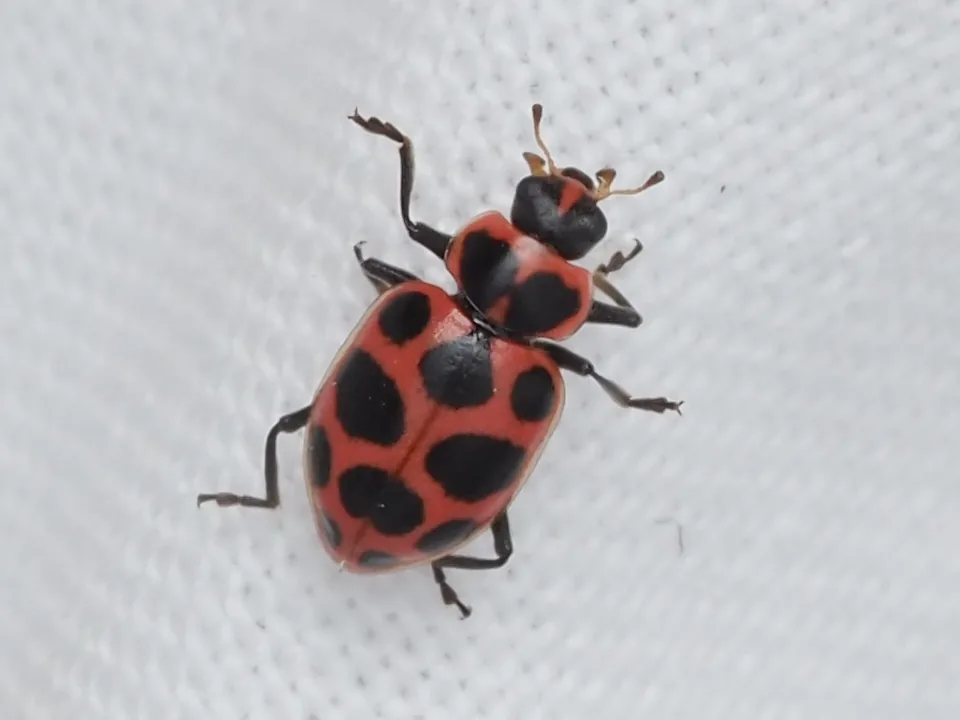
- Adults are pink to red, 1/5 to 1/4 inch (5 to 6 mm) long and more oval than round, with six black spots on each wing cover. Twelve spots in all give it another name, twelve-spotted lady beetle.[1][2][3]
- Two black spots sit on the thorax behind the head.[1]
- Larvae are long, dark and alligator-like, blackish with orange or yellow, and grow from about 1 mm to 5 or 6 mm. NYS IPM says two yellow hourglass-shaped marks near the head set them apart from other lady beetle larvae. Pupae are oval, black and orange, and glued openly to plants.[1][2]
- Eggs are orange to yellow, about 1/25 inch long, and stand on end in small groups near prey.[1][2]
Look-alikes
| Look-alike | How to tell them apart |
|---|---|
| Colorado potato beetle eggs | Pink spotted lady beetle eggs look a lot like Colorado potato beetle eggs but are narrower and smaller.[2] |
| Multicolored Asian lady beetle | A non-native lady beetle whose adults range from heavily spotted to spotless and often move into buildings to overwinter. The pink spotted lady beetle is native, pink and oval, with six spots on each wing cover.[4][1][2] |
Where it lives
Native to North America and found through most of the continent, including parts of Mexico and Canada. It is very common in Kentucky fields, gardens and landscapes and common in Colorado gardens and crops. UC IPM lists three subspecies, which may actually be separate species; C. maculata strenua is the one in California and elsewhere in the Southwest.[2][3][4][1]
Biology and life cycle
A female lays 200 to more than 1,000 eggs over a life of one to three months.[1][2]
Adults spend the winter in large groups under leaf litter, stones and other sheltered spots along crop borders, especially near fields that grew corn. In spring many walk along the ground hunting prey before flying to crops to lay eggs.[2][1]
Egg to adult takes three to four weeks in warm weather.[1]
Adults are commonly found from April through late September, often in corn, potato and mixed vegetable fields. UC IPM says it is active from late winter through fall.[2][1]
Larvae may travel up to 39 feet (12 meters) in search of food, and the pupal stage lasts 3 to 12 days depending on temperature.[2]
Damage and signs
- Adults and larvae eat aphids, mites, thrips and the eggs and small larvae of other insects, including eggs of the Colorado potato beetle, corn earworm and European corn borer.[2][1][3][4]
- Pollen may make up about half its diet, and flowering plants with nectar and pollen raise its egg laying, its life span and the number of prey it eats.[2][3][1]
- In alfalfa fields the beetles gathered where dandelions grew, and aphid numbers were lower on the alfalfa nearby.[5]
- Pollen is not a perfect food. In lab studies, beetles reared on corn pollen grew less and laid fewer eggs than beetles fed aphids, and pollen from different corn hybrids varied in how well it supported them.[6][7]
- It tends to arrive after aphid numbers are already high, so it is better at keeping small aphid populations down than at stopping an outbreak.[2]
Health risk
It does not harm people or pets, according to the New York State IPM Program. Kentucky and Colorado State Extension describe it as a predator of aphids and insect eggs.[2][3][4]
Control
Prevention
Skip broad-spectrum, persistent insecticides, which are toxic to natural enemies. NYS IPM names pyrethroids and pyrethrins in home gardens and neonicotinoids on farms as harmful to adults and larvae.[1][2]
Biological control
Keep early-flowering, pollen-rich plants such as dandelions and clover near the garden to feed adults when prey is scarce.[2][5]
Keep ants in check, since they attack lady beetles and other natural enemies.[1]
Conserving wild beetles is recommended over buying them. If you do release them, NYS IPM advises waiting until temperatures stay above 55°F (13°C), ideally 61 to 81°F (16 to 27°C), and releasing early in the season while soft-bodied pests or insect eggs are present.[2]
Pesticides
In a lab study, imidacloprid applied to the soil at nursery and landscape rates moved into flowers at levels that significantly reduced survival of pink spotted lady beetles.[8]
Where sources disagree
Generations: NYS IPM gives two to five a year, depending on conditions; UC IPM says several.[2][1]
Egg shape: UC IPM calls the eggs football shaped, NYS IPM spindle shaped.[1][2]
Common questions
- Why are there pink ladybugs in my garden?
- It's likely the native pink spotted lady beetle, which is most common on low-growing plants such as vegetables, field crops and garden ornamentals.[1][3]
- Does it eat my plants?
- No. It eats aphids, mites and insect eggs, and the plant food it takes is pollen and nectar.[1][2]
- Where do they go in winter?
- Adults gather in large groups under leaf litter, stones or other sheltered spots, often along field borders.[2][1]
- Will releasing them stop an aphid outbreak?
- Probably not on its own. The beetle tends to show up after aphids are already past the action threshold, and NYS IPM recommends conserving wild beetles over releasing bought ones.[2]
Sources
- University of California Statewide IPM Program, “Pink Spotted Lady Beetle (Natural Enemies Gallery).” ipm.ucanr.edu/natural-enemies/pink-spotted-lady-beetle/ (accessed 2026-11-11)
- New York State Integrated Pest Management Program, Cornell University, “Pink spotted lady beetle (Coleomegilla maculata) Biocontrol Agent.” cals.cornell.edu/integrated-pest-management/outreach-education/fact-sheets/pink-spotted-lady-beetle-coleomegilla-maculata-biocontrol-agent (accessed 2026-11-11)
- University of Kentucky Entomology, “Ladybugs (ENTFACT-702).” entomology.mgcafe.uky.edu/ef702 (accessed 2026-11-11)
- Colorado State University Extension, “Lady Beetles (Fact Sheet 5.594).” extension.colostate.edu/topic-areas/insects/lady-beetles-5-594/ (accessed 2026-11-11)
- Oecologia, via PubMed, “Harmon, Ives, Losey, Olson and Rauwald (2000), Coleomegilla maculata predation on pea aphids promoted by proximity to dandelions.” pubmed.ncbi.nlm.nih.gov/28547224/ (accessed 2026-11-11)
- Journal of Insect Physiology, via PubMed, “Lundgren and Wiedenmann (2004), Nutritional suitability of corn pollen for the predator Coleomegilla maculata (Coleoptera: Coccinellidae).” pubmed.ncbi.nlm.nih.gov/15183287/ (accessed 2026-11-11)
- Journal of Insect Physiology, via PubMed, “Pilorget, Buckner and Lundgren (2010), Sterol limitation in a pollen-fed omnivorous lady beetle (Coleoptera: Coccinellidae).” pubmed.ncbi.nlm.nih.gov/19772860/ (accessed 2026-11-11)
- PLoS One, via PubMed, “Krischik, Rogers, Gupta and Varshney (2015), Soil-applied imidacloprid translocates to ornamental flowers and reduces survival of adult Coleomegilla maculata, Harmonia axyridis, and Hippodamia convergens lady beetles, and larval Danaus plexippus and Vanessa cardui butterflies.” pubmed.ncbi.nlm.nih.gov/25799432/ (accessed 2026-11-11)
- iNaturalist, “Coleomegilla maculata taxon page (order and family).” www.inaturalist.org/taxa/126267 (accessed 2026-10-06)