On this page
How to identify it
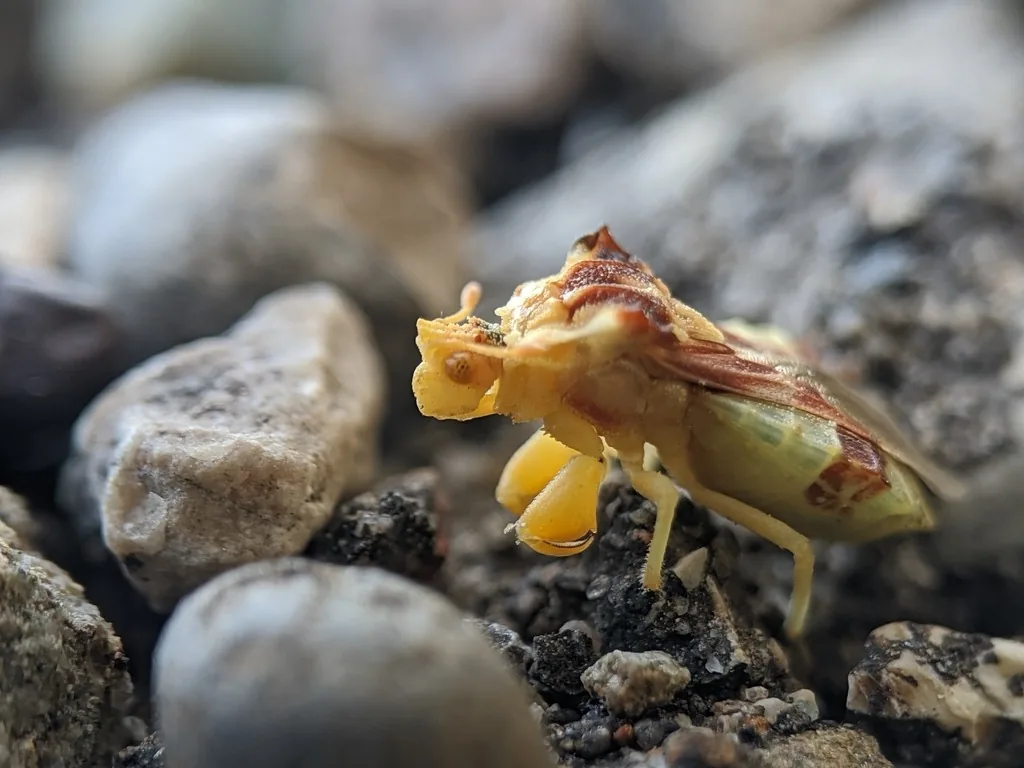
- Adults are usually less than 1/2 inch long, chunky and smaller than most assassin bugs, with clubbed antennae and a back half of the abdomen so wide that it usually sticks out beyond the folded wings.[4][1][2]
- The front legs are hooked and thick, with greatly widened thighs, and shaped for grabbing, a lot like a praying mantis's.[4][1]
- Most are gold, yellow, leaf-green, tan, brown or white, often with dark mottled patches or bands, and their jagged outlines blend into textured flower heads. Males are often darker or more spotted than females.[4]
- Nymphs look like smaller, wingless versions of the adults.[4]
Look-alikes
| Look-alike | How to tell them apart |
|---|---|
| Assassin bugs | Ambush bugs are a subfamily of assassin bugs but are smaller and chunkier, with hooked forelegs with greatly widened thighs, clubbed antennae and a widened abdomen, and they wait on flowers rather than hunting elsewhere.[4][1][2] |
| Praying mantids | Both grab prey with raptorial front legs, but mantids chew their prey while ambush bugs pierce it and suck out the fluids.[1] |
| Crab spiders | Flower crab spiders hunt the same way, sitting motionless and camouflaged on flowers, but spiders have eight legs and a pair of fangs, while an ambush bug is an insect with a single strawlike beak.[4] |
Where it lives
Found on flowers in open, sunny places such as prairies, roadsides and fields, especially on goldenrod and other sunflower-family blooms, and most noticeable in fall. Two closely related, hybridizing species, Phymata americana and P. pennsylvanica, have neighboring ranges in North America; models predict P. americana will spread northwest as the climate warms.[4][1][7]
Biology and life cycle
About 30 species in 3 genera live in North America north of Mexico; more than 20 of them are jagged ambush bugs (Phymata), which can be very hard to tell apart.[4]
Worldwide, Phymata is the largest genus of ambush bugs, with about 109 species, and DNA evidence suggests the genus began in the Neotropics before spreading north into North America and Eurasia.[8]
When an insect comes close, the bug seizes it with its front legs and stabs it with its single, strawlike beak.[4][1]
Venomous saliva paralyzes the prey and liquefies its insides, which the bug then sucks out.[1][4]
The first ambush bug genome, of Phymata mystica, turned up venom proteins shared with other true bugs, mainly serine proteases, metallopeptidases and true-bug venom family proteins.[9]
Young ambush bugs live on other parts of the plant and feed on small soft-bodied insects and mites.[2]
Jagged ambush bugs lay clusters of dark, barrel-shaped eggs in a single layer and cover them with a frothy secretion that hardens to protect them; Washington State notes these egg batches can be found on twigs or fences in fall and winter.[4][2]
Fun fact: color helps males find mates. In Phymata americana, darker males warmed up more under light and were better at finding mates when the air was cool.[6]
Their hunting can even shape flowers. In a field study of great blue lobelia, ambush bugs hunted from plants with bigger daily flower displays, which reversed the usual pollinator preference for showier plants.[5]
Damage and signs
Health risk
Ambush bugs are not aggressive and do not bite people unless mishandled, but they can give a painful bite if pressed against the skin. If one lands on you, brush it away instead of swatting it. For first aid after a bite, MedlinePlus advises washing the site with soap and water and putting ice wrapped in a washcloth on it, 10 minutes on and 10 minutes off; call 911 for trouble breathing or swelling of the face or mouth.[4][1][10]
Control
Prevention
No control is needed; Washington State recommends no chemical management for them, and the Missouri Department of Conservation describes them as predators that help control the insects they eat.[2][4]
Biological control
Native plants and flowers give them hunting grounds and overwintering sites, and avoiding regular use of broad-spectrum pesticides helps keep them around.[2]
Adults mostly catch flower visitors, while the nymphs contribute more to garden pest control by eating small soft-bodied insects and mites.[2]
Where sources disagree
Prey size: Mississippi State's entomologist says they usually choose prey smaller than themselves (though he has seen them take larger honey bees), while the Missouri Department of Conservation says they often capture insects much bigger than themselves.[1][4]
Common questions
- Do ambush bugs kill bees?
- Yes. Bees are among the flower visitors they catch, along with flies, wasps, butterflies and moths. Because they eat pollinators, some gardeners see them as a mixed blessing.[4][2][1]
- Can an ambush bug bite?
- It can give a painful little bite if you handle it, so warn children to look and not touch. Wash a bite with soap and water and cool it with wrapped ice; get emergency help for trouble breathing or face or mouth swelling.[1][4][10]
- Where should I look for one?
- Search goldenrod and other flowers in the sunflower and daisy family, such as thistles, in open sunny places, especially in fall. Finding them can be a fun contest with kids.[1][4]
- Can ambush bugs change color?
- Nobody is sure. The Missouri Department of Conservation says it isn't clear whether they change color to match the flowers or simply settle on flowers that match them; they may change color with each molt.[4]
- How many kinds of ambush bugs are there?
- About 30 species live in North America north of Mexico, and the main genus, Phymata, has about 109 species worldwide.[4][8]
Sources
- Mississippi State University Extension Service, “Bug's Eye View: Ambush Bug, Vol. 3, No. 29.” extension.msstate.edu/newsletters/bugs-eye-view/2017/ambush-bug-vol-3-no-29 (accessed 2026-11-12)
- Washington State University Extension, “Predatory Bugs: Ambush bugs (HortSense).” hortsense.cahnrs.wsu.edu/fact-sheet/predatory-bugs-ambush-bugs/ (accessed 2026-11-12)
- iNaturalist, “Phymata taxon page (order and family).” www.inaturalist.org/taxa/119535 (accessed 2026-11-12)
- Missouri Department of Conservation, “Ambush Bugs (Field Guide).” mdc.mo.gov/discover-nature/field-guide/ambush-bugs (accessed 2026-11-12)
- Ecology (2021), via PubMed, “A sit-and-wait predator, but not an active-pursuit predator, alters pollinator-mediated selection on floral traits.” pubmed.ncbi.nlm.nih.gov/34319595/ (accessed 2026-11-12). Cited from the PubMed abstract.
- Proceedings of the Royal Society B (2008), via PubMed, “Sexual selection mediated by the thermoregulatory effects of male colour pattern in the ambush bug Phymata americana.” pubmed.ncbi.nlm.nih.gov/18089533/ (accessed 2026-11-12). Cited from the PubMed abstract.
- Ecology and Evolution (2020), via PubMed, “Climate change has different predicted effects on the range shifts of two hybridizing ambush bug (Phymata) species.” pubmed.ncbi.nlm.nih.gov/33209268/ (accessed 2026-11-12). Cited from the PubMed abstract.
- Molecular Phylogenetics and Evolution 2017, via PubMed, “Molecular phylogenetics and biogeography of the ambush bugs (Hemiptera: Reduviidae: Phymatinae).” pubmed.ncbi.nlm.nih.gov/28634150/ (accessed 2026-11-12). Cited from the PubMed abstract.
- G3: Genes, Genomes, Genetics 2026, via PubMed, “Genome report: genome sequence of Phymata mystica (Evans), an ambush bug.” pubmed.ncbi.nlm.nih.gov/42663046/ (accessed 2026-11-12). Cited from the PubMed abstract.
- MedlinePlus, U.S. National Library of Medicine, “Insect bites and stings (Medical Encyclopedia).” medlineplus.gov/ency/article/000033.htm (accessed 2026-11-12)