On this page
How to identify it
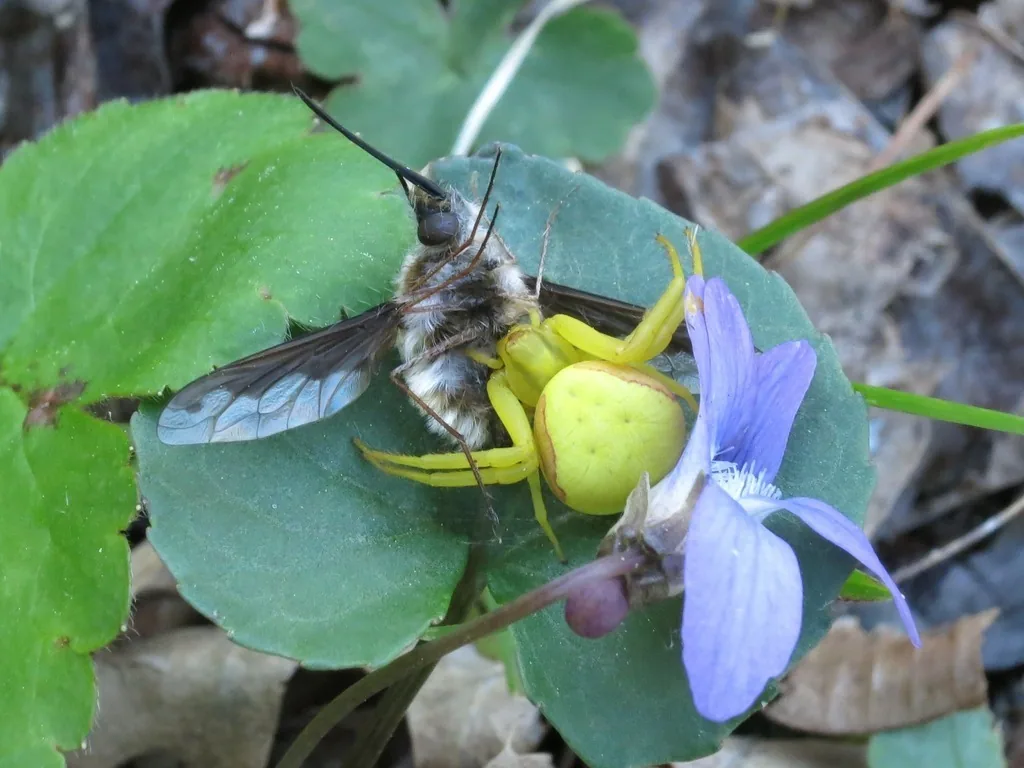
- The first two pairs of legs are enlarged and stick out past the sides of a flattened body, so the spider looks like a tiny crab.[1][2]
- Crab spiders can scuttle in any direction, including sideways.[2]
- Flower crab spiders in the genus Mecaphesa are about 1/4 inch long (females) and spiny; males are smaller, more brightly colored and have very long front legs. The green crab spider is almost always pale green to silvery white, and the whitebanded crab spider has a white or yellowish ridge on each side of its face.[2]
- The goldenrod crab spider (Misumena vatia) can change its body color between white and yellow to match the flower it hunts on.[6][8]
- Their small eyes sit in two slightly curved rows, the top row often much wider than the lower one.[1]
- Ground crab spiders (Xysticus) are a duller group, usually gray and brown, 1/4 to 3/8 inch long for females and about 1/8 inch for males; they live on the forest floor and under bark.[3]
Look-alikes
| Look-alike | How to tell them apart |
|---|---|
| Jumping spiders | Jumping spiders also hunt without webs, but they stalk and leap on prey and have a distinctive pair of large middle eyes in the front row.[1] |
| Ground crab spiders (Xysticus) | These are crab spiders too, generally larger than flower crab spiders and dull gray or brown, living on the forest floor and under bark rather than in flowers.[3] |
Where it lives
Counts of North American species differ: UC IPM says over 200, the Missouri Department of Conservation about 130. Flower crab spiders are found statewide in Missouri in gardens, prairies, old fields and other grasslands with flowers. GBIF's 1990-2026 U.S. records for the family (about 53,400) come from every state on the map, most from California, Washington and Texas.[1][3][2][9]
Biology and life cycle
They hunt by day and don't build webs; they stalk or wait for insects walking or resting on surfaces.[1]
Flower crab spiders turn up in daisy fleabanes, asters, goldenrods, snapdragons, Queen Anne's lace and marigolds.[2]
When a bee, fly or other insect lands for nectar, the spider seizes it, injects venom and holds it while drinking its body fluids. Unlike web spinners, crab spiders have good vision.[2]
How well the camouflage works is debated. Missouri describes them as looking like part of the flower; in a field experiment, goldenrod crab spiders that matched their flower caught no more prey than mismatched ones, solitary bees and hover flies avoided the spiders whatever their color, and bumble bees and honey bees ignored them. Another study found the spiders hard to see from a distance for bees and birds but often visible up close.[2][6][7]
In Missouri, egg cases overwinter and spiderlings hatch in spring; adults generally die at the first hard freeze.[2][3]
Damage and signs
Health risk
UC IPM notes that spiders seen out in the open during the day, like crab spiders, are unlikely to bite, and the jaws of most spiders are too small to bite people. MedlinePlus says most spider bites are harmless and look like a bee sting, with redness, pain and swelling; wash the bite with soap and water, use an ice pack or wet compress, and get care for small children or anyone with severe symptoms, since bites occasionally cause allergic reactions.[1][5]
Control
Prevention
Outdoors, no control is needed; these small predators help hold down insect numbers.[3][1]
Keep them out
Spiders can be carried in on plants, firewood and boxes; seal cracks and keep window and door screens tight to keep them and their insect prey out.[1]
Traps and physical control
To remove one from indoors, cover it with a jar, slide a piece of paper underneath, and release it outside.[1]
Pesticides
UC IPM advises that insecticides won't give long-term spider control and generally shouldn't be used against spiders outdoors.[1]
Common questions
- Are crab spiders poisonous?
- Like most spiders they use venom on their prey, but MedlinePlus says most spider bites are harmless; the black widow and brown recluse are the spiders whose bites can be very dangerous.[1][2][5]
- Why do crab spiders sit on flowers?
- Flowers draw bees, flies and other nectar feeders, and the spider waits there to ambush them. In one field study, solitary bees and hover flies avoided the spiders.[2][6]
- Do crab spiders make webs?
- No. They are hunters that grab prey directly instead of catching it in a web.[1][2]
Sources
- University of California Statewide IPM Program, “Spiders (Pest Notes, Home and Landscape).” ipm.ucanr.edu/home-and-landscape/spiders/ (accessed 2026-11-11)
- Missouri Department of Conservation, “Flower Crab Spiders (Field Guide, reviewed December 31, 2024).” mdc.mo.gov/discover-nature/field-guide/flower-crab-spiders (accessed 2026-11-11)
- Missouri Department of Conservation, “Ground Crab Spiders (Field Guide).” mdc.mo.gov/discover-nature/field-guide/ground-crab-spiders (accessed 2026-11-11)
- iNaturalist, “Misumena vatia taxon page (order and family).” www.inaturalist.org/taxa/55746 (accessed 2026-11-11)
- MedlinePlus, U.S. National Library of Medicine, “Spider Bites (health topic).” medlineplus.gov/spiderbites.html (accessed 2026-11-11)
- Proceedings of the Royal Society B, via PubMed, “Brechbuhl R, Casas J, Bacher S (2010), Ineffective crypsis in a crab spider: a prey community perspective, Proceedings of the Royal Society B 277(1682):739-746.” pubmed.ncbi.nlm.nih.gov/19889699/ (accessed 2026-11-11). Cited from the PubMed abstract.
- Journal of Experimental Biology, via PubMed, “Defrize J, Thery M, Casas J (2010), Background colour matching by a crab spider in the field: a community sensory ecology perspective, Journal of Experimental Biology 213(9):1425-1435.” pubmed.ncbi.nlm.nih.gov/20400626/ (accessed 2026-11-11). Cited from the PubMed abstract.
- Journal of Chemical Ecology, via PubMed, “Riou M, Christides JP (2010), Cryptic color change in a crab spider (Misumena vatia): identification and quantification of precursors and ommochrome pigments by HPLC, Journal of Chemical Ecology 36(4):412-423.” pubmed.ncbi.nlm.nih.gov/20224921/ (accessed 2026-11-11). Cited from the PubMed abstract.
- Global Biodiversity Information Facility (GBIF), “Thomisidae (crab spiders): occurrence records in the U.S., 1990-2026 (GBIF occurrence search).” api.gbif.org/v1/occurrence/search?taxonKey=6163&country=US&hasGeospatialIssue=false&occurrenceStatus=PRESENT&year=1990%2C2026&facet=stateProvince&facetLimit=400&limit=0 (accessed 2026-11-11). State counts are records reported (iNaturalist research-grade, museum specimens, surveys), not abundance.