On this page
How to identify it
- Most adults are 1/8 to 1/2 inch (3 to 12 mm) long, though the family ranges from about 1/12 to 4/5 inch. Many are blackish to gray, some are striped, and some mimic bees or wasps.[1][2]
- Abundant bristles cover the head and body, and many species look somewhat like house flies.[1][2]
- Eggs are oval, clear when laid and soon white; some species glue eggs up to 1 mm long on the head or back of the host, where you can see them.[1][2]
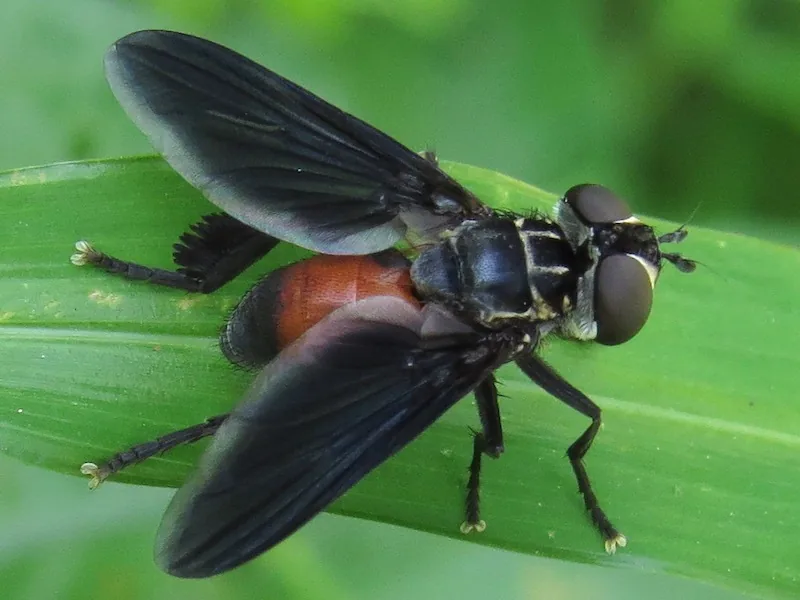
- Trichopoda pennipes, a parasite of true bugs, is 1/3 to 1/2 inch long with a black and yellowish front thorax, a mostly orange abdomen and dark wings. UF/IFAS says they are called feather-legged flies because the hind legs bear short black hairs; the oval eggs and the maggots are smooth and whitish gray or cream colored, and the pupae are oval and dark reddish brown.[1][4]
- Mature larvae of many species leave the host and form an oblong, dark reddish to blackish puparium nearby. A moth pupa killed by Erynnia shows Y-shaped breathing tubes poking out under the wing pads.[1]
Look-alikes
Where it lives
More than 1,300 species live in North America and over 400 in California. Adults turn up in almost every habitat, from crops and gardens to wildlands, resting on foliage, visiting flowers or searching for hosts.[2][1]
Biology and life cycle
Depending on species, females glue eggs onto a host, insert them into it with a piercing ovipositor, lay them on leaves the host later eats, or lay them in soil near root-feeding grubs. Some species give birth to live larvae.[1][2]
Larvae feed first on nonessential tissue, so the host lives normally for a while before it dies. Pupation often follows 4 to 14 days after the egg is laid, and the pupal stage usually lasts 1 to 2 weeks.[2]
Most tachinids overwinter as mature larvae inside a host. Many have several generations a year, but species whose hosts have one generation may have only one.[1][2]
Adults feed on nectar and on honeydew from aphids and scale insects; UC suggests flowering plants to feed them.[2][1]
They are especially important natural enemies of caterpillars.[3][1]
Trichopoda pennipes parasitizes mainly adult bugs but also fourth and fifth instars of the southern green stink bug, the squash bug and at least seven other true bug species. A female may lay several hundred eggs, but only a few on each host; the larvae burrow in and only one survives to leave the bug as a large maggot. It has up to three generations a year and overwinters as a larva inside its host.[4]
Damage and signs
- They don't feed on plants. Their larvae attack caterpillars, adult and larval beetles, sawfly larvae, true bugs and grasshoppers; UC adds centipedes, crickets, earwigs and other flies.[2][1]
- Trichopoda pennipes attacks late-stage nymphs and adults of the southern green stink bug, and is one of the parasitoids found on squash bugs in Kentucky squash fields.[5][6]
Health risk
Tachinids are parasites of other insects, and the adults feed on nectar and honeydew; none of the sources describes them biting or stinging people.[1][2][3]
Control
Prevention
There is nothing to control: tachinids are natural enemies of many important pests and are usually overlooked by gardeners.[2][1]
Biological control
To help them, UC suggests growing flowering plants for nectar, controlling ants, hosing dust off small plants, and avoiding broad-spectrum, persistent insecticides.[1]
Many tachinid species have been introduced into North America to suppress pests that arrived from elsewhere.[2]
How much they help
Lydella thompsoni, a European fly introduced against the European corn borer, can parasitize up to 75% of corn borer larvae and is established from Connecticut west to central Ohio and south into South Carolina.[2]
Other tachinids act too late to save a crop: Voria ruralis doesn't kill a cabbage looper until it is fully grown, and parasitism of Colorado potato beetle by Myiopharus doryphorae can reach 75% but usually comes late in the season.[2]
In Georgia corn, cotton and soybean, Trichopoda pennipes parasitized southern green stink bugs more than brown marmorated stink bugs; it laid eggs on brown marmorated stink bugs, but no flies emerged from them.[5]
In a Maryland squash study, Trichopoda pennipes flies visited buckwheat flowers, though a buckwheat border didn't measurably raise parasitism of adult squash bugs.[7]
In mid-1970s surveys, Trichopoda pennipes parasitized southern green stink bug at high rates in North Central Florida, and it has been introduced to Hawaii and Australia as a biological control agent against that pest.[4]
Common questions
- What are the small white dots on this caterpillar or squash bug?
- They may be tachinid eggs; several species glue conspicuous white eggs to the head or body of their host.[2][1]
- Why don't butterfly gardeners like them?
- Because tachinids parasitize caterpillars, people raising butterflies may not appreciate them.[2][3]
- Do tachinid flies bite?
- None of the sources describes them biting people. The adults feed on nectar and honeydew, and only the larvae are parasites, inside other insects.[2][1]
Sources
- University of California Statewide IPM Program, “Tachinid Flies (Natural Enemies Gallery).” ipm.ucanr.edu/natural-enemies/tachinid-flies/ (accessed 2026-11-11)
- University of Wisconsin-Madison Extension, “Tachinid Flies.” hort.extension.wisc.edu/articles/tachinid-flies/ (accessed 2026-11-11)
- Annual Review of Entomology, via PubMed, “Tachinidae: evolution, behavior, and ecology (Stireman, O'Hara and Wood 2006).” pubmed.ncbi.nlm.nih.gov/16332222/ (accessed 2026-11-11)
- University of Florida, Department of Entomology and Nematology, “Trichopoda pennipes (Fab.) (Beneficial Arthropods: Parasitoids photo gallery).” entnemdept.ufl.edu/projex/gallery/dl/Beneficial_Arthropods_Parasitoids/TEXT/DIP_Trichopoda_pennipes.html (accessed 2026-11-14)
- Journal of Insect Science, via PubMed, “Success of parasitism of Nezara viridula and Halyomorpha halys by Trichopoda pennipes in the southeastern United States (Tillman and Grabarczyk 2025, USDA-ARS).” pubmed.ncbi.nlm.nih.gov/40358517/ (accessed 2026-11-11)
- Environmental Entomology, via PubMed, “Seasonal phenology and natural enemies of the squash bug in Kentucky (Decker and Yeargan 2008).” pubmed.ncbi.nlm.nih.gov/18559172/ (accessed 2026-11-11)
- Insects, via PubMed, “Use of Flowering Plants to Enhance Parasitism and Predation Rates on Two Squash Bug Species (Cornelius et al. 2019, USDA-ARS).” pubmed.ncbi.nlm.nih.gov/31557963/ (accessed 2026-11-11)
- iNaturalist, “Trichopoda pennipes taxon page (order and family).” www.inaturalist.org/taxa/133764 (accessed 2026-11-11)