On this page
How to identify it
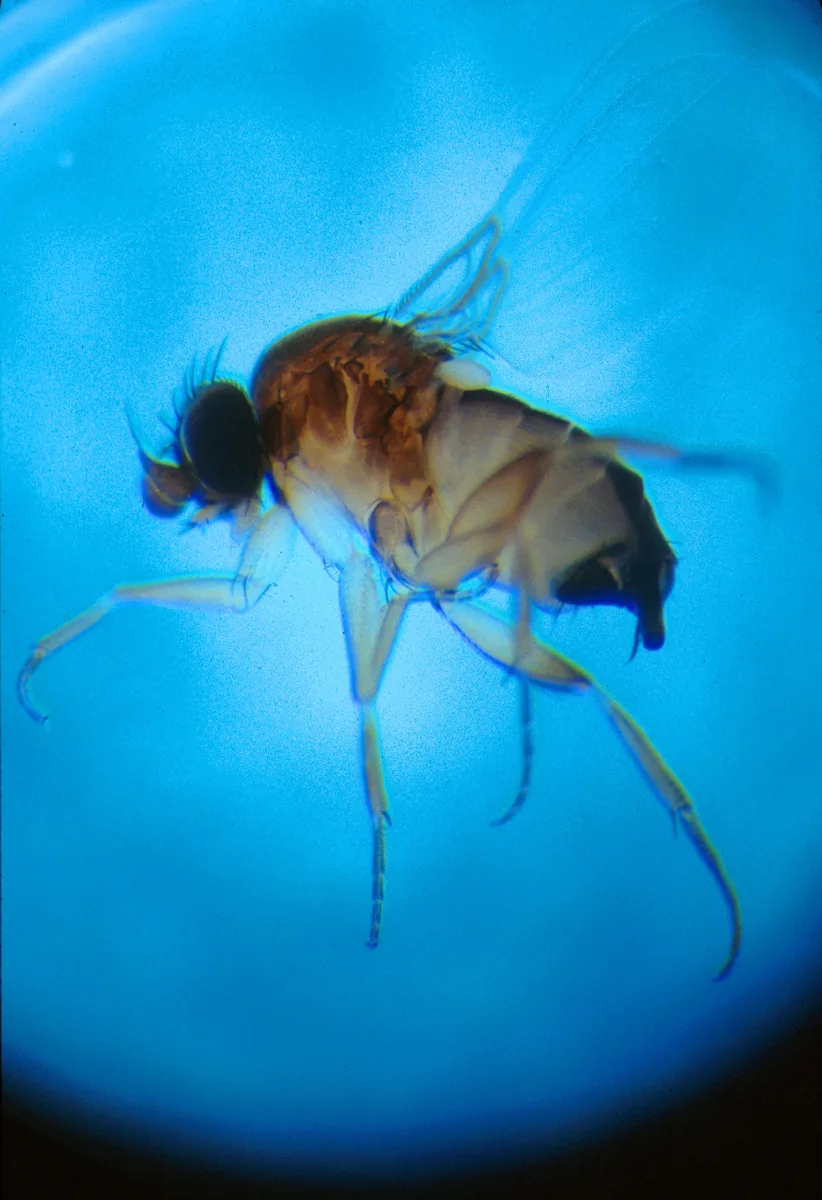
- Adults are tiny, only about one-sixteenth of an inch long, with a hump-backed look and few veins in the wings, like other phorid (scuttle) flies.[3][4]
- Females have a hardened, external egg-laying organ (ovipositor) used to pierce the ant; its shape differs from species to species and is used to tell them apart, and in Pseudacteon curvatus it is hooked. Males are sometimes smaller than females.[3][4]
- The best clue is behavior: the flies hover over fire ant workers near a mound and dart in to strike an ant, often in less than a second. They are hard to see unless you kick over a mound, and the released species orient mainly to disturbed mounds.[3][5][4]
- Parasitized ants end up as detached heads. The fly pupates inside the empty head, and within a couple of days two small breathing horns poke out from its sides.[1][3][4]
Look-alikes
| Look-alike | How to tell them apart |
|---|---|
| Other phorid flies | Most phorids that people notice breed in decaying matter, and some become household pests. UF/IFAS says decapitating flies are not attracted to people, animals other than ants, rotting material, carrion, feces, fruits, vegetables or prepared foods, and tests before release found the same.[4][3] |
Where it lives
More than 20 Pseudacteon species attack fire ants in South America. In the United States, by fall 2008 P. tricuspis covered about half of the fire ant quarantine area and two biotypes of P. curvatus almost 60%. By UF/IFAS's 2017 account, P. tricuspis and P. curvatus covered most of the Southeast; P. obtusus was abundant in much of Texas and Florida, with smaller populations in Mississippi and Georgia; P. litoralis (Alabama) and P. nocens (Texas) had limited but expanding ranges; and P. cultellatus, the most recently released, was established at two sites in Florida.[1][4]
Biology and life cycle
A mated female hovers over foraging fire ant workers, strikes one in the thorax with her ovipositor and lays an egg inside. One female usually carries a hundred or more eggs, so she can attack many ants.[3][4]
The maggot moves into the ant's head and feeds mostly on its blood (hemolymph). Before pupating it releases a chemical, likely an enzyme, that loosens the joints of the ant's shell, eats out the head, and the head usually falls off. It then pushes off the ant's mouthparts and pupates inside the head, its hardened front segments plugging the mouth opening.[3][1][4]
In several species the size of the ant's head decides the sex of the fly: large ants produce females and small ants males. In P. tricuspis the larger workers are needed to produce female flies, while the smaller P. curvatus is not limited by worker size.[4][5]
Each species is highly host specific, attacking only one ant species or a group of closely related ones. The released species mainly attack the red imported fire ant; P. litoralis and P. curvatus also attack the black imported fire ant and hybrids, and some species or biotypes prefer one or the other.[2][1][4]
Adults emerge from the head 2 to 6 weeks after pupation. The whole life cycle takes 4 to 12 weeks depending on temperature, and adults live only about 3 to 5 days of it.[4]
Imported fire ants have been in the United States since around 1918 and are far less dense in their native South America, which one researcher attributes to the absence of their natural enemies here. Programs to import the flies began around 1994 at the USDA-ARS fire ant unit in Gainesville, Florida, and the University of Texas at Austin; the first successful release was P. tricuspis in Florida in 1997.[4]
Damage and signs
- They are beneficial. Besides killing the ants they parasitize, the flies disrupt fire ant foraging: workers stop to defend themselves or hide, and even a single fly can stop or greatly slow hundreds of workers, which can let other ants compete for food.[2][1][4]
- Their overall effect on fire ant populations may be limited, because fire ant workers have evolved ways to cope with the parasites.[2]
Health risk
UF/IFAS and pre-release tests found they are not attracted to people, animals other than ants, food, dung, garbage or carrion; the sources describe them only as parasites of ants.[4][3][2]
Control
Prevention
No control is needed. These flies are biological control agents for imported fire ants and UF/IFAS says they are found only around disturbed fire ant mounds.[1][3][4]
Biological control
USDA-ARS and state cooperators released P. tricuspis in 11 states and P. curvatus in six states between 1997 and 2004, and from 2001 USDA-APHIS ran a cooperative program to rear and release the flies in all infested states. Fire ant biological control also uses microsporidian pathogens and viruses.[1]
Common questions
- Do decapitating flies really cut off fire ant heads?
- In effect, yes. The maggot develops inside the ant's head, releases an enzyme that dissolves the membranes holding it together, eats the contents, and the head usually falls off. The fly then finishes developing inside the detached head.[3][1][4]
- Will decapitating flies get rid of fire ants in my yard?
- Not on their own. They kill some ants and disrupt foraging, but fire ant workers have evolved ways to cope with them, which may limit their effect on fire ant populations. Fire ant biological control also uses microsporidia, viruses and other parasites.[2][4]
- Will these flies bother people or get into food?
- No. Tests showed they are not attracted to anything other than fire ants, including foods, dung or human waste.[3]
Sources
- Journal of Insect Science, via PubMed Central, “Fire ant decapitating fly cooperative release programs (1994-2008): two Pseudacteon species, P. tricuspis and P. curvatus, rapidly expand across imported fire ant populations in the southeastern United States (Callcott et al., 2011).” pmc.ncbi.nlm.nih.gov/articles/PMC3281391/ (accessed 2026-11-12). PMID 21526930
- Annual Review of Entomology (via NCBI PubMed), “Pseudacteon Phorid Flies: Host Specificity and Impacts on Solenopsis Fire Ants (L. Chen and H. Y. Fadamiro; Annual Review of Entomology, 2018; abstract).” pubmed.ncbi.nlm.nih.gov/28938082/ (accessed 2026-11-12)
- USDA Agricultural Research Service, “Ouch! The Fire Ant Saga Continues (Agricultural Research magazine, Vol. 47, No. 9, September 1999).” agresearchmag.ars.usda.gov/1999/sep/anti (accessed 2026-11-12)
- University of Florida IFAS Extension (EDIS), “Fire Ant Decapitating Flies, Pseudacteon spp., EENY680/IN1174 (A. McCorquodale, J. P. Cuda and S. D. Porter; May 2017, reviewed May 2020).” ask.ifas.ufl.edu/publication/IN1174 (accessed 2026-11-14)
- Southwestern Entomologist; copy hosted by USDA Agricultural Research Service, “Introducing Phorid Fly Parasitoids of Red Imported Fire Ant Workers from South America to Texas: Outcomes Vary by Region and by Pseudacteon Species Released (Gilbert et al., Southwestern Entomologist 33(1), 2008).” www.ars.usda.gov/arsuserfiles/60360510/publications/Gilbert_et_al-2008(M-4307).pdf (accessed 2026-11-12)
- iNaturalist, “Pseudacteon taxon page (order and family).” www.inaturalist.org/taxa/504017 (accessed 2026-11-09)