On this page
How to identify it
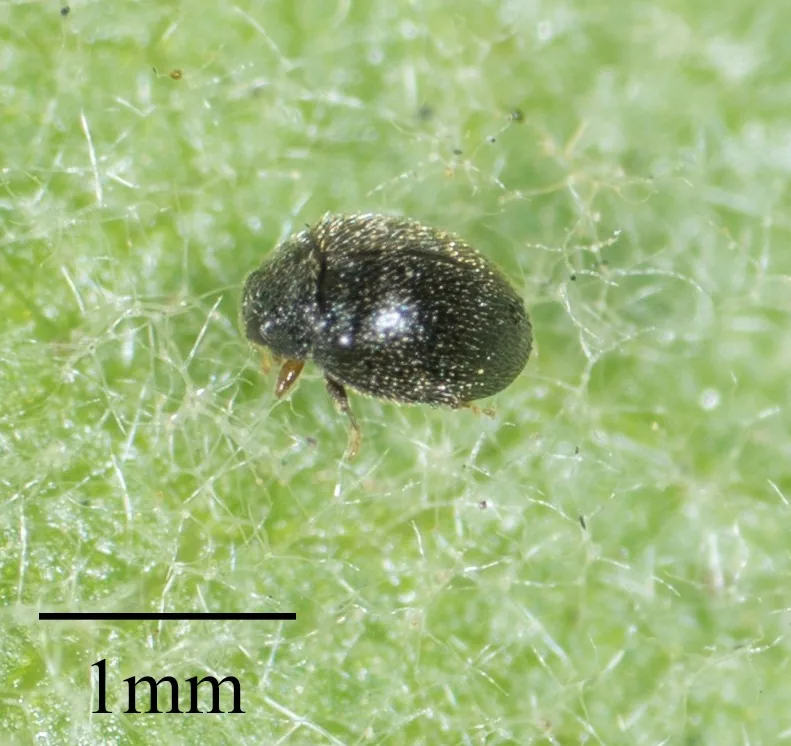
- Adults are black, oval and domed, about 1/16 inch (1.5 mm) long, and look grayish because of fine pale hairs.[1]
- Young larvae are dark gray to brown with many tiny branched hairs, and they turn reddish from the edges inward as they mature.[1]
- Eggs are about 1/64 inch, pale yellow to white and turn grayish to black before hatching; they're laid one at a time, mostly beside the main veins under leaves.[1]
Where it lives
At least seven Stethorus species live in the U.S. UC IPM says S. picipes is the only one in California and S. punctum punctum lives in the East; a 2021 California almond study, though, names the almond predator S. punctum. The European S. punctillum, accidentally introduced, pushed native S. punctum out of Ontario orchards over about 20 years.[1][4][2]
Biology and life cycle
Females lay about 100 to 200 eggs over a one- to two-month life, one to ten per leaf depending on mite numbers (UC IPM). A lab figure for S. punctum is about 221 eggs.[1][2]
In warm weather it goes from egg to adult in three to four weeks, or about 17 days at 77 F for S. punctum in lab studies. Temperate populations of S. punctum have two to three generations a year.[1][2]
Adults spend the winter in a resting state, often bunched near the base of orchard trees; in Washington apple orchards they also shelter in cardboard bands wrapped around trunks.[2]
Damage and signs
- It eats only mites. UC IPM says adults and larvae can each eat up to 75 mites a day; a 2009 research review puts egg-laying females at 30 to 60 a day.[1][2]
- Adults are good at finding mites. Researchers have seen them locate infested trees in an orchard when mites averaged fewer than one per leaf, and they fly readily to fresh hot spots.[2][1]
Health risk
It's a mite predator; neither UC IPM nor the research review describes any effect on people.[1][2]
Control
Biological control
Leave sheltered spots near the base of fruit and garden trees undisturbed over winter, since that is where adults tend to cluster.[2]
Neonicotinoids and several insect growth regulators are toxic to it. In one lab test, buprofezin didn't kill the eggs, but about 71% of treated young larvae failed to develop.[2][3]
S. punctum and S. picipes aren't sold, so conserving local beetles is the way to use them. A related European species, S. punctillum, is sold by a British Columbia supplier for releases in the U.S. and Canada.[2]
Spotting them
Yellow sticky cards are the usual way to check for them. In one study yellow cards caught up to 15 times more Stethorus punctum than white ones, and a California almond study also used yellow sticky traps to track them.[2][4]
Common questions
- What are the tiny black beetles in my mite-infested plants?
- Possibly spider mite destroyers. Adults fly well and gather where mites are thick, then lay eggs there.[1]
- Are the reddish hairy larvae a problem?
- No. Spider mite destroyer larvae turn reddish as they mature and feed on spider mites.[1]
- Can I buy spider mite destroyers?
- The native species aren't sold. A 2009 review names one British Columbia company that sells the related S. punctillum.[2]
- Do they help in almond and fruit orchards?
- Yes. In California almonds, sixspotted thrips and S. punctum have taken over from predatory mites as the main spider mite predators, and the 2021 study found yellow strip sticky traps, paired with leaf checks for mites, a practical way to track them.[4]
Sources
- University of California Statewide IPM Program, “Spider Mite Destroyer (Natural Enemies Gallery).” ipm.ucanr.edu/natural-enemies/spider-mite-destroyer/ (accessed 2026-11-13)
- Biological Control (Elsevier); review PDF hosted by USDA Agricultural Research Service, “Biology, ecology and management of Stethorini, specialized mite predators (Biddinger, Weber & Hull, Biological Control 51:268-283, 2009).” www.ars.usda.gov/ARSUserFiles/30842/Biddinger-etal2009-Stethorini.pdf (accessed 2026-11-13)
- Journal of Economic Entomology, 2004 (via PubMed), “Effect of buprofezin on survival of immature stages of Harmonia axyridis, Stethorus punctum picipes (Coleoptera: Coccinellidae), Orius tristicolor (Hemiptera: Anthocoridae), and Geocoris spp. (Hemiptera: Geocoridae) (abstract).” pubmed.ncbi.nlm.nih.gov/15279269/ (accessed 2026-11-13)
- Journal of Economic Entomology, 2021 (via PubMed), “Evaluation of Sticky Traps for Monitoring Scolothrips sexmaculatus (Thysanoptera: Thripidae) and Stethorus punctum (Coleoptera: Coccinellidae) as Predators of Spider Mites in California Almonds (abstract).” pubmed.ncbi.nlm.nih.gov/33346359/ (accessed 2026-11-13)
- Global Biodiversity Information Facility (GBIF), “Stethorus Weise, 1885 (GBIF Backbone Taxonomy).” api.gbif.org/v1/species/1043608 (accessed 2026-11-13)