On this page
How to identify it
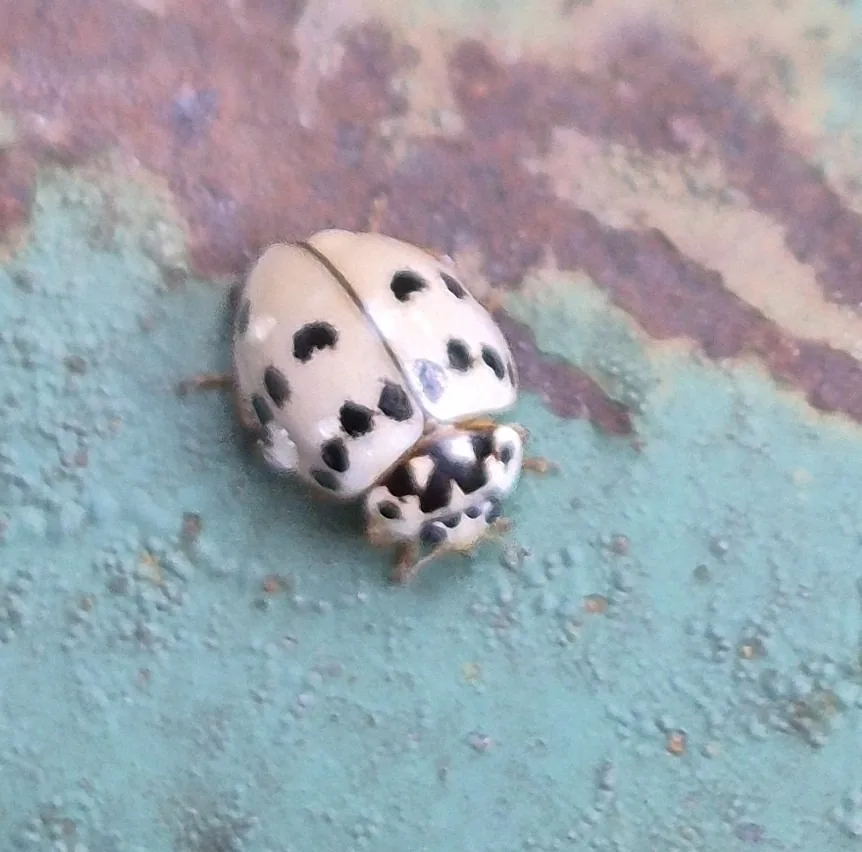
- Adults are 1/6 to 1/4 inch long, oval to round and domed.[1]
- The usual form is gray or pinkish gray with more than a dozen black spots on the thorax and wing covers.[1]
- A black form has two red spots, and another is gray with a large black blotch on each wing cover.[1]
- Larvae are alligator-like and fairly smooth, blackish with white and yellow marks; all stages sit in the open on leaves and stems.[1]
Look-alikes
| Look-alike | How to tell them apart |
|---|---|
| Twicestabbed and similar lady beetles | Black two-spotted look-alikes have wing-cover edges that flare out into a ridge, lack pale color on the head and thorax, and have spiny larvae.[1] |
Where it lives
It lives mostly in trees and shrubs, including fruit and nut trees, landscape plantings and wildland woody plants. It's the only Olla species reported in the U.S.[1]
Biology and life cycle
Females lay eggs on end in loose groups of about one to three dozen.[1]
Newly hatched larvae stay near their egg shells and feed on them at first.[1]
Egg to reproductive adult takes about three weeks at 77 degrees F, with several generations a year.[1]
In a pecan orchard study, the ashy gray lady beetle and the multicolored Asian lady beetle were the two lady beetles collected often both up in the tree canopy and at ground level, while convergent and seven-spotted lady beetles were rarely found in the canopy.[4]
Damage and signs
Health risk
UC IPM covers it only as a predator of soft-bodied insects; nothing in the source points to a concern for people.[1]
Control
Prevention
Avoid broad-spectrum insecticides that persist on foliage.[1]
Biological control
Flowering insectary plants feed adults with nectar and pollen.[1]
Ants attack lady beetles, so controlling ants helps them.[1]
More from the research literature
A 2015 laboratory study in the Brazilian Journal of Biology, comparing three predatory lady beetles reared on pollen and moth eggs, found that this species had the longest egg-laying period of the three and completed its life cycle with good reproduction under lab conditions.[2]
A 2017 study in pecan orchards found that trap height changed which lady beetles were caught; apart from the ashy gray lady beetle, native species were caught only in low numbers, while the multicolored Asian lady beetle dominated the catch.[5]
Common questions
- What's the gray ladybug with black spots?
- Most likely the ashy gray lady beetle, which is usually gray or pinkish gray with many black spots.[1]
- Is a black lady beetle with two red spots always a twicestabbed?
- No. One form of the ashy gray lady beetle looks like that too; its head and thorax show some pale gray or white.[1]
- Is the ashy gray lady beetle a pest?
- No. UC IPM lists it as a natural enemy that eats aphids and psyllids especially, plus whiteflies and other soft-bodied insects, and it is a common lady beetle in pecan tree canopies.[1][4]
Sources
- University of California Statewide IPM Program, “Ashy Gray Lady Beetle (Natural Enemies Gallery).” ipm.ucanr.edu/natural-enemies/ashy-gray-lady-beetle/ (accessed 2026-11-12)
- Peer-reviewed literature (PubMed), “Biology and fertility life table of Eriopis connexa, Harmonia axyridis and Olla v-nigrum (Coleoptera: Coccinellidae) (Zazycki LC et al., Brazilian journal of biology = Revista brasleira de biologia, 2015).” pubmed.ncbi.nlm.nih.gov/26675915/ (accessed 2026-11-12)
- iNaturalist, “Olla v-nigrum taxon page (order and family).” www.inaturalist.org/taxa/313246 (accessed 2026-11-12)
- Insects 2012;3(4):1257-70, via PubMed, “Seasonal Abundance of Aphids and Aphidophagous Insects in Pecan.” pubmed.ncbi.nlm.nih.gov/26466738/ (accessed 2026-11-12). Cited from the PubMed abstract.
- Environmental Entomology 2017;46(2):343-352, via PubMed, “Trap Height Affects Capture of Lady Beetles (Coleoptera: Coccinellidae) in Pecan Orchards.” pubmed.ncbi.nlm.nih.gov/28334128/ (accessed 2026-11-12). Cited from the PubMed abstract.