On this page
How to identify it
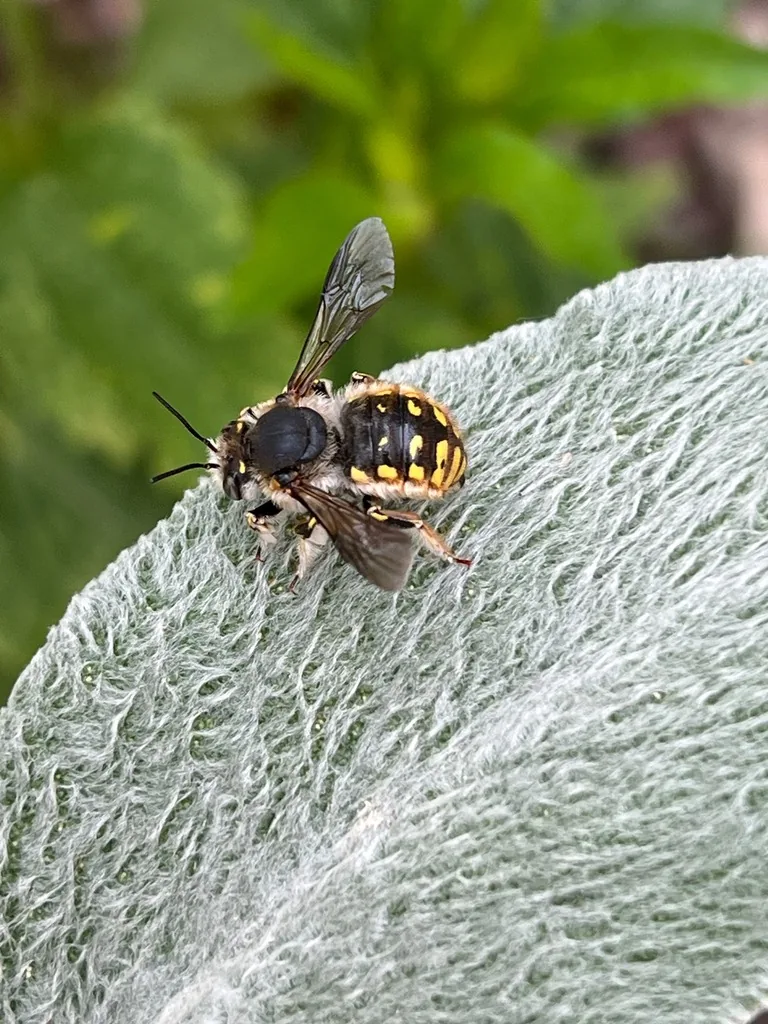
- Robust and about honey-bee size, with a brightly yellow-and-black patterned abdomen that is not very hairy. UF/IFAS gives 11 to 17 mm (7/16 to 5/8 inch). At a glance it can be mistaken for a yellowjacket, but it is hairier and more robust.[1][4]
- Males are a bit larger than females, with darker markings, and carry sharp spurs at the tip of the abdomen. UF/IFAS gives males 14 to 17 mm and females 11 to 13 mm, which is unusual among bees, where females are typically the larger sex. Males usually show more yellow than females and have five sharp spines on the last abdominal segments, used in defending their territory.[1][4]
- Females trim the hairs off lamb's ear leaves with their jaws, a habit called carding.[2][1]
- They are fast fliers that can hover.[1]
- UF/IFAS says females have large toothed jaws for scraping plant hairs, short dense hairs on the lower legs that help shape the fibers into a ball, and white-to-amber hairs under the abdomen for carrying pollen.[4]
Look-alikes
| Look-alike | How to tell them apart |
|---|---|
| Native Anthidium bees | Colorado alone has at least six native Anthidium species. Four are black and white; two, A. emarginatum and A. mormonum, are yellow and black like the wool carder bee and need a closer look.[1] |
| Yellowjackets | UF/IFAS says both have bright yellow warning markings and can be confused at a glance, but wool carder bees are hairier and more robust.[4] |
Where it lives
Native to Eurasia. Called the most widely distributed unmanaged bee in the world, it was accidentally brought to North America from Europe in the late 1960s and later to South America, New Zealand and the Canary Islands, and is now widespread in North America. In Utah it turned up in 10 of 29 counties, mostly in towns and suburbs; Colorado State reports it in many Front Range gardens. UF/IFAS says it is native to Europe, western Asia and northern Africa, was likely moved in nests inside wood cavities and hollow plant stems, and now occurs across most of the United States and into southern Canada. As of the UF publication it had not been reported in Florida, though UF says its arrival there would not be surprising.[5][3][1][4]
Biology and life cycle
A solitary bee that nests in existing cavities: in gardens, cracks in walls or building foundations and knotholes or drill holes in wood. UF/IFAS lists cavities in wood such as beetle holes, hollow plant stems and reeds, cracks in walls and man-made bee houses.[1][4]
Nest cells are lined with plant hairs collected from hairy-leaved plants of the mint family; lamb's ear (Stachys) is probably the most used. Females stock the cells with pollen and nectar. UF/IFAS says she lays a single egg on top of the pollen and nectar before sealing each cell, plugs the end with nearby bits such as gravel, mulch and dried leaves, and repeats with adjoining cells until the cavity is full.[1][2][4]
Females appear to find plants by smell: lamb's ear leaves that have already been carded give off a different, stronger blend of volatile compounds, and the bees visit carded plants more often than intact ones.[2]
Males patrol and aggressively defend flower territories, attacking other wool carder bees and other kinds of pollinators, including honey bees. UF/IFAS says a male perches or hovers near the flowers females prefer and drives off intruders so he has the females there to himself for mating.[1][3][4]
UF/IFAS reports at least two generations a year in most areas. Eggs laid in fall overwinter as prepupae and emerge as adults the next spring or early summer. Each larva eats its pollen store, pupates in the cell and leaves the nest as an adult.[4]
Damage and signs
- Carding strips hairs from the leaves of lamb's ear and similar plants. A 2017 study found that carded plants attract more carding, so the bees may bring the plant both pollination and tissue damage.[2][1]
- The males' abdominal spurs can wound other bees fatally.[1]
- In a two-year study, common eastern bumble bees avoided foraging near wool carder bees, but the bumble bee colonies showed no loss of fitness; they likely found food elsewhere.[3]
- UF/IFAS notes concern that it competes with native bees for nest sites, pollen and nectar, that it is most common in towns, and that non-native bees visiting non-native flowers may help those plants spread.[4]
Health risk
None of the sources here reports wool carder bees stinging people; the males' spurs are used against other bees. If anyone is stung by a bee, wash the site, scrape out any stinger without squeezing it, and apply ice; people who have had a severe, bodywide reaction to a sting should see an allergist and carry an emergency kit.[1][3][6][7]
Control
Prevention
None of the sources here recommends controlling them. Females use holes that already exist, such as cracks in walls and old drill holes, rather than chewing their own.[1]
Where sources disagree
Flower choice: Colorado State says females provision cells with pollen and nectar only from mint-family plants, while a 2019 Biological Invasions study describes females as generalists visiting many of the same plants as native pollinators. UF/IFAS also calls them generalist feeders, most often reported on dead nettles, Stachys and other mints, peas and other legumes, and figworts.[1][3][4]
Arrival: UF/IFAS says it was first recorded in the U.S. near Ithaca, New York, in 1963, while a 2011 Biological Invasions paper says it was brought to North America in the late 1960s.[4][5]
Harm to plants: UF/IFAS says plants such as lamb's ear, rose campion and mulleins are not thought to be damaged by the fiber harvesting, while a 2017 study describes carding as tissue damage to lamb's ear.[4][2]
Common questions
- What is the bee chasing other bees off my lamb's ear?
- Likely a male European wool carder bee defending a flower patch; males attack other bees, including honey bees.[1][3]
- Do wool carder bees damage plants?
- Females trim leaf hairs from lamb's ear and similar plants for their nests. A 2017 study suggests the plant pays a cost in tissue damage as well as gaining pollination, and carded plants draw more carding.[2]
- What should I do if I'm stung by a bee?
- Wash the site, scrape out any stinger without squeezing it, and apply ice. Call 911 for trouble breathing or swelling of the face or mouth.[6][7]
- Are European wool carder bees found in Florida?
- Not as of the UF/IFAS profile, which found no Florida records but said its arrival there would not be surprising given its wide range.[4]
Sources
- Colorado State University Extension (Colorado Insects of Interest, W. Cranshaw), “Wool Carder Bee (Colorado Insect of Interest).” wci.extension.colostate.edu/wp-content/uploads/sites/14/2017/04/WoolCarderBee.pdf (accessed 2026-11-14)
- Behavioural Processes, via PubMed, “The European wool-carder bee (Anthidium manicatum) eavesdrops on plant volatile organic compounds during trichome collection (Graham et al. 2017).” pubmed.ncbi.nlm.nih.gov/28830833/ (accessed 2026-11-14)
- Biological Invasions 21: 1089-1099 (abstract), “Anthidium manicatum, an invasive bee, excludes a native bumble bee, Bombus impatiens, from floral resources (Graham, Obrien & Starks 2019).” link.springer.com/article/10.1007/s10530-018-1889-7 (accessed 2026-11-11)
- University of Florida IFAS Extension (EDIS), “European Wool Carder Bee, Anthidium manicatum (Linnaeus), EENY-746/IN1274 (Featured Creatures).” ask.ifas.ufl.edu/publication/IN1274 (accessed 2026-11-14)
- Biological Invasions 13: 2115-2133 (abstract), “Global invasion by Anthidium manicatum: assessing potential distribution in North America and beyond (Strange, Koch, Gonzalez & Griswold 2011).” link.springer.com/article/10.1007/s10530-011-0030-y (accessed 2026-11-14)
- MedlinePlus, U.S. National Library of Medicine, “Insect bites and stings (Medical Encyclopedia).” medlineplus.gov/ency/article/000033.htm (accessed 2026-11-11)
- CDC, National Institute for Occupational Safety and Health, “Insects and Scorpions at Work.” www.cdc.gov/niosh/outdoor-workers/about/insects-and-scorpions.html (accessed 2026-11-11)
- iNaturalist, “Anthidium manicatum taxon page (order and family).” www.inaturalist.org/taxa/62453 (accessed 2026-11-11)