On this page
How to identify it
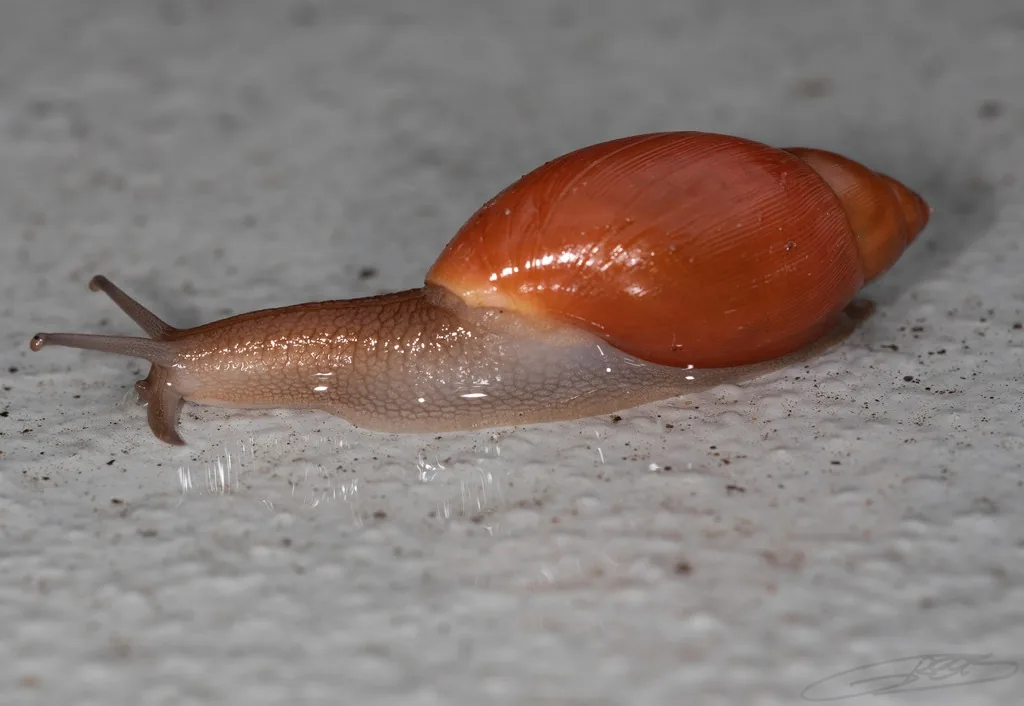
- The long, tapering shell is light brown, reddish brown, pinkish or grayish and nearly translucent. NC State says some shells reach 2.75 inches, and the stretched-out body can reach 4 inches.[1][2]
- The upper tentacles, with eyes at the tips, are about three times as long as the short lower pair, which almost touch the ground.[1][2]
- Two lip-like lappets on the sides of the head carry chemical receptors; the snail uses them to follow the slime trails of prey and of mates.[1][3][2]
- It moves at least three times faster than most snails and readily climbs vertical surfaces after prey.[1]
Look-alikes
| Look-alike | How to tell them apart |
|---|---|
| Decollate snail | Another snail-eating snail, with a pinkish-brown, tapered shell up to about 1-3/5 inches long whose tip breaks off as it grows. It is native to North Africa and the Mediterranean and is used against brown garden snails in parts of California.[4] |
Where it lives
NC State calls it native to tropical North America. Animal Diversity Web places it across Florida, historically north to Georgia and South Carolina, and west through Alabama, Mississippi and Louisiana to southeastern Texas, with a population found near Nashville, Tennessee, in 2006. It has been introduced to Hawaii and many other Pacific and Indian Ocean islands, parts of Asia, the Bahamas and Bermuda.[1][2]
Biology and life cycle
In gardens it turns up where its prey lives. It sometimes burrows under mulch, boards or plywood, follows prey into water, and gathers in small numbers to mate after rain.[1]
It is a hermaphrodite. Animal Diversity Web reports breeding from late May to early November, with 25 to 35 eggs laid in a shallow patch of soil each time and hatching in 27 to 43 days. Snails mature 5 to 11 months after hatching.[2]
It is active mostly at night and at dawn and dusk, and hibernates roughly from December to March. In captivity the life cycle averaged 16 months, and the longest-lived snail reached 24 months.[2]
Damage and signs
- It does no garden damage. It eats plant-feeding snails and slugs, and NC State notes it also eats other rosy wolf snails and their eggs.[1]
- It was released in Hawaii to control the giant African snail, with little success, and has driven many native snails there to extinction.[1][2]
- On the Society Islands of French Polynesia, its deliberate introduction led to the extinction or loss from the wild of 55 of 61 native Partula tree snail species.[5]
Health risk
Animal Diversity Web reports no direct harm to people, and NC State treats it as beneficial in landscapes.[2][1]
Control
Prevention
No control is needed in gardens, where it eats pest snails and slugs, unless you are trying to protect native snails.[1]
Don't move it to new areas. Animal Diversity Web says efforts to reduce populations where it was introduced have had little success.[2]
Where sources disagree
Diet: NC State describes it as eating both snails and slugs, while Animal Diversity Web says it feeds on snails and turns to slugs mainly after long periods without snail prey.[1][2]
Origin: NC State calls it native to tropical North America, while Animal Diversity Web places its native range in the southern and southeastern United States.[1][2]
Common questions
- Is the big pink snail in my garden a pest?
- No. A rosy wolf snail eats other snails and slugs, so in gardens it is a helper rather than a pest.[1][2]
- Why is it a problem in Hawaii?
- People released it there to fight the giant African snail. It did little against that snail and drove many native snails extinct.[1][2]
- How does it find other snails?
- It follows their slime trails, sensing the mucus with two mobile lip extensions on its head.[3][1]
Sources
- NC State Extension, “Rosy Wolf Snail (PDIC Factsheet).” content.ces.ncsu.edu/rosey-wolf-snail (accessed 2026-11-11)
- Animal Diversity Web, University of Michigan Museum of Zoology, “Euglandina rosea (rosy wolfsnail) species account.” animaldiversity.org/accounts/Euglandina_rosea/ (accessed 2026-11-11)
- Brain and Behavior, via PubMed, “Patel et al. (2014), Mucus trail tracking in a predatory snail.” pubmed.ncbi.nlm.nih.gov/24653958/ (accessed 2026-11-11)
- University of California Statewide IPM Program, “Decollate Snail (Natural Enemies Gallery).” ipm.ucanr.edu/natural-enemies/decollate-snail/ (accessed 2026-11-11)
- Molecular Phylogenetics and Evolution, via PubMed, “Haponski, Lee and O Foighil (2017), Moorean and Tahitian Partula tree snail survival after a mass extinction.” pubmed.ncbi.nlm.nih.gov/27677398/ (accessed 2026-11-11)
- iNaturalist, “Euglandina rosea taxon page (order and family).” www.inaturalist.org/taxa/121012 (accessed 2026-10-06)