On this page
How to identify it
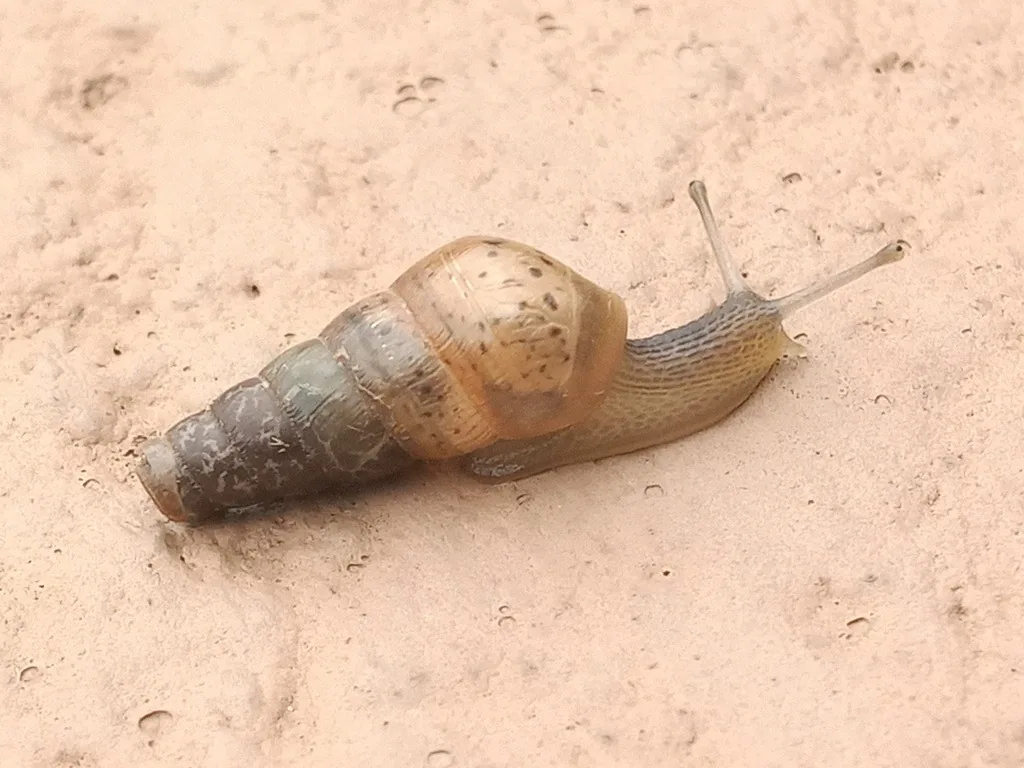
- The shell is pinkish brown, long and tapered toward the rear; young snails can be paler. UC IPM gives a length of up to 1-3/5 inches (40 mm) and a width of 5/8 inch (14 mm); Arizona Game and Fish gives up to 45 mm long and 14 mm wide.[1][2]
- As it grows the tip breaks off, so older snails look blunt-ended. UC IPM says older snails keep four to seven whorls (young ones up to 10); Arizona Game and Fish says typically four to six.[1][2]
- A neat trick: the snail seals the broken end with a chalky (calcareous) wall, so the shell stays closed. Arizona Game and Fish says the top 3 to 3.5 whorls break off once the shell is about 10 mm long, and that losing them may make the snail lighter, more mobile and better at resisting drying out.[2]
- The head, antennae and foot are blackish to dark olive-gray. The Texas Invasive Species Institute describes adults as about an inch long and uniformly tan to light brown.[1][3]
- Eggs are round, whitish, brittle-shelled and about 1/12 inch (2 mm) across, laid in topsoil.[1][2]
Look-alikes
| Look-alike | How to tell them apart |
|---|---|
| Brown garden snail | The pest snail climbs trees and other objects; the decollate stays on soil and litter and climbs only to escape heavy water.[1] |
Where it lives
Native to North Africa and the Mediterranean, it reached Southern California in the 1960s and lives at irrigated sites in Central and Southern California. The Texas Invasive Species Institute dates the first U.S. introduction to the 1800s in Charleston, South Carolina, and Arizona Game and Fish calls it widespread but localized across the Sun Belt from California to Florida and up the Atlantic coast to Pennsylvania. GBIF holds about 9,700 U.S. records since 1990 from 13 state-level areas, the most from Texas (about 5,400), California (about 3,200) and Arizona (about 960). A 1973 genetic study found one strain had colonized much of the southern United States and northern Mexico.[1][3][2][4][5]
Biology and life cycle
Each snail is both male and female. It can fertilize itself but commonly mates with another decollate before laying eggs.[1][2]
It matures about 10 months after hatching. UC IPM says a mature snail lays about 200 eggs a year and up to 500 in its lifetime; Arizona Game and Fish gives about 500 eggs in a lifetime and a life span of 1 to 1-1/2 years.[1][2]
Eggs are laid singly or in loose clusters in a shallow hollow in the soil. UC IPM says they hatch in 10 to 45 days; Arizona Game and Fish gives 10 to 30 days, and the Texas Invasive Species Institute says they typically hatch within a month if conditions are good.[1][2][3]
It is active mostly at night and in wet or overcast weather, hiding by day in litter and the top inch of soil. It tracks prey by following the slime trails of brown garden snails and slugs.[1][2]
It can go months without water, goes dormant in hot dry weather and burrows into the soil in cold weather, but it does not survive where temperatures stay below freezing for long.[2]
It stays close to home: marked snails released in New Orleans moved no more than 25 inches in six months, as cited by Arizona Game and Fish.[2]
DNA studies show Rumina decollata is really a complex of several species; the introduced populations tested from North America and elsewhere all belong to one of them, the dark form. Back in 1973, a University of Texas study found no genetic variation within or among U.S. populations at 25 protein genes tested, which fits a single self-fertilizing strain that colonized the region.[6][5]
Damage and signs
- Besides snails, slugs and worms it eats some seedlings, leaves touching the soil, decaying plant material and fallen bruised fruit. In citrus it hasn't been seen eating leaves or undamaged fruit.[1][2]
- How much plant damage it does is disputed. University of Arizona Extension warns that it eats seedlings, small plants and flowers, and the Texas Invasive Species Institute says it can seriously damage landscape plants when no snails are around to eat; a researcher cited by Arizona Game and Fish did not think it did considerable plant damage under natural conditions.[7][3][2]
- As an introduced predator it may harm native snails and slugs, which is why UC IPM says not to release it outside the approved California counties. In China, where it is also introduced, researchers found it preys on a native snail, though the two still coexist where food is plentiful.[1][2][8]
Health risk
None of these sources (UC IPM, University of Arizona Extension, Arizona Game and Fish, the Texas Invasive Species Institute) reports a bite, sting or other risk to people or pets.[1][7][2][3]
Control
Prevention
Don't use snail baits where decollates live, because the baits kill both kinds of snail.[1]
Because it burrows and its eggs sit in topsoil, it spreads easily in container plants and moved soil; check plants and soil before bringing them in.[1]
Keep them out
Pruning low tree skirts and using copper trunk barriers stop climbing pest snails without affecting decollates, which rarely climb.[1]
Traps and physical control
Where you don't want decollates, the Texas Invasive Species Institute recommends combining habitat changes (removing hiding places such as clumps of vegetation and brush piles), hand-picking, trapping, barriers and bait.[3]
Biological control
Release is legal only in Fresno, Imperial, Kern, Los Angeles, Madera, Orange, Riverside, Santa Barbara, San Bernardino, San Diego, Ventura and Tulare counties; check with the county agricultural commissioner or wildlife officials first.[1]
Results aren't consistent, but releases can cut brown garden snails to insignificant levels in four to 10 years.[1]
More from Arizona Extension
University of Arizona Extension (Yavapai County) notes that although decollate snails prey on young brown garden snails, they also eat seedlings, small plants and flowers.[7]
Common questions
- Is the decollate snail good or bad for my garden?
- Both. It eats young brown garden snails and slugs, but it also eats seedlings, small plants and flowers, and it may harm native snails.[1][7][3]
- Can I buy decollate snails anywhere?
- They're reared and sold commercially, but release is legal only in certain California counties; never release them outside those areas.[1]
- Why does the shell look broken?
- The tip naturally breaks off as the snail grows and is sealed with a chalky plug, which is how it gets its name.[1][2]
- How fast do decollates work?
- Slowly. Expect four to 10 years, and results vary.[1]
- Can one decollate snail start a colony by itself?
- It can: each snail is both male and female and can fertilize itself, though UC IPM says decollates commonly mate with another before laying eggs. A PNAS study found the strain that colonized North America is genetically uniform, as expected from self-fertilization.[1][5]
Sources
- University of California Statewide IPM Program, “Decollate Snail (Natural Enemies Gallery).” ipm.ucanr.edu/natural-enemies/decollate-snail/ (accessed 2026-11-12)
- Arizona Game and Fish Department, “Invertebrate Abstract: Rumina decollata (Decollate snail), Heritage Data Management System.” azgfd-hdms.s3.amazonaws.com/public/abstracts/Rumideco.pdf (accessed 2026-11-12)
- Texas Invasive Species Institute, “Decollate snail (Rumina decollata).” tsusinvasives.org/database/decollate-snail.html (accessed 2026-11-12)
- Global Biodiversity Information Facility (GBIF), “Rumina decollata: U.S. occurrence records since 1990 by state (GBIF occurrence search).” api.gbif.org/v1/occurrence/search?taxonKey=2294129&country=US&hasGeospatialIssue=false&occurrenceStatus=PRESENT&year=1990%2C2026&facet=stateProvince&facetLimit=400&limit=0 (accessed 2026-11-12)
- Proc Natl Acad Sci U S A 1973;70(4):1186-1190, via PubMed, “Self-fertilization and genetic population structure in a colonizing land snail.” pubmed.ncbi.nlm.nih.gov/16592078/ (accessed 2026-11-12)
- Genome 2014;57(3):161-167, via PubMed, “Predominance of a single phylogenetic species in colonization events among a sextet of decollate land snail, Rumina decollata (Mollusca: Pulmonata: Subulinidae), species.” pubmed.ncbi.nlm.nih.gov/24804823/ (accessed 2026-11-12)
- University of Arizona Cooperative Extension, “Snails and Slugs (Yavapai County).” extension.arizona.edu/sites/default/files/attachment/SnailsSlugs.pdf (accessed 2026-11-12)
- Sci Total Environ 2024, via PubMed, “Revealing potential mechanisms of native and non-native snail coexistence through fecal microbiomes and dietary compositions.” pubmed.ncbi.nlm.nih.gov/39612711/ (accessed 2026-11-12)
- iNaturalist, “Rumina decollata taxon page (order and family).” www.inaturalist.org/taxa/125669 (accessed 2026-10-06)