On this page
How to identify it
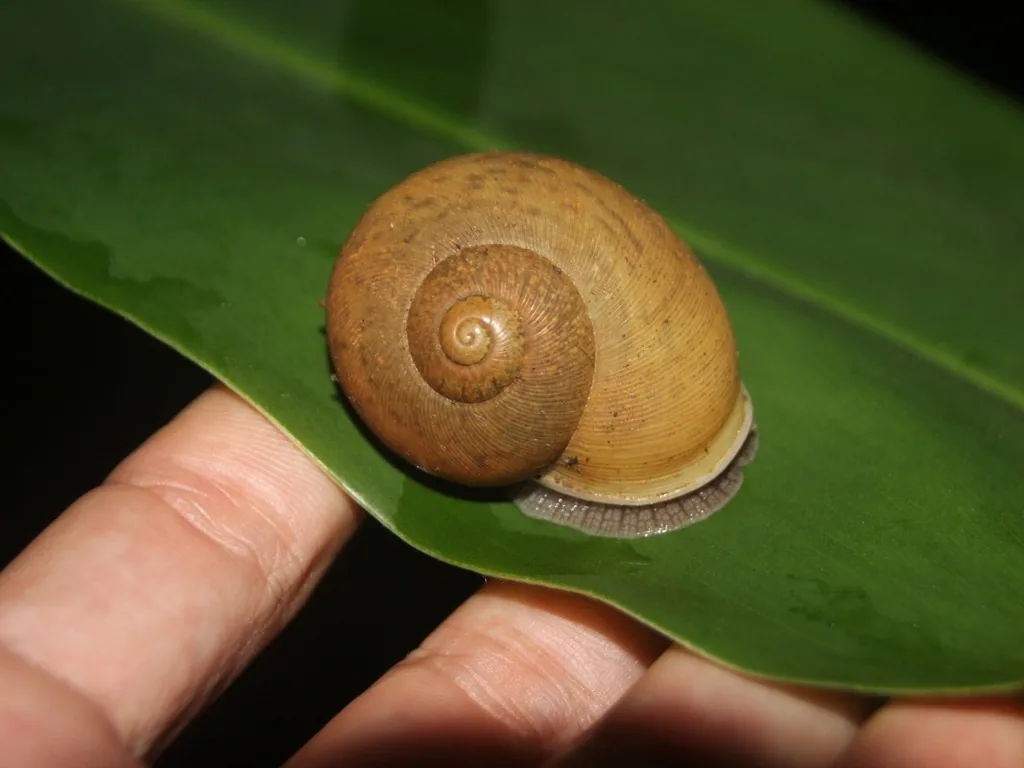
- Mature snails typically measure 25 to 30 mm (about 1 inch) across, with 4 to 5 rapidly widening whorls; Hawaii's agriculture department says the shell can exceed 3 cm and is about 2 cm high. UF/IFAS gives the same 25 to 30 mm width, about 20 mm (3/4 in) height and 4 to 5 whorls, and describes the shell as brown or yellowish brown, sometimes with brown streaks radiating from the center; the mouth is edged in white but not flared.[1][2][10]
- The upper surface of the shell has regular, strong, curved ribs. The lip of the opening is typically white, in sharp contrast with the yellowish-brown to dark brown shell.[1]
- The shell has no umbilicus (no hollow visible in the center from below). Eggs are about 1/2 cm long.[1][2]
- The shell changes shape as the snail grows. In young snails the lower lip of the opening droops well away from the whorls; as they mature it rounds out to an oval almost in line with the base of the shell, so UF/IFAS says adults are normally needed for identification.[10]
Look-alikes
| Look-alike | How to tell them apart |
|---|---|
| Zachrysia trinitaria | A closely related Cuban snail first reported from southern Florida in 2004 and still rare. UF/IFAS says it greatly resembles the Cuban brown snail but is larger, 41 to 45 mm (about 1 2/3 to 1 3/4 inches) across.[10] |
| Asian tramp snail | Another plant-feeding snail in south Florida, but much smaller when mature, about 12 to 16 mm across, usually with a narrow brown stripe around the whorl, a slightly flared mouth and fine rather than pronounced ribs.[10] |
Where it lives
Native to Cuba, it probably reached the Bahamas in the late 1800s and has since been detected on a variety of Caribbean islands. Plant Pono says it has become widespread in Florida and California, but of about 3,600 U.S. GBIF records since 1990 nearly all are from Florida, with none from California. Hawaii's agriculture department detected it on Oahu in September 2020, though Plant Pono's fact sheet lists it as not known in Hawaii. UF/IFAS says it was deliberately introduced to the Miami area from Cuba in the early 1900s and is now the most abundant of the large land snails in south Florida, reaching as far north as Tampa and Orlando; it is also known from several Caribbean islands and Costa Rica.[1][4][5][2][10]
Biology and life cycle
It feeds at night and burrows into the soil by day to avoid heat and drying out, which lets it ride along unseen in potted plants. It also hides in other cool, damp spots such as cinder blocks.[2][1]
It climbs trees readily and can damage tree foliage and strip bark from stems.[1]
UF/IFAS says land snails in general are hermaphrodites, with both male and female organs. Mating needs high humidity and often follows rain, and eggs are normally laid in clusters in nest holes in the soil.[10]
Damage and signs
- It is mainly a pest of ornamentals such as bougainvillea, crape myrtle, hibiscus, ti plant, impatiens, orchids, bromeliads, ornamental asparagus, begonia, cactus, aroids and cut flowers. It also attacks citrus, cabbage-family crops, peppers, sweet potato, starfruit and mango. UF/IFAS calls it quite voracious, able to eat most plants it encounters, including tropical fruit, citrus, most ornamentals and vegetables, and because it travels readily in potted plants it is a quarantine issue.[1][10]
- In Hawaii it has been found feeding on garden vegetables and leafy greens.[2]
- Florida-grown ornamentals are shipped regularly to other states, and its arrival on some Caribbean islands is blamed on plants shipped from Florida.[1]
Health risk
It can carry rat lungworm (Angiostrongylus cantonensis). Infected Cuban brown snails have been found in Florida, and the death of a non-human primate there was attributed to eating one. People are infected by eating raw or undercooked snails or slugs, or raw produce carrying a small snail or part of one. Most recover without treatment, but the infection sometimes causes a rare meningitis with headache, stiff neck, tingling or painful skin, low fever, nausea and vomiting.[6][3][7][8][2]
Control
Prevention
Inspect potted plants and other materials before moving them, and consider where nursery plants come from before buying.[2][1]
In Hawaii, photograph the snail with a coin for scale, collect it with gloves into a sealed jar with holes in the lid, and send the photos, date and location to the Hawaii Department of Agriculture or report it at 643pest.org.[2][1]
Sanitation
Cut down hiding places: remove unnecessary groundcover, cut back vegetation, and move stored items off the ground.[1]
Snails favor high humidity, so UF/IFAS suggests removing mulch, ground cover, wood and stones that give them moist shelter, reducing irrigation where you can, and checking under the flowerpots of damaged plants, since snails don't move far from their host plants.[10]
Traps and physical control
Hand-pick snails in the evening or at night after watering. Wear gloves or use a tool rather than bare hands.[2][8]
Set a board, flowerpot saucer or unglazed flowerpot in a shady spot as a refuge, then collect and destroy the snails hiding under it in daytime. Copper strips around bench legs or tree trunks deter snails from crossing, but copper becomes less effective as it oxidizes and does nothing about snails already inside.[10]
Biological control
The rosy wolf snail, native to the Southeast and common in Florida woodlands and gardens, readily attacks other snails. UF/IFAS discourages moving it outside its natural range because it has been disruptive to native snails elsewhere.[10]
Pesticides
Slug and snail baits containing a molluscicide kill the snails or reduce feeding; read and follow the label. UF/IFAS says no bait is completely effective, lists iron phosphate and sodium ferric EDTA baits as fairly effective alternatives to metaldehyde, and finds boric acid and sulfur baits much less effective. Baits work best applied after watering (but don't water right after), scattered thinly rather than piled.[2][10]
Rat lungworm and handling snails
In a statewide Florida survey, the Cuban brown snail was one of six snail species newly recorded as carrying rat lungworm. Researchers have found the parasite from the panhandle to Miami, often in areas with many people, and expect human cases there eventually.[3][7]
CDC advises against eating raw or undercooked snails or slugs, wearing gloves and washing your hands if you handle them, and washing fresh produce thoroughly.[8]
Where the sources disagree
Florida spread: Plant Pono calls it widespread in Florida; UF/IFAS describes it as most abundant in south Florida and found as far north as Tampa and Orlando.[1][10]
Shell size: UF/IFAS and Plant Pono give 25 to 30 mm across; Hawaii's agriculture department says the shell can exceed 3 cm.[10][1][2]
Common questions
- What is the brown snail eating my hibiscus at night?
- In Florida, a heavily ribbed brown snail about an inch across with a white-lipped opening, feeding on ornamentals at night, may be the Cuban brown snail.[1][2]
- What should I do if I find one in Hawaii?
- Take a clear photo with a coin for scale, collect the snail with gloves into a sealed container, and report it to the Hawaii Department of Agriculture or at 643pest.org.[2][1]
- Is it safe to touch a Cuban brown snail?
- Use gloves. It can carry rat lungworm, and CDC advises gloves and hand-washing for anyone who handles snails or slugs.[2][3][8]
- Do crushed eggshells or diatomaceous earth keep snails away?
- UF/IFAS says research has not supported using diatomaceous earth or broken eggshells as snail deterrents.[10]
Sources
- Plant Pono (Hawaii Invasive Species Council), “Cuban Brown Snail (pest fact sheet).” plantpono.org/wp-content/uploads/cuban-brown-snail-fact-sheet.pdf (accessed 2026-11-11)
- Hawaii Department of Agriculture, Plant Pest Control Branch, “New Pest Advisory 21-02: Cuban Brown Snail (J. R. Ocenar and J. N. Matsunaga, June 2021).” dab.hawaii.gov/pi/files/2021/06/21-02-Cuban-brown-snail.pdf (accessed 2026-11-11)
- PLoS One, via PubMed, “Geographic distribution of Angiostrongylus cantonensis in wild rats and terrestrial snails in Florida (Stockdale Walden et al. 2017).” pubmed.ncbi.nlm.nih.gov/28542310/ (accessed 2026-11-11)
- Global Biodiversity Information Facility (GBIF), “Zachrysia provisoria: U.S. occurrence records since 1990 by state (GBIF occurrence search).” api.gbif.org/v1/occurrence/search?taxonKey=4304769&country=US&hasGeospatialIssue=false&occurrenceStatus=PRESENT&year=1990%2C2026&facet=stateProvince&facetLimit=400&limit=0 (accessed 2026-11-11). Exact count at access: 3,619 U.S. records since 1990 (Florida 3,584; Hawaii 9; North Carolina 4; Pennsylvania 3; no California records).
- Global Biodiversity Information Facility (GBIF), “Zachrysia provisoria: occurrence records since 1990 by country (GBIF occurrence search).” api.gbif.org/v1/occurrence/search?taxonKey=4304769&hasGeospatialIssue=false&occurrenceStatus=PRESENT&year=1990%2C2026&facet=country&limit=0 (accessed 2026-11-11). Exact counts at access: 4,773 records since 1990; United States 3,619, Dominican Republic 186, Antigua and Barbuda 131, Bahamas 127, Jamaica 124.
- Journal of Parasitology, via PubMed, “Angiostrongylus cantonensis in introduced gastropods in southern Florida (Stockdale-Walden et al. 2015).” pubmed.ncbi.nlm.nih.gov/25564891/ (accessed 2026-11-11)
- Parasitology, via PubMed, “Angiostrongylus cantonensis (rat lungworm) in Florida, USA: current status (Walden et al. 2021).” pubmed.ncbi.nlm.nih.gov/32729436/ (accessed 2026-11-11)
- Centers for Disease Control and Prevention, “About Rat Lungworm Disease.” www.cdc.gov/angiostrongylus/about/index.html (accessed 2026-11-11)
- iNaturalist, “Zachrysia provisoria taxon page (order and family).” www.inaturalist.org/taxa/233921 (accessed 2026-10-06)
- University of Florida IFAS Extension, EDIS (Featured Creatures), “Terrestrial Snails (Phylum Mollusca, Class Gastropoda) Affecting Plants in Florida, EENY-497/IN893 (Featured Creatures).” ask.ifas.ufl.edu/publication/IN893 (accessed 2026-11-14)