On this page
How to identify it
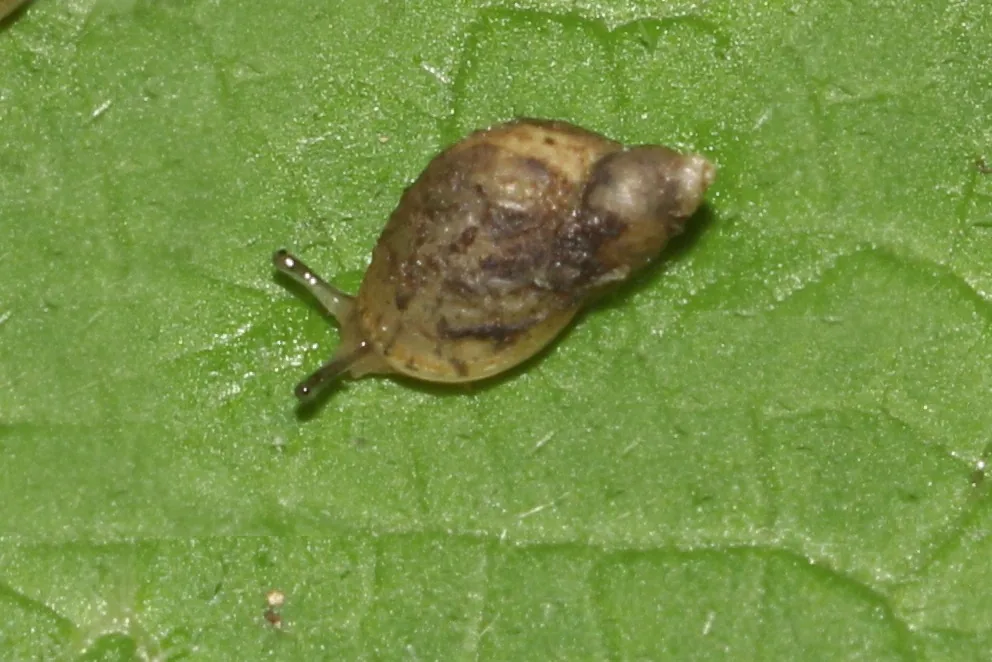
- The shell is thin, translucent and often amber, and usually less than 3/4 inch long. UF/IFAS describes Florida's Succinea as tan to amber, some semi-transparent, and about 1 to 2 cm long.[1][2]
- The spire is unusually short and the opening is large: sometimes half to two thirds as wide as the rest of the shell, with no lip around it. UF/IFAS says the spire has only 2 to 3 whorls, which taper toward the back right side of the shell rather than evenly down the middle, so the opening takes up most of the shell's length.[1][2]
- They have two pairs of tentacles; the upper pair are stalked eyes that can be pulled back into the body.[1]
- A swollen, colorful, pulsating eyestalk is a sign of a parasitic flatworm, Leucochloridium, whose brood sacs mimic caterpillars to attract birds.[3][4]
Look-alikes
| Look-alike | How to tell them apart |
|---|---|
| Bulimulus bonariensis | UF/IFAS says amber snails in Florida often live in mixed groups with this invasive snail, whose spire has 5 to 7 whorls, so its opening is a much smaller part of the shell; amber snails have 2 to 3 whorls.[2] |
Where it lives
NC State counts about twenty species in the eastern United States, usually along stream banks, ponds, lakes and marshes. GBIF's 1990-2026 U.S. records for the whole family (about 2,900) come mostly from Illinois, Arkansas and Vermont. UF/IFAS says the genus Succinea has several species native to Florida and the southeastern United States.[1][5][2]
Biology and life cycle
Young amber snails are male and older ones become female; self-fertilization may happen at the in-between stage. UF/IFAS says they are likely hermaphrodites, with male and female organs in each individual.[1][2]
They mate during the growing season and lay batches of transparent eggs on stones, soil and water plants. Tiny snails hatch in about two weeks and mature in about a year.[1]
They survive dry spells of five to ten days by going dormant, can live at least 36 hours under water, and rain brings them out.[1]
They can travel far: biologists in southwest Louisiana found amber snails attached to two migrating songbirds.[6]
Damage and signs
- They feed near ponds, lakes and streams among monkeyflower, watercress, sedges and rushes, and have also been reported from euonymus, hibiscus and New Zealand flax. NC State says they are ordinarily not plant pests.[1]
- They can ride along on nursery stock: a Costa Rican amber snail is one of the quarantine pests U.S. inspectors look for on imported Dracaena plants.[7]
- UF/IFAS says they gather near moisture and plant matter and have been seen in crops and irrigation systems; under the right conditions they can overwhelm plants or irrigation systems, though they mostly eat detritus and plant films and generally don't harm plants directly.[2]
Health risk
Snails and slugs can carry rat lungworm. CDC says people get infected by eating raw or undercooked infected snails or slugs, including by accident in raw produce such as lettuce; most people recover without treatment, but it can cause a rare type of meningitis. The amber snail Succinea tenella is one of the known hosts in Hawaii. CDC advises wearing gloves to handle snails or slugs, washing your hands, and washing produce thoroughly.[8][9]
Control
Biological control
UF/IFAS says amber snails in Florida tend to be less damaging than Bulimulus bonariensis and are kept in check by natural enemies; it pictures a shell parasitized by a flesh fly (Sarcophagidae).[2]
Pesticides
If control is needed, NC State says iron phosphate baits are effective and can be water resistant, a plus where these snails live. UC IPM lists iron phosphate baits (such as Sluggo) as a good choice for an IPM program and says ferric sodium EDTA baits work similarly but somewhat faster. It says not to use metaldehyde baits where children and pets could encounter them, and to avoid baits that also contain carbaryl, which is toxic to earthworms and beneficial ground beetles.[1][10]
Snail baits and pets
Metaldehyde bait is a known dog poison. Of 772 suspected cases reported to the UK Veterinary Poisons Information Service, 77% of dogs developed signs such as convulsions, drooling and twitching, half within an hour, and 16% died or were put down.[11]
In U.S. National Pesticide Information Center records from 2001 to 2011, 35 dog deaths were linked to metaldehyde baits and none to iron phosphate baits. Reports of metaldehyde exposures fell after labeling changes that began in 2006, while iron phosphate reports rose.[12]
Where the sources disagree
Which bait: NC State names metaldehyde as one pesticide to consider for amber snails, while UC IPM warns that metaldehyde baits are particularly poisonous to dogs and cats and prefers iron phosphate for home IPM.[1][10]
How safe iron phosphate is: UC IPM recommends iron phosphate baits, and the U.S. pesticide center records found no dog deaths from them, but the same review described 61 dogs with suspected iron toxicosis after eating iron phosphate bait and said veterinarians should be aware of that risk.[10][12]
Washing produce: a University of Hawaii study found vinegar, bleach and salt washes no better than tap water at removing snails and slugs from lettuce; only washing, rinsing and then rinsing each leaf separately removed them all.[9]
Diet: NC State says they feed on plants, bacteria, fungi, algae and diatoms near water, while UF/IFAS says they typically eat detritus and plant films and generally don't harm plants directly.[1][2]
Common questions
- What are the tiny see-through snails near my pond or drip line?
- Probably amber snails: small snails with thin, translucent amber shells and a very short spire, found where it stays moist.[1]
- Do amber snails damage plants?
- Ordinarily not. They feed on plants, bacteria, fungi, algae and diatoms near water, and NC State does not consider them plant pests.[1]
- Why does a snail have a striped, pulsing eye stalk?
- That is a Leucochloridium parasite. Its brood sacs fill the snail's tentacle and mimic a caterpillar so a bird will eat it.[3][4]
- How do I tell amber snails from Bulimulus snails?
- Count the whorls. UF/IFAS says amber snails have only 2 to 3 whorls in the spire, so the opening takes up most of the shell, while Bulimulus bonariensis has 5 to 7 and a much smaller opening.[2]
Sources
- NC State Extension, “Amber Snails.” content.ces.ncsu.edu/publication/amber-snails (accessed 2026-11-14)
- University of Florida IFAS, Snail Pests Identification, “Amber Snails (Succinea spp.), Pest Snails ID Tool (K. Malfa, X. Martini, F. Borrero).” programs.ifas.ufl.edu/snail-pests-identification/pest-snails-id-tool/amber-snails/ (accessed 2026-11-14)
- Parasitology International, via PubMed, “Iwaki T, Sasaki M, Waki T, Kurozumi T (2026), An unidentified species of Leucochloridium found in an amber snail (Succinea lauta) from Chiba Prefecture, Japan, Parasitology International 110:103137.” pubmed.ncbi.nlm.nih.gov/40774373/ (accessed 2026-11-13). Cited from the PubMed abstract.
- Journal of Invertebrate Pathology, via PubMed, “Fernandez MV, Beltramino AA, Vogler RE, Hamann MI (2024), Morphological and molecular characterization of brown-banded broodsacs and metacercariae of Leucochloridium parasitizing the semi-slug Omalonyx unguis (Succineidae) in Argentina, Journal of Invertebrate Pathology 204:108112.” pubmed.ncbi.nlm.nih.gov/38631556/ (accessed 2026-11-13). Cited from the PubMed abstract.
- Global Biodiversity Information Facility (GBIF), “Succineidae (amber snails): occurrence records in the U.S., 1990-2026 (GBIF occurrence search).” api.gbif.org/v1/occurrence/search?taxonKey=6531&country=US&hasGeospatialIssue=false&occurrenceStatus=PRESENT&year=1990%2C2026&facet=stateProvince&facetLimit=400&limit=0 (accessed 2026-11-13). Family-level search: all amber snail species combined. State counts are records reported (museum specimens, surveys, iNaturalist research-grade), not abundance.
- Ecology and Evolution, via PubMed, “Zenzal TJ Jr, Denny K, Hayden B, Jolly S, Roberts K, Solomon L (2026), Songbirds as a potential vector for snail dispersal, Ecology and Evolution 16(11):e74616 (U.S. Geological Survey; University of Southern Mississippi).” pubmed.ncbi.nlm.nih.gov/42985363/ (accessed 2026-11-13). Cited from the PubMed abstract.
- Journal of Economic Entomology, via PubMed, “Hidalgo E, Benjamin T, Casanoves F, Sadof C (2013), Factors influencing the abundance of pests in production fields and rates of interception of Dracaena marginata imported from Costa Rica, Journal of Economic Entomology 106(5):2027-2034.” pubmed.ncbi.nlm.nih.gov/24224243/ (accessed 2026-11-13). Cited from the PubMed abstract.
- U.S. Centers for Disease Control and Prevention (CDC), “About Rat Lungworm Disease.” www.cdc.gov/angiostrongylus/about/index.html (accessed 2026-11-13)
- Hawaii Journal of Medicine and Public Health (via PubMed), “Effects of washing produce contaminated with the snail and slug hosts of Angiostrongylus cantonensis with three common household solutions (Yeung, Hayes and Cowie, 2013) (abstract).” pubmed.ncbi.nlm.nih.gov/23901391/ (accessed 2026-11-13)
- University of California Statewide IPM Program, “Snails and Slugs, Pest Notes Publication 7427.” ipm.ucanr.edu/PMG/PESTNOTES/pn7427.html (accessed 2026-11-13)
- Veterinary Record (via PubMed), “Suspected metaldehyde slug bait poisoning in dogs: a retrospective analysis of cases reported to the Veterinary Poisons Information Service (Bates, Sutton and Campbell, 2012) (abstract).” pubmed.ncbi.nlm.nih.gov/22859414/ (accessed 2026-11-13)
- Journal of the American Veterinary Medical Association (via PubMed), “Reports of metaldehyde and iron phosphate exposures in animals and characterization of suspected iron toxicosis in dogs (Buhl, Berman and Stone, 2013) (abstract).” pubmed.ncbi.nlm.nih.gov/23600781/ (accessed 2026-11-13)
- Global Biodiversity Information Facility (GBIF), “Succineidae (GBIF Backbone Taxonomy).” api.gbif.org/v1/species/6531 (accessed 2026-11-13)