On this page
How to identify it
- Adults are usually 3 to 4 inches long, but some reach almost 8 inches long and 5 inches across, about the size of an adult fist.[3][2]
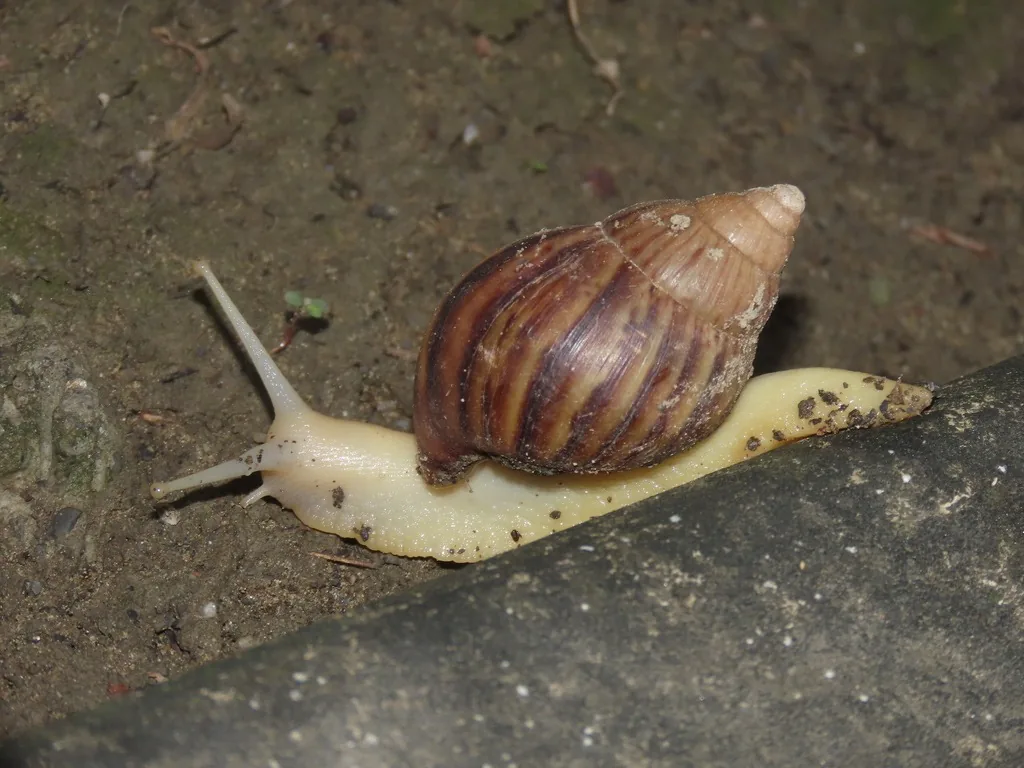
- The shell is brownish and cone-shaped, tapering to a point, with nearly vertical lighter brown stripes; FDACS describes it as thin and ceramic-like. Shell color varies widely. UF/IFAS describes it as conical, tapering to a distinct point at one end but rounded at the other, typically light brown with dark brown stripes.[3][4][2][5]
- A mature shell has seven to nine whorls.[2]
- Body color varies: FDACS reports dark-shelled snails with grayish-brown flesh as well as lighter snails with milky white flesh, sometimes called albino GALS.[1]
- Look at the shell opening: the central column (columella) is long, with an inward-curled free edge. The stripes run only lengthwise, with no cross-banding or other patterns.[4][6]
- Eggs are round, about 1/4 inch across and yellow to cream; FDACS calls them pea-sized.[3][4]
- Like other snails it has two pairs of tentacles, with eyes on the tips of the larger upper pair, and glides on a long muscular foot that releases mucus.[5]
Look-alikes
| Look-alike | How to tell them apart |
|---|---|
| Garden snails | A snail several inches long with a tall, pointed, cone-shaped shell fits the giant African land snail. If you aren't sure, take a photo and email it to the FDACS helpline instead of handling the snail.[3][1] |
| Ghost snail | The ghost snail, Bulimulus sporadicus, is about 1 inch at most, with low-contrast stripes and a straight columella, and feeds on algae without damaging plants. Giant African land snails grow up to 8 inches, with strongly contrasting stripes and an inward curl to the columella.[6] |
| Stock Island tree snail | In Florida, the only large snail of similar shape and coloring is the Stock Island tree snail of Miami-Dade and Monroe counties, which lacks the inward-curled columella.[4] |
| Apple snails | The large invasive apple snails are often confused with it, but they are nearly always found near water and their shells are round, like an apple. Giant African land snails can't survive long underwater.[4] |
Where it lives
Established from East Africa across the Indo-Pacific and southern Asia to Hawaii and Guam, introduced to several Caribbean islands, widespread in several South American countries, and reported in Spain in 2016. In U.S. territory it is widespread in Hawaii and established in American Samoa, Guam and the Mariana Islands. Florida has eradicated it three times, most recently in 2026 in Lee County, and quarantines are in place in Broward and Pasco counties. Nearly all of GBIF's US records since 1990 (3,261 of 3,281) come from Hawaii. UF/IFAS records that in 1966 a Miami child smuggled three snails home from Hawaii and they were released into a garden; seven years later more than 18,000 snails had been found, and eradication took 10 years. It was found again in Miami-Dade County in early September 2011.[2][3][1][7][5]
Biology and life cycle
It is active mostly at night and hides in cool, damp places during the day. UF/IFAS says it is most abundant in disturbed places such as gardens, is active at night and in wet weather (above 50% relative humidity), and may travel up to 50 feet in a single night, leaving a slime trail. Adults often return to the same resting spot in the morning; young snails are less likely to, and snails can climb trees and walls to rest.[4][5]
Each snail has both male and female organs; after mating, it can lay 100 to 500 eggs and produce clutches every two to three months without mating again. UF/IFAS says they rarely fertilize themselves; they mate, usually at night, with both partners trading sperm, and egg laying starts 1–3 weeks later.[2][5]
Snails can reproduce at just four months old and lay many thousands of eggs over a life of several years; FDACS says one can lay more than 2,500 eggs a year.[4][6]
In a two-year study of 23,890 snails from 22 South Florida populations, only 5% carried eggs, but egg-carrying snails turned up year-round. Gravid snails measured 48 to 128 mm (about 2 to 5 inches), and the share carrying eggs peaked at about 90 mm.[8]
More snails were collected in humid weeks, and more of them carried eggs when temperatures were higher.[8]
When conditions turn bad, it can bury itself in soil and stay inactive for up to a year. UF/IFAS says dry weather triggers this resting state, called aestivation; snails often choose moist soil and may seal the shell opening with a hard covering called an epiphragm for several months.[4][5]
It does best in tropical and subtropical climates but can survive short spells of cold; APHIS says in a northern U.S. winter it would turn sluggish, almost hibernating, until warm weather returned. UF/IFAS says they are active at about 48–90°F (9–32°C) and, based on their range elsewhere, might survive as far north as 40 degrees latitude, which could include areas such as New Jersey and Colorado.[3][2][5]
Snails move long distances clinging to vehicles and machinery or in yard trash, and they hitchhike into the country on cargo or are smuggled in as pets, classroom animals, food or for ceremonies.[4][2]
The hard-shelled eggs are laid in soil. Hatchlings eat their egg shells and organic matter and stay in the soil for 1–2 weeks before digging to the surface; they feed near the hatching site at first, then spread out in search of food. UF/IFAS says eggs are normally produced at the start of the rainy season and again at the end.[5]
Damage and signs
- It feeds on at least 500 types of plants, including peanuts, beans, peas, cucumbers and melons, and when those run out it eats ornamental plants, tree bark and even paint and stucco on houses. UF/IFAS expects the most damage to vegetables, flowers, other ornamentals and annual weeds, and says any succulent plant is at risk, especially seedlings. Mid-sized snails feed most on living plants; older, larger snails turn more to leaf litter and decaying plant matter.[2][3][1][5]
- FDACS warns it could be devastating to Florida agriculture and natural areas.[1]
Health risk
It can carry rat lungworm, a parasite that sometimes causes a rare type of meningitis. In Florida the parasite has been found in giant African land snails from Miami. People get infected by eating raw or undercooked snails or slugs, or raw produce carrying a small snail or part of one, so CDC advises wearing gloves when you handle snails, washing your hands, and washing produce well.[9][10][11][12]
Control
Prevention
Never touch these snails with bare hands, and never buy, keep, release or give one away. They are illegal to import or possess in the U.S. without a permit, and travelers should not mail or bring snails back from abroad.[3][1][2]
Inside a Florida quarantine area, moving plants, soil, yard waste, debris, compost or building materials within, through or out of the area requires a compliance agreement.[1]
Pesticides
Florida's program also uses iron phosphate bait. FDACS says it is practically non-toxic to mammals, birds and fish and isn't expected to harm pets; the state publishes similar FAQs on its boric acid and metaldehyde baits. UF/IFAS also calls iron phosphate much safer than metaldehyde or carbamate baits around pets and wildlife, and says any bait should be scattered thinly rather than piled so pets and wildlife are less likely to eat much of it.[13][1][5]
When to call a professional
Don't try to get rid of it yourself. Take a photo, note the location and report it right away to your state department of agriculture or USDA APHIS; in Florida, call the FDACS Division of Plant Industry helpline at 1-888-397-1517 or email DPIHelpline@FDACS.gov.[3][2][1]
When officials confirm a find, they may set up a quarantine and treat the area with an EPA-registered molluscicide. In South Florida's eradication program, adding metaldehyde bait to debris removal and hand collection cut snail numbers the most, and egg-producing snails disappeared from most populations.[3][8]
Where sources disagree
Maximum size: APHIS says some reach almost 8 inches, FDACS's pest alert says over 7 inches, and the 23,890 snails measured in South Florida ranged from 25 to 131 mm (about 1 to 5 inches).[3][4][8]
Eradications: APHIS counts two eradications from Miami (1975 and 2021), while FDACS counts three in Florida, adding the 2026 eradication of the population found in Lee County in 2022.[3][1]
Handling: UF/IFAS's homeowner guide describes hand-collecting snails with gloves or a tool and killing them by freezing in a sealed plastic bag; FDACS and USDA APHIS now say not to touch, kill or move a suspected giant African land snail, but to photograph it and report it. Follow FDACS and APHIS.[5][1][3]
Eggs: USDA says 100 to 500 eggs after mating, while UF/IFAS gives about 100 in a snail's first year and 200–1000 in its second. APHIS gives eggs about 1/4 inch across; UF/IFAS gives 1/6–1/5 inch (4.5–5.5 mm).[5][2][3]
Making a garden less snail-friendly
For snails in general, UF/IFAS says removing mulch, dense ground cover, wood and stones and cutting back irrigation takes away the moist shelter they need. If you think you have a giant African land snail, report it first; don't handle it.[5][1]
Checking plants at night can reveal snails that leave no sign by day, and since snails seldom move far from their host plants, visible damage usually means the snail is close by.[5]
Copper strips around bench legs, tree trunks or whole beds, or a band of diatomaceous earth, can discourage snails from crossing, though copper loses effect as it oxidizes and neither barrier kills snails.[5]
Common questions
- What should I do if I find a giant African land snail?
- Don't touch it or try to kill it, and don't move or release it. Take a photo, note the location and contact your state agriculture department or USDA; in Florida, email the photo to the FDACS helpline.[3][1]
- Can I keep one as a pet?
- No. Giant African land snails are prohibited in the United States without a permit, and FDACS notes that lighter-fleshed snails are sought after in the illegal pet trade. Research and government institutions need an APHIS permit, granted under very strict conditions.[1][3]
- Can touching a giant African land snail make you sick?
- Rat lungworm infection comes mainly from eating raw or undercooked snails or slugs, or produce carrying them. CDC still advises wearing gloves and washing your hands whenever you handle snails or slugs.[9][10]
Sources
- Florida Department of Agriculture and Consumer Services, Division of Plant Industry, “Giant African Land Snail.” www.fdacs.gov/Agriculture-Industry/Pests-and-Diseases/Plant-Pests-and-Diseases/Giant-African-Land-Snail (accessed 2026-11-14)
- USDA Animal and Plant Health Inspection Service, “Pest Alert: Giant African Snails, APHIS 81-35-009 (revised May 2018).” www.aphis.usda.gov/sites/default/files/alert-gas.pdf (accessed 2026-11-14)
- USDA Animal and Plant Health Inspection Service, “Giant African Snail.” www.aphis.usda.gov/plant-pests-diseases/mollusks (accessed 2026-11-14)
- Florida Department of Agriculture and Consumer Services, Division of Plant Industry, “Lissachatina fulica, Giant African Land Snail (Pest Alert FDACS-P-01717, revised June 2023).” ccmedia.fdacs.gov/content/download/104723/file/giant-african-land-snail-pest-alert.pdf (accessed 2026-11-14)
- University of Florida/IFAS Extension, “Giant African Land Snail in Florida, ENY-512/IN904.” ask.ifas.ufl.edu/publication/IN904 (accessed 2026-11-14). Used for identification, biology and general snail management only; not for disease lines. Report suspected snails to FDACS/APHIS.
- Florida Department of Agriculture and Consumer Services, Division of Plant Industry, “Comparing GALS to Ghost Snail (FDACS-P-01996).” ccmedia.fdacs.gov/content/download/106812/file/FDACS-P-01996_2022-09%28ComparingGALStoGhostsnail%29.pdf (accessed 2026-11-14)
- Global Biodiversity Information Facility (GBIF), “Lissachatina fulica: US occurrence records since 1990 by state (GBIF occurrence search API).” api.gbif.org/v1/occurrence/search?taxonKey=8790531&country=US&hasGeospatialIssue=false&occurrenceStatus=PRESENT&year=1990%2C2026&facet=stateProvince&facetLimit=400&limit=0 (accessed 2026-11-14)
- PLoS ONE, via PubMed, “Reproductive ecology of the giant African snail in South Florida: implications for eradication programs (Roda et al. 2016).” pubmed.ncbi.nlm.nih.gov/27861504/ (accessed 2026-11-14)
- Centers for Disease Control and Prevention, “About Rat Lungworm Disease (June 24, 2024).” www.cdc.gov/angiostrongylus/about/index.html (accessed 2026-11-14)
- Centers for Disease Control and Prevention, “Preventing Rat Lungworm.” www.cdc.gov/angiostrongylus/prevention/index.html (accessed 2026-11-14)
- Hawaii Journal of Medicine and Public Health, via PubMed, “The occurrence of the rat lungworm, Angiostrongylus cantonensis, in nonindigenous snails in the Gulf of Mexico region of the United States (Teem et al. 2013).” pubmed.ncbi.nlm.nih.gov/23901374/ (accessed 2026-11-14)
- Journal of Parasitology, via PubMed, “Angiostrongylus cantonensis in introduced gastropods in southern Florida (Stockdale-Walden et al. 2015).” pubmed.ncbi.nlm.nih.gov/25564891/ (accessed 2026-11-14)
- Florida Department of Agriculture and Consumer Services, “Frequently Asked Questions about Iron Phosphate for Controlling Snails (FDACS-P-01991).” ccmedia.fdacs.gov/content/download/105080/file/FAQsIronPhosphateforControllingSnails01991.pdf (accessed 2026-11-14)
- iNaturalist, “Lissachatina fulica taxon page (order and family).” www.inaturalist.org/taxa/502885 (accessed 2026-11-14)