On this page
How to identify it
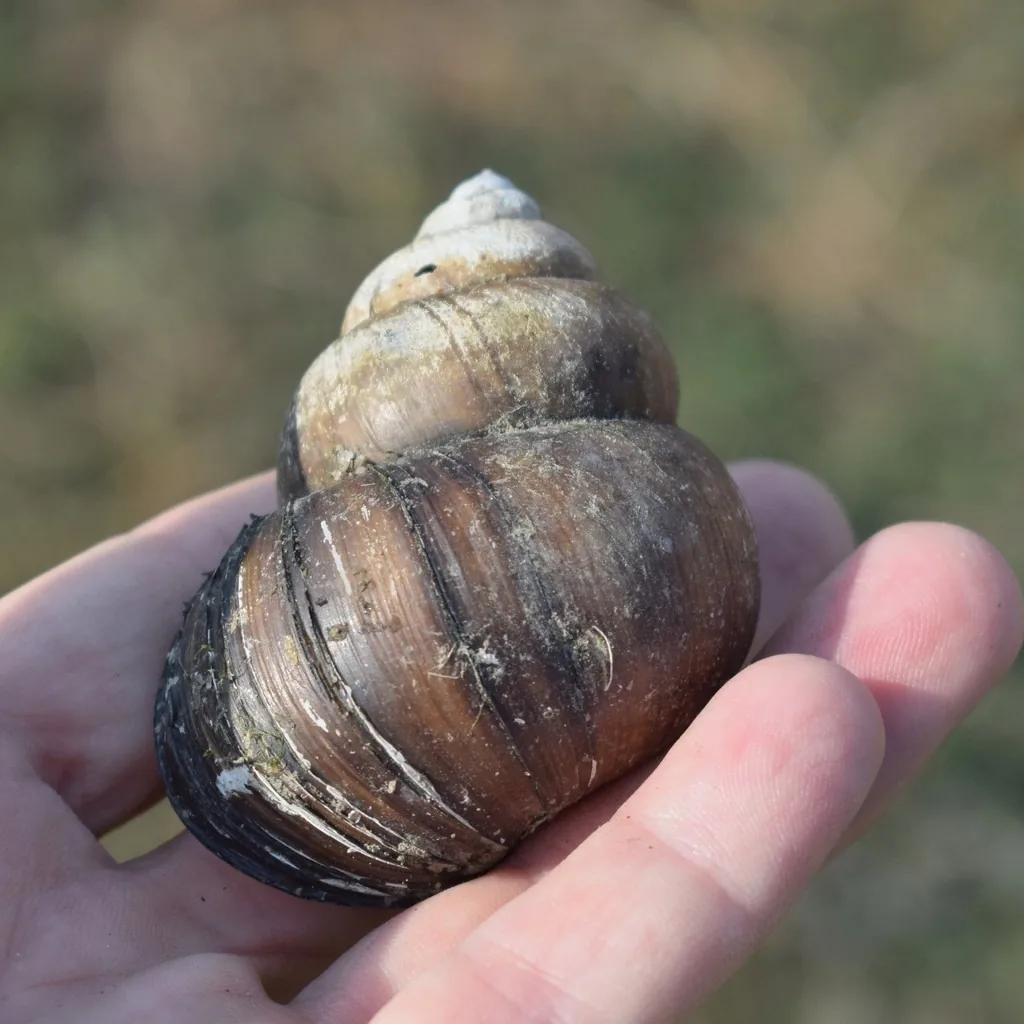
- The smooth shell is taller than wide, with 6 to 8 whorls, and olive green to brown or reddish brown; the inside of the opening is white to pale blue. Sources give different top sizes: about 3 inches (Illinois Extension and the Minnesota DNR), 2 1/2 inches (Missouri) or 2 inches (Minnesota Extension).[1][3][5][6][2]
- A hard trapdoor (operculum) with concentric growth rings closes the opening, which sits on the right when the tip points up. Empty shells have lost it.[1][5][6]
- Young are born live and can be as small as a grain of rice.[3][6]
Look-alikes
| Look-alike | How to tell them apart |
|---|---|
| Japanese mystery snail | Illinois Extension says the Chinese species has a more compressed shell, and USGS says its adult shell is less elongate. USGS also cites a 2019 genetic study from New York that found the two species living together and impossible to tell apart by shell.[1][2] |
| Banded mystery snail | Has dark bands circling the shell; the Chinese mystery snail has none.[1] |
Where it lives
Native to Southeast Asia, Japan and eastern Russia. It was sold in San Francisco food markets in the late 1800s and reached the East Coast early: USGS cites a Boston record from 1914, the Minnesota DNR a Massachusetts find in 1915. It probably got into the Niagara River from an aquarium between 1931 and 1942, is established in Great Lakes drainages, showed up in Minnesota in the early 2000s and is known from at least 11 Missouri counties.[1][2][3][5]
Biology and life cycle
It lives on muddy or silty bottoms in lakes, ponds, ditches, rice fields and calm streams, grazing on algae and detritus.[1][5][2]
People spread it by dumping aquarium pets and by moving boats, anchors, docks and fishing or hunting gear. With its trapdoor shut it can live out of water for several days.[1][3]
Females give birth to crawling young from June through October. Brood counts vary: Missouri reports up to 102 young at a time and more than 169 in a lifetime, while USGS cites brood pouches holding up to 133 embryos. Females live up to 5 years and males about 3 to 4.[5][2][6]
In fall, females move into deeper water for the winter.[2]
Damage and signs
- It competes with native snails for food. Its thick shell protects it from rusty crayfish, and in a tank experiment it cut numbers of a native pond snail, which died out completely when rusty crayfish were added as well.[1][2][7]
- Big die-offs leave piles of shells and dead snails along beaches, and the snails can clog water-intake pipes.[1][2]
- In the same experiment it reduced algae growing on surfaces and raised the water's nitrogen-to-phosphorus ratio.[7]
Health risk
Don't eat snails you collect raw or undercooked. In Korea this species has carried larvae of human intestinal flukes, and CDC says people catch rat lungworm by eating raw or undercooked infected snails. CDC also advises wearing gloves when handling snails and washing your hands afterward.[8][9][10]
Control
Prevention
No method is known that wipes out populations in open water, so the goal is to stop the spread. Never dump aquarium animals, plants or water into lakes or streams; North Dakota Game and Fish suggests freezing unwanted aquarium animals for 24 hours before throwing them out.[1][3][11][4]
Clean, drain and dry boats and gear between waters. Minnesota requires docks, lifts and swim rafts to dry for at least 21 days before going into another lake, and Illinois Extension says to dry other equipment for at least 5 days.[3][1]
In Minnesota, report new finds to a DNR invasive species specialist or through EDDMapS.[3]
Legal status
Minnesota lists the Chinese mystery snail and the Japanese trapdoor snail (Cipangopaludina species) as regulated invasive species. They are legal to own, buy, sell and transport there, but may not be released into a free-living state such as public waters.[3][12]
Minnesota also makes it illegal to release or dump unwanted aquatic plants or animals in or near public waters.[3]
Wisconsin classifies the Chinese mystery snail and Japanese trapdoor snail as restricted invasive species, and a 2012 DNR flyer for sellers marks them "do not sell." The same flyer listed the banded mystery snail as not yet regulated.[4][1]
Illinois Extension says the snail is unregulated in Illinois.[1]
Parasites and contaminants
In Korea, a 1999 survey found larvae of the human intestinal fluke Echinostoma cinetorchis in this snail (the subspecies malleata) at 3 of 12 sites. A 2017 study found another fluke, E. macrorchis, in 60 to 100% of the snails sampled at five Korean sites.[8][9]
Rat lungworm findings point two ways. In a lab study in China the snail took up rat lungworm larvae readily, but field surveys found no infected snails among 183 collected in Shanghai or in samples from three lakes in Yunnan.[13][14][15]
CDC says most people infected with rat lungworm get better without treatment, though it can cause a rare form of meningitis.[10]
In arsenic-polluted shallow lakes near Puget Sound, Chinese mystery snails held more arsenic than crayfish or sunfish from the same lakes, and the study found a health risk for people who eat them. USGS adds that the species can take up heavy metals, with implications for food safety.[16][2]
Common questions
- What is the big snail in my pond?
- If it's large and smooth with a trapdoor that seals the opening, it may well be a Chinese mystery snail. In many states that's an invasive species worth reporting.[1][5][3]
- Can I get rid of them?
- Probably not from a lake or pond. No proven way to clear them from open water exists, so agencies focus on keeping them from spreading.[1][3]
- Is it legal to keep Chinese mystery snails?
- It depends on the state. Minnesota allows owning and selling them but bans releasing them, Wisconsin lists them as restricted, and Illinois doesn't regulate them. All of these agencies say not to release them into the wild.[3][12][4][1]
- Can I eat Chinese mystery snails?
- Not raw or undercooked. Snails of this species have carried fluke larvae in Korea, and CDC warns that raw or undercooked snails can spread rat lungworm. Snails from polluted lakes can also hold arsenic.[8][10][16]
Sources
- University of Illinois Extension, “Chinese Mystery Snail (Invasive Species).” extension.illinois.edu/invasives/chinese-mystery-snail (accessed 2026-11-13)
- U.S. Geological Survey, Nonindigenous Aquatic Species Program, “Cipangopaludina chinensis (Chinese mysterysnail) fact sheet.” nas.er.usgs.gov/queries/FactSheet.aspx?speciesID=1044 (accessed 2026-11-13)
- Minnesota Department of Natural Resources, “Chinese mystery snail.” www.dnr.state.mn.us/invasives/aquaticanimals/chinese-mystery-snail/index.html (accessed 2026-11-13)
- Wisconsin Department of Natural Resources, “Are Your Snails Okay? NR 40 invasive snails and crayfish flyer (draft, August 2012).” dnr.wisconsin.gov/sites/default/files/topic/Invasives/NR40CrayfishSnail.pdf (accessed 2026-11-13)
- Missouri Department of Conservation, “Chinese Mysterysnail (Field Guide).” mdc.mo.gov/discover-nature/field-guide/chinese-mysterysnail (accessed 2026-11-13)
- University of Minnesota Extension, “Chinese mystery snail (Identify invasive species).” extension.umn.edu/identify-invasive-species/chinese-mystery-snail (accessed 2026-11-13)
- Oecologia 2009;159(1):161-70, via PubMed, “Interactions among invaders: community and ecosystem effects of multiple invasive species in an experimental aquatic system (Johnson et al., 2009).” pubmed.ncbi.nlm.nih.gov/18941789/ (accessed 2026-11-13)
- J Parasitol 1999;85(5):963-4, via PubMed, “Cipangopaludina chinensis malleata (Gastropoda: Viviparidae): a new second molluscan intermediate host of a human intestinal fluke Echinostoma cinetorchis (Trematoda: Echinostomatidae) in Korea (Chung & Jung, 1999).” pubmed.ncbi.nlm.nih.gov/10577736/ (accessed 2026-11-13)
- Korean J Parasitol 2017;55(5):541-548, via PubMed, “Echinostoma macrorchis (Digenea: Echinostomatidae): Metacercariae in Cipangopaludina chinensis malleata Snails and Adults from Experimental Rats in Korea (Sohn & Na, 2017).” pubmed.ncbi.nlm.nih.gov/29103269/ (accessed 2026-11-13)
- U.S. Centers for Disease Control and Prevention, “About Rat Lungworm.” www.cdc.gov/angiostrongylus/about/index.html (accessed 2026-11-13)
- North Dakota Game and Fish Department, “Chinese Mystery Snail (Aquatic Nuisance Species).” gf.nd.gov/ans/species/chinese-mystery-snail (accessed 2026-11-13)
- Minnesota Department of Natural Resources, “Invasive species laws.” www.dnr.state.mn.us/invasives/laws.html (accessed 2026-11-13)
- Zhongguo Ji Sheng Chong Xue Yu Ji Sheng Chong Bing Za Zhi 2006;24(4):277-80, via PubMed, “Experimental study on compatibility of three species of freshwater snails with Angiostrongylus cantonensis (Lv et al., 2006).” pubmed.ncbi.nlm.nih.gov/17094598/ (accessed 2026-11-13)
- Zhongguo Ji Sheng Chong Xue Yu Ji Sheng Chong Bing Za Zhi 2014;32(6):455-8, via PubMed, “Investigation on the species distribution and infection status of host snails of Angiostrongylus cantonensis in Shanghai (2014).” pubmed.ncbi.nlm.nih.gov/25902678/ (accessed 2026-11-13)
- Zhongguo Ji Sheng Chong Xue Yu Ji Sheng Chong Bing Za Zhi 2014;32(2):139-42, via PubMed, “Preliminary survey on the host of Angiostrongylus cantonensis in three plateau lakes of Yunnan Province (2014).” pubmed.ncbi.nlm.nih.gov/25065215/ (accessed 2026-11-13)
- Sci Total Environ 2021;770:145318, via PubMed, “Human health risk from consumption of aquatic species in arsenic-contaminated shallow urban lakes (Hull et al., 2021).” pubmed.ncbi.nlm.nih.gov/33736365/ (accessed 2026-11-13)
- Global Biodiversity Information Facility (GBIF), “Cipangopaludina chinensis (J.E.Gray, 1833) (GBIF Backbone Taxonomy).” api.gbif.org/v1/species/9738098 (accessed 2026-11-13)
- iNaturalist, “Margarya chinensis taxon page (order and family).” www.inaturalist.org/taxa/1672221 (accessed 2026-10-06)