On this page
How to identify it
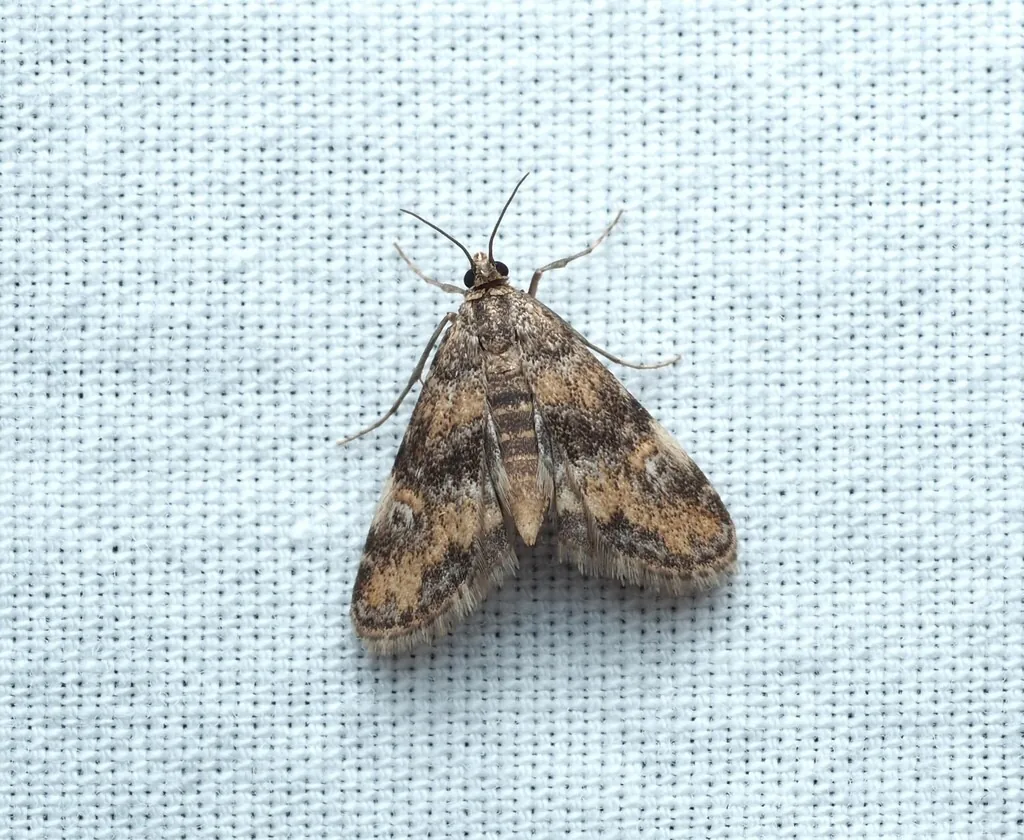
- Adults are grayish brown with dark brown shading, whitish lines and a whitish crescent-shaped kidney spot. Wingspan is 1 to 2.2 cm (under an inch). UF/IFAS says the sexes are easy to tell apart: females have a 15 to 19 mm wingspan and paler grayish-brown wings with orange-brown markings, while males span about 11 to 13 mm, with grayish-brown wings mixed with brownish and white markings.[1][8]
- The sexes differ: males are smaller and broader-winged, while females have paler light areas and less sharp markings.[1]
- The caterpillar lives between two roundish pieces of leaf that form a sandwich-like portable case, usually cut from the plant it is eating. It pokes the front of its body out of the case to feed and cuts new, larger cases as it grows. Unlike most of its relatives, it has no gills.[2]
- The Connecticut Agricultural Experiment Station describes the caterpillars as off-white with a dark line along the back and a small, light brown head. Its case of leaf pieces tied together with silk is open at both ends and is carried along as the caterpillar feeds, much like a bagworm's.[3]
- UF/IFAS describes the caterpillar's body as creamy white, turning increasingly brownish toward the head from the fourth abdominal segment forward, with a yellowish-brown head and skin covered in tiny bumps. Its habit of living between two cut leaf pieces has earned it the nickname 'the sandwich man'.[8]
- Eggs are whitish, oval and flattened like a dome, about 0.6 mm long and 0.4 mm wide, with wrinkles running down the domed side. They are glued singly or in overlapping, ribbon-like masses near the edges of submersed leaves.[8]
- Pupae are pale yellow with a darker head and wing area. Before pupating, the caterpillar fastens its case to a leaf stalk or blade above or below the water and spins a silk cocoon inside it.[8]
Look-alikes
| Look-alike | How to tell them apart |
|---|---|
| Elophila tinealis | The only other Elophila in Florida. UF/IFAS says the adult is much smaller, with longer, narrower and darker wings, and its caterpillars seem to feed on and build their cases mostly from duckweed.[8] |
| Elophila gyralis and Elophila icciusalis | Their caterpillars are similar, but the two bands of gripping hooks on the prolegs are the same size, and they usually cut a single leaf piece and attach it to a whole leaf, living between the two layers. The adults are more brightly colored, yellowish orange and white or brownish.[8] |
Where it lives
BAMONA calls it common throughout eastern North America. GBIF holds about 13,800 U.S. records from 1990 to 2026, most of them from Texas, Florida and Louisiana. UF/IFAS gives its range as all of Florida, west to Texas and north to western Nova Scotia and southern Manitoba, and says it has been introduced into Hawaii, England and British Columbia. Of the more than twenty moths in its aquatic subfamily in Florida, it is the most common. A South Carolina survey found it in both still and flowing fresh water, at 6.2% of 65 sites.[1][4][8]
Biology and life cycle
Adults fly from May to August.[1]
USDA describes the eggs as whitish, oval and flattened, laid near the edges of leaf surfaces under water, often in ribbon-like masses. Young caterpillars' cases are apparently water-filled and they take in oxygen through the skin; older caterpillars' cases hold air. The caterpillar pupates inside its case after fixing it to a leaf blade or stalk, above or below the water.[2]
In a study of a related aquatic moth (then called Munroessa gyralis; BAMONA notes Munroessa has since been merged into Elophila), caterpillars preferred two water lilies, Brasenia schreberi and Nymphaea odorata, over 14 other plants, and their leaf-fragment shelters protected them from fish in the field.[5][1]
The moth lays eggs near the edges of waterlily leaves in summer. Young caterpillars first feed as leaf miners, then build their leaf-piece case, which lets air in while keeping water out.[3]
UF/IFAS says no published information is available on its development times. Young caterpillars' cases stay attached to the leaf they were cut from; older caterpillars detach theirs and float free, abandoning small cases for larger ones made from new leaves. A case may be two whole leaves, parts of leaves, or bits of many plants tied together with silk.[8]
UF/IFAS's host table includes waterlilies (Nymphaea), lotus (Nelumbo), spatterdock (Nuphar), watershield (Brasenia), arrowheads (Sagittaria), water milfoils (Myriophyllum), duckweeds (Lemna), water lettuce (Pistia), elodea, Egeria and hydrilla, as well as the invasive weed hygrophila.[8]
Damage and signs
- Caterpillars feed on white water lily, pondweeds, water stargrass, duckweed, hydrilla, water hyacinth, water lettuce and 60 or more other aquatic plants.[1]
- BAMONA rates it a minor pest of aquatic ornamentals and sometimes a problem in greenhouses. The USDA bulletin says it is frequently a pest in aquatic nurseries, especially on waterlilies, but knows of no studies of its effects on the plants.[1][2]
- USDA calls the common name misleading because the diet is not limited to waterlilies: its recorded food plants span 23 plant families.[2]
- Caterpillars usually chew chunks from the base or middle of a leaf, which often makes the leaf break away from the stem. When numbers are high and leaves run short they move on to the stems, which can break the whole plant apart. Cutting ever-larger cases adds to the damage.[8]
- UF/IFAS says most feeding is superficial and rarely endangers the plant, but in October 2007 UF researchers found it severely damaging the invasive weed hygrophila. In aquatic plant nurseries, especially on waterlilies, feeding makes plants unattractive to customers, and extensive feeding can reduce plant health or kill plants.[8]
- It also feeds on invasive weeds such as hydrilla, salvinia, water lettuce and hygrophila, and one study found it and a weevil among the most influential factors holding back common salvinia. Because it eats so many plants, UF/IFAS advises against trying to boost its numbers for weed control.[8]
Health risk
It is a plant-feeding aquatic caterpillar. BAMONA, the Connecticut Agricultural Experiment Station and the USDA bulletin describe it only as a pest of water plants; none of them mentions bites, stings or any effect on people or pets.[1][3][2]
Control
Prevention
BAMONA, the Connecticut station and the USDA bulletin list no insecticide for it. UF/IFAS says Bacillus thuringiensis subspecies kurstaki would likely control it in aquatic nurseries with little or no harm to other aquatic life, and notes that a related strain, subspecies israelensis, caused significant mortality in a test.[1][3][2][8]
Traps and physical control
Watch leaves for the characteristic holes, and pick off caterpillars in their cases by hand. UF/IFAS adds that adults can be caught in UV black-light traps.[8]
Biological control
Fish feed on the caterpillars. The Connecticut Agricultural Experiment Station suggests temporarily flooding the pond so the cases and caterpillars wash into open water, where fish can reach them. In a study of a related aquatic moth, caterpillars in their leaf-fragment shelters were protected from fish in the field.[3][5]
Where the sources disagree
The case: the Connecticut station says it lets air in while keeping water out; USDA says young caterpillars' cases are apparently water-filled and only older caterpillars' cases hold air.[3][2]
Pest status: BAMONA calls it a minor pest of aquatic ornamentals; USDA says it is frequently a pest in aquatic nurseries.[1][2]
Size: BAMONA gives a wingspan of 1 to 2.2 cm; USDA gives 11 to 13 mm for males and 15 to 19 mm for females.[1][2]
The caterpillar's head: the Connecticut station calls it light brown; USDA says yellowish or brownish with slightly darker patches.[3][2]
Host range: USDA counts 60 or more food plants in 23 families; UF/IFAS says nearly 60 plant species.[2][8]
Range: BAMONA calls it common throughout eastern North America; UF/IFAS gives Florida west to Texas and north to Nova Scotia and southern Manitoba, with introductions to Hawaii, England and British Columbia.[1][8]
Common questions
- What is eating my waterlily leaves?
- Waterlily leafcutter caterpillars are one possibility: they feed on waterlilies and many other water plants, and BAMONA calls them a minor pest of aquatic ornamentals.[1]
- Do moth caterpillars really live underwater?
- This one does. USDA says young waterlily leafcutter caterpillars live in water-filled cases and take in oxygen through the skin, while older ones keep air in their cases.[2]
- Does the waterlily leafcutter only eat waterlilies?
- No. UF/IFAS says it feeds on nearly 60 plant species, including invasive weeds such as hydrilla, water lettuce, salvinia and hygrophila.[8]
Sources
- Butterflies and Moths of North America (BAMONA), “Waterlily Leafcutter Moth, Elophila obliteralis (Walker, 1859).” www.butterfliesandmoths.org/species/Elophila-obliteralis (accessed 2026-11-13)
- USDA Agricultural Research Service, “Insects and Other Arthropods That Feed on Aquatic and Wetland Plants, Technical Bulletin 1870 (T. D. Center, F. A. Dray Jr., G. P. Jubinsky and M. J. Grodowitz, October 2002): Waterlily leafcutter.” www.ars.usda.gov/is/np/aquaticweeds/aquaticweeds.pdf (accessed 2026-11-13)
- Connecticut Agricultural Experiment Station, “Waterlily (Nymphaea), Plant Pest Handbook.” portal.ct.gov/caes/plant-pest-handbook/pphw/waterlily-nymphaea (accessed 2026-11-13)
- Global Biodiversity Information Facility (GBIF), “Elophila obliteralis (waterlily leafcutter): occurrence records in the U.S., 1990-2026 (GBIF occurrence search).” api.gbif.org/v1/occurrence/search?taxonKey=9181627&country=US&hasGeospatialIssue=false&occurrenceStatus=PRESENT&year=1990%2C2026&facet=stateProvince&facetLimit=400&limit=0 (accessed 2026-11-13). State counts are records reported (iNaturalist research-grade, museum specimens, surveys), not abundance.
- Oecologia, via PubMed, “Dorn NJ, Cronin G, Lodge DM (2001), Feeding preferences and performance of an aquatic lepidopteran on macrophytes: plant hosts as food and habitat (Munroessa gyralis), Oecologia 128(3):406-415.” pubmed.ncbi.nlm.nih.gov/24549910/ (accessed 2026-11-13). Cited from the PubMed abstract.
- Global Biodiversity Information Facility (GBIF), “Elophila obliteralis (Walker, 1859) (GBIF Backbone Taxonomy).” api.gbif.org/v1/species/9181627 (accessed 2026-11-13)
- iNaturalist, “Elophila obliteralis taxon page (order and family).” www.inaturalist.org/taxa/335071 (accessed 2026-11-11)
- University of Florida IFAS Extension, EDIS (Featured Creatures), “Waterlily Leafcutter, Elophila obliteralis (Walker), EENY-424/IN803 (Featured Creatures).” ask.ifas.ufl.edu/publication/IN803 (accessed 2026-11-14)